What Paperwork Do You Need to Sell Your House in the UK? The Complete Seller's Checklist
Missing paperwork is one of the most common reasons property sales in England and Wales stall or collapse before completion. This complete checklist covers every document you are likely to need as a seller, from the core requirements every seller must meet to the additional certificates needed for leasehold properties and homes where building works have been carried out.

Elizabeth C.
Elizabeth covers costs, timelines, and what to expect at each stage of a home sale. She keeps explanations practical for first-time and experienced sellers alike.
Paperwork is the part of selling a house that most sellers underestimate. You find a buyer, agree a price, and assume the hard work is done. Then the weeks pass, enquiries stack up, your solicitor chases documents you cannot locate, and the buyer starts to lose patience. Missing or late paperwork is one of the most common reasons property transactions in England and Wales stall or collapse before completion. Research from 2024 indicates that nearly thirty percent of agreed sales fell through before completing, and documentation delays are a frequent contributing factor. Getting your paperwork in order before your property even goes on the market removes one of the most controllable risks in the entire process.
This guide sets out every document you are likely to need to sell your house in England and Wales, explains what each one is, where to get it if you do not already have it, and when in the process you will need it. It covers documents required by every seller, additional paperwork for leasehold properties, certificates needed when works have been carried out, and what your solicitor produces on your behalf.
Work through this checklist before you list and you will be in a far stronger position than the majority of sellers who start gathering documents only after an offer has been accepted.
Use the free Valuation Calculator on YooSell to understand your property's current market value as part of your preparation.
Documents Every Seller Needs
These are the core documents required in every residential property sale in England and Wales, regardless of the property type, tenure, or whether any building works have been carried out.
Proof of Identity
Your solicitor is legally required to verify your identity before they can act for you. This is a requirement under the Money Laundering, Terrorist Financing and Transfer of Funds Regulations 2017, which apply to all property transactions. Providing your identification documents on the day you instruct your solicitor means your file can be opened and work can begin without delay.
What You Need to Provide
You will need two documents: one to confirm your identity and one to confirm your current address.
For identity confirmation, acceptable documents include:
A valid passport
A full UK driving licence with photograph
A current national identity card issued by an EEA country
For address confirmation, acceptable documents include:
A bank or building society statement dated within the last three months
A utility bill such as gas, electricity, or water dated within the last three months
A council tax statement for the current year
An HMRC letter or tax document dated within the last three months
Some solicitors carry out these checks digitally through identity verification services, which means you can complete the process online without posting physical documents. Ask your solicitor at the outset what their process is. If you are selling jointly with another person, both parties must complete separate identity verification.
Why This Document Matters
Without completed anti-money laundering checks, your solicitor cannot legally open your file or begin work on the sale. Delays at this stage push back the entire conveyancing timeline. It is the first thing to provide as soon as you instruct.
Title Deeds and Land Registry Documents
Title deeds are the documents that prove you legally own the property you are selling. Without evidence of legal ownership, the sale cannot proceed.
How Title is Held in England and Wales
The vast majority of residential properties in England and Wales are now registered with HM Land Registry. For registered properties, legal ownership is confirmed by an official copy of the title register and the title plan, both of which are available directly from HM Land Registry. Your solicitor will obtain these on your behalf as part of their standard work. The current fee for downloading an official copy is seven pounds per document.
If your property was purchased in the last thirty or so years, it is almost certainly registered. If you are unsure, your solicitor can check this quickly.
Unregistered Properties
A small number of older properties are not yet registered with HM Land Registry. If your property is unregistered, you will need to locate the original paper title deeds, which prove the chain of ownership going back many years. These are typically held by your mortgage lender or by the solicitor who handled your original purchase.
If you cannot locate paper deeds for an unregistered property, your solicitor will need to apply for first registration with HM Land Registry before the sale can proceed. This is a specialist process that requires legal assistance and adds time to the transaction. Identify this issue early if it may apply to your property.
What the Title Register Contains
The official title register contains:
The property address and description
The name or names of the registered owner or owners
Any mortgage or charge registered against the property
Restrictive covenants, easements, and rights affecting the title
Any other entries relevant to the legal status of the property
Your solicitor uses this document to prepare the contract for sale and to identify any title issues that need to be resolved before exchange of contracts.
Energy Performance Certificate
A valid Energy Performance Certificate is a legal requirement before you can market a residential property for sale. It must be in place before your listing is published, whether on a property portal, in a window display, or promoted in any other way. You cannot list your property without one.
Checking Whether You Already Have a Valid EPC
EPCs are valid for ten years from the date they are lodged on the national register. If your property was sold or let within the last decade, a valid certificate may already exist. You can check this at no cost using the government's EPC register, which is publicly searchable by postcode or property address. If a valid certificate exists, download it and share it with your solicitor. You do not need to commission a new one.
What Happens if Your EPC Has Expired or Does Not Exist
If no valid certificate exists, or your existing certificate has expired, you must commission a new assessment from a qualified Domestic Energy Assessor who is accredited by a government-approved scheme. The assessment takes between thirty and ninety minutes. Costs typically range from around sixty-five to one hundred and twenty pounds depending on the size of the property and the provider.
Note that since 15 June 2025, assessors work under the updated RdSAP 10 methodology, which requires more detailed recording of glazing types, heating system data, and insulation. This means assessments are slightly more thorough than before and you may be asked to provide more specific information about your property's systems during the assessment.
What Happens if You Market Without an EPC
Marketing a property without a valid EPC is illegal and subject to a fixed penalty fine of two hundred pounds. Beyond the fine, a missing EPC will be raised by the buyer's solicitor during conveyancing and can cause unnecessary delays. Sorting this before listing avoids both risks.
The TA6 Property Information Form
The TA6 is one of the most important documents in your entire sale. It is a standardised form produced by the Law Society that your solicitor will ask you to complete. It records all the information a buyer needs to know about the property that cannot be established from the title register or searches alone.
What the TA6 Covers
The TA6 is divided into several sections, each covering a different aspect of the property:
Boundaries: which boundaries belong to your property and who is responsible for maintaining each one
Disputes and complaints: any current or historical disputes with neighbours or third parties affecting the property
Notices: any planning notices, enforcement notices, or formal communications about the property received from any authority
Alterations: all building works carried out during your ownership, with details of any planning permissions and building regulations completion certificates obtained
Guarantees and warranties: details of any existing guarantees for works including damp-proofing, timber treatment, double glazing, roofing, and any structural work
Insurance: whether there are any outstanding insurance claims on the property and details of any works that followed a claim
Environmental matters: whether the property has ever been affected by flooding, subsidence, or contamination
Parking: the nature of any parking rights and whether they are registered or informal
Services and utilities: connection to mains gas, water, electricity, and drainage, and whether any services cross third-party land
Occupiers: details of any other adults living in the property whose rights might affect the buyer's occupation
Why Accuracy on the TA6 Matters
You have a legal duty as a seller to disclose all known material facts that could affect a buyer's decision. Completing the TA6 inaccurately or leaving sections blank where you have relevant information is not just an administrative problem. It can expose you to legal action after completion if a buyer suffers loss as a result of something you failed to disclose. Answer every question as fully and honestly as you can. If you are unsure about any question, discuss it with your solicitor rather than leaving it blank.
When to Complete the TA6
Complete the TA6 as early as possible, ideally before your property goes on the market. This allows your solicitor to identify at the earliest opportunity any documents or information that will be needed during the conveyancing process. Buyers move faster when everything is ready, and solicitors who have the TA6 in advance can anticipate and head off potential enquiries before they arise.
The TA10 Fixtures, Fittings and Contents Form
The TA10 records exactly what is included in the sale and what you intend to take with you when you leave. It sits alongside the TA6 as part of the standard contract pack.
What the TA10 Covers
The TA10 works through the property room by room and asks you to confirm whether specific items are included, excluded, or not present. It covers:
Kitchen: fitted units, worktops, sink, oven, hob, extractor fan, dishwasher, fridge and freezer, washing machine
Bathrooms: bathroom suites, towel rails, mirrors if fitted
Living areas and bedrooms: fitted wardrobes, curtain poles, curtains, carpets, light fittings
Outside: garden sheds, greenhouses, outdoor lighting, fencing, water features
General: television aerials, satellite dishes, doorbell systems, alarm systems
Why Getting This Right Avoids Disputes
Disagreements about what was agreed to be included or excluded from a sale are a surprisingly common source of friction on and around completion day. A buyer who arrives to find that the light fittings they assumed were included have been taken, or that the garden shed that appeared in listing photographs is not there, has legitimate grounds for complaint.
Complete the TA10 carefully and honestly. If you are unsure about a specific item, the safest approach is to discuss it with your solicitor and either confirm its inclusion in writing or exclude it explicitly so both parties have a clear record.
Your Mortgage Details
If you have an outstanding mortgage on the property, your solicitor will need specific information about it to obtain the official mortgage redemption figure, which is the amount required to repay the mortgage in full on a given completion date.
What Information Your Solicitor Needs
Provide your solicitor with:
The name of your mortgage lender
Your mortgage account number
A recent mortgage statement showing the current outstanding balance
Your solicitor will use this to request a formal redemption statement from your lender as the transaction approaches exchange and completion. The redemption statement gives the exact amount required to discharge the mortgage on the anticipated completion date.
Early Repayment Charges
If your mortgage is still within a fixed or tracker rate period, repaying it early through a sale may trigger an early repayment charge. Check the terms of your mortgage before listing your property so you can factor this cost into your financial planning. Your solicitor can handle the mechanics of the redemption on completion day, but the decision about whether to accept an early repayment charge is yours.
Documents Your Solicitor Prepares on Your Behalf
Several important documents are prepared by your solicitor rather than provided by you. Understanding what these are helps you know what to expect at each stage.
The Draft Contract for Sale
Your solicitor prepares a draft contract for sale using the information in the title register, the TA6, the TA10, and any other relevant documents. The draft contract sets out the purchase price, the property description, the agreed completion date, and the standard conditions of sale. It is sent to the buyer's solicitor for review and is amended in response to any queries or negotiations before the final version is signed.
The Transfer Deed
The transfer deed, known as a TR1, is the document that formally transfers legal ownership of the property from your name to the buyer's name at completion. Your solicitor prepares it and you will be asked to sign it before completion day. It must be signed and witnessed as a deed. Your solicitor will explain the witnessing requirements when they send it to you.
The Memorandum of Sale
Once you accept an offer, a memorandum of sale is issued. This records the agreed purchase price, the property address, the names and contact details of both parties, and the solicitors instructed on each side. It signals to both legal teams that they should begin work. If you are selling privately through a platform such as YooSell, the platform generates this document automatically once an offer is accepted.
Additional Paperwork for Leasehold Properties
If you are selling a leasehold property, typically a flat but sometimes a house, there is a significant amount of additional documentation required beyond the standard freehold pack. Gathering this early is essential because some of it takes several weeks to arrive.
The Original Lease Document
Your solicitor will need a copy of the original lease agreement. This is the document that sets out the terms of your leasehold ownership, including the remaining term, the ground rent provisions, the service charge arrangements, your repair and maintenance obligations, and any restrictions on alterations, subletting, or use.
If you cannot locate your original lease, your solicitor can obtain a copy from HM Land Registry, where it is typically stored as a filed document. There is a small fee for this. If your lease has been varied since it was originally granted, provide any deed of variation as well.
The TA7 Leasehold Information Form
The TA7 is a leasehold-specific information form that sits alongside the TA6 in a leasehold sale. Your solicitor will ask you to complete it. It covers the service charge history, the contact details of the freeholder and managing agent, the ground rent provisions, any outstanding demands or arrears, and any disputes involving the building or the management of it.
The Management Information Pack
The management information pack, sometimes called an LPE1 pack, is provided by the freeholder or managing agent rather than by you directly. However, it is your responsibility as the seller to request it and to pay the fee for it, which typically ranges from around two hundred to four hundred pounds depending on the managing agent.
The management pack typically contains:
Current and historical service charge accounts for at least two to three years
Details of the buildings insurance policy and the annual premium
Information about any planned major works and the estimated cost
The balance of any reserve or sinking fund
Confirmation of whether there are any current disputes, tribunal proceedings, or enforcement action involving the building
Details of the ground rent and any provisions for review
Confirmation of compliance with any leasehold legislation
Why You Must Request This Early
Management packs can take between two and four weeks to arrive from a managing agent. Larger managing agents and housing associations sometimes take longer. This is one of the most common causes of delay in leasehold conveyancing. Request the pack as soon as you decide to sell, not after you have accepted an offer. Having it ready in advance prevents a significant bottleneck.
Ground Rent Demands and Service Charge Statements
In addition to the formal management pack, gather your most recent ground rent demand and at least three years of service charge demands and accounts if you hold them. These give the buyer's solicitor a clear picture of the building's finances and maintenance history. A well-organised set of accounts with no unexplained spikes or arrears is reassuring to buyers and generates fewer enquiries.
Building Safety Documentation for Taller Buildings
For flats in buildings above eleven metres or four storeys in height, building safety requirements introduced by the Building Safety Act 2022 are relevant to your sale. Buyers and their mortgage lenders will want to know:
Whether the building has a valid building safety certificate
The cladding status of the building and whether any EWS1 assessment has been carried out
Whether any remediation works are planned, underway, or completed
If your building has gone through the EWS1 (External Wall System) assessment process, obtain a copy of the certificate. Your managing agent or freeholder should hold this. If the building is registered with the Building Safety Regulator, this should be confirmed. Speak to your solicitor about the current position before listing if your flat is in a building that may be affected.
Certificates and Documentation for Building Works
Any works carried out on your property during your ownership that required planning permission or building regulations approval need to be evidenced with the appropriate documentation. The buyer's solicitor will raise enquiries on these matters as part of the conveyancing process. Having the certificates ready in advance prevents delays at the enquiries stage.
Planning Permission
Planning permission is required for certain types of development and alteration. Common examples where planning permission is needed include:
Extensions that exceed permitted development limits in terms of size or design
Loft conversions that alter the roofline
Changes of use, such as converting a garage to a habitable room where permitted development rights do not cover it
New outbuildings beyond the size limits permitted without consent
Works in a conservation area that require consent
If planning permission was obtained, locate the original decision notice. This confirms what was approved, the conditions attached, and the date of approval. If the work has been completed for more than four years, enforcement action for most types of breach is time-barred, but the buyer's solicitor will still want to see the relevant documentation or will advise on whether indemnity insurance is appropriate.
Building Regulations Completion Certificate
Building regulations approval is separate from planning permission and applies to most structural, electrical, heating, and drainage works. Unlike planning permission, building regulations compliance cannot simply be covered by the passage of time in the same way. For works that required building regulations approval, you should have a completion certificate confirming that the work was signed off by the local authority building control or an approved inspector.
Common works that require a building regulations completion certificate include:
Extensions of any size
Loft conversions
Garage or outbuilding conversions to habitable use
New or replacement heating systems
Electrical installation or significant alteration carried out by someone other than a Part P competent person
Structural alterations including removal of load-bearing walls
New bathrooms or ensuites where drainage work is involved
If you cannot locate a completion certificate, your solicitor can advise whether indemnity insurance is appropriate as a practical solution. Indemnity insurance provides the buyer with financial protection against any loss arising from the absence of the certificate and is a common way of resolving this type of issue without needing to return to the local authority.
FENSA or CERTASS Certificate for Windows and Doors
Replacement windows and external doors installed since April 2002 must comply with Part L of the Building Regulations regarding thermal performance. If the windows were installed by a registered FENSA or CERTASS installer, the installation is self-certified and a certificate is issued confirming compliance. This removes the need for a separate building regulations application.
Locate FENSA or CERTASS certificates for any replacement windows or doors installed during your ownership. If you do not have the certificate, you can check whether one is registered using the FENSA or CERTASS online registers by searching by address. If no certificate is found, your solicitor can advise on whether indemnity insurance is appropriate.
Gas Safe Certificate for Boiler or Gas Work
If a new boiler or other gas appliance has been installed, or if gas work has been carried out, the installer should have provided a Gas Safe certificate confirming the work was carried out by a Gas Safe registered engineer. Locate this document if it applies to your property. Buyers often ask about boiler age and service history, and having the installation certificate and any service records to hand demonstrates the system has been properly maintained.
NAPIT or NICEIC Certificate for Electrical Work
For electrical work carried out by a Part P competent person registered with a government-approved scheme such as NAPIT or NICEIC, a certificate is issued confirming the work meets building regulations requirements. Locate any such certificates for electrical work carried out during your ownership.
If your property has had a full electrical rewire or significant electrical work and you do not have a certificate, your solicitor may advise obtaining an Electrical Installation Condition Report (EICR) from a qualified electrician as an alternative way of demonstrating the current condition of the electrical installation.
Structural Warranties and Guarantees
A range of other guarantees and warranties may be relevant depending on the works carried out and when:
NHBC Buildmark warranty or similar new build structural warranty for properties less than ten years old
Damp-proofing and timber treatment guarantees from specialist contractors
Roof repair or replacement guarantees
Underpinning guarantees where subsidence has been addressed
Double glazing guarantees from the installer
Solar panel installation documentation and feed-in tariff documentation if applicable
Gather all warranties and guarantees you hold and pass them to your solicitor at the start of the process. Even older guarantees that have expired are worth providing as they demonstrate that works were properly carried out and documented at the time.
Documents for New Build Properties
If you are selling a property that was newly built and you are the first or an early owner, some additional documents are relevant that do not apply to older properties.
NHBC Buildmark Warranty or Equivalent
New build properties are typically covered by a structural warranty for ten years from the date of construction. The most common is the NHBC Buildmark warranty, though several other providers including Premier Guarantee, LABC Warranty, and PROTEK also operate in this space. Locate the original warranty certificate and pass it to your solicitor.
The Original Sales Pack
If you purchased the property from a developer, locate the original sales pack or completion documents from your purchase. These will contain the original specifications, any covenants imposed by the developer, and details of any infrastructure agreements such as Section 38 or Section 104 agreements relating to roads and drainage.
Useful Supporting Documents
While not always legally required, the following documents are frequently useful during a sale and having them available can prevent delays or strengthen buyer confidence.
Boiler Service Records
A record of regular annual boiler servicing demonstrates that the heating system has been maintained. Buyers and their surveyors often ask about this. Keep service records from any Gas Safe registered engineer who has serviced the boiler.
Utility Bills
Recent utility bills confirm that services are connected, that accounts are in your name, and that there are no outstanding debts. Your solicitor or the buyer's solicitor may request evidence of utilities, particularly if the property has been unoccupied for any period.
Council Tax Documents
A council tax bill or statement confirms the council tax band for the property, which buyers ask about in relation to running costs. Your most recent council tax correspondence is sufficient.
Shared Drains or Boundary Agreements
If there are any informal agreements with neighbours about shared drains, access arrangements, or boundary maintenance that are not formally recorded in the title, document these clearly and disclose them in the TA6. Informal arrangements that are not disclosed can become the subject of disputes after completion.
What to Do if Documents Are Missing
Many sellers are unable to locate all the documents listed above. This is normal and does not automatically mean your sale cannot proceed. There are practical solutions for most missing document situations.
For Missing Title Deeds
Your solicitor can obtain an official copy of the title register and title plan from HM Land Registry for a nominal fee. For most registered properties this is all that is needed.
For Missing Planning Permissions or Building Regulations Certificates
Where a planning permission or building regulations completion certificate cannot be located, the most common practical solution is indemnity insurance. This is a one-off insurance policy that protects the buyer against financial loss arising from any enforcement action or legal challenge relating to the absence of the document. Your solicitor will advise on whether indemnity insurance is appropriate and obtain quotes on your behalf.
For Missing Installation Certificates
For missing FENSA, Gas Safe, or electrical certificates, check the relevant online registers first. FENSA certificates can be searched by property address. If the installer is still trading, they may be able to issue a replacement certificate. If no certificate can be found or obtained, indemnity insurance is again the common solution.
For Missing Leasehold Documents
If you cannot locate your original lease, your solicitor can obtain a copy from HM Land Registry. Contact your managing agent or freeholder early for the management information pack even if you cannot yet provide other leasehold documents. The pack can be requested before you have assembled everything else.
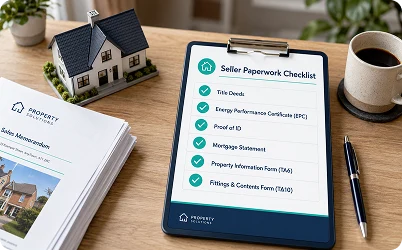
A Quick Reference Checklist for Sellers
Use the list below to track what you have and what you still need to find before marketing.
Required for Every Sale
Proof of identity: photographic ID and proof of address
Official copy of the title register and title plan
Valid Energy Performance Certificate
Completed TA6 Property Information Form
Completed TA10 Fixtures, Fittings and Contents Form
Mortgage statement and lender details if a mortgage is outstanding
Required for Leasehold Properties
Original lease document or copy from HM Land Registry
Completed TA7 Leasehold Information Form
Management information pack from freeholder or managing agent
Ground rent demands for recent years
Service charge accounts and demands for at least three years
Buildings insurance certificate for the building
EWS1 or building safety certificate if the building is above eleven metres
Required if Building Works Have Been Carried Out
Planning permission decision notice for any works that required it
Building regulations completion certificate for applicable works
FENSA or CERTASS certificate for replacement windows or doors
Gas Safe certificate for boiler installation or gas work
NAPIT or NICEIC certificate for electrical work
Damp-proof, structural, or specialist contractor guarantees
NHBC Buildmark or equivalent warranty for properties under ten years old
Selling Your Home with YooSell
If you are selling your home in Leicestershire or the Midlands, YooSell is a self-service home-selling platform that puts you in full control of your sale without paying traditional estate agent commission.
Why Sellers Choose YooSell
YooSell lets you list, manage, and complete your sale directly. You set your price, handle viewings through a built-in booking diary, communicate with verified buyers through the platform, and access trusted conveyancing professionals directly from your seller dashboard when you are ready to instruct a solicitor. There is no percentage commission taken at completion, only a simple fixed monthly listing fee.
See how it all works on the How It Works page or explore plan options on the Pricing page.
Integrated Conveyancing from Your Dashboard
Once you accept an offer on YooSell, you can access trusted conveyancers directly through your seller dashboard. This means you do not need to source a solicitor independently. The platform connects you with regulated professionals who understand the full conveyancing process and can help you work through the paperwork requirements covered in this guide.
List on Rightmove Through YooSell
You can list your property directly on Rightmove through YooSell, giving your home maximum visibility on the UK's largest property portal. Visit the YooSell Rightmove page for full details on how it works.
Free Tools to Support Your Sale
Valuation Calculator: get a data-driven estimate of your property's current market value
Cost Saving Calculator: see exactly how much you save compared to a traditional estate agent
Stamp Duty Calculator: work out the buyer's SDLT liability at the April 2025 rates
Mortgage Calculator: plan your onward purchase
Frequently Asked Questions
Read Our Blog
Tips, insights and expert advice to help you sell smarter.

Slough House Prices & Property Market Analysis 2026
Slough house prices averaged £334,000 in May 2026 according to ONS data, down modestly from £348,000 a year earlier. The market has softened in the short term, with flat prices falling 7.8% and transaction volumes down significantly. Average monthly rents, however, have risen to £1,572, strengthening the case for buying over renting. The Elizabeth Line puts Slough to Paddington in around 15 minutes, keeping buyer demand structurally strong. For buyers with a medium-term horizon, Slough remains one of the better-value commuter markets in the South East.

Nottingham House Prices 2026: What Buyers Should Know
Nottingham house prices in 2026 are holding steady, with the ONS recording an average of £192,000 in the city area as of June 2026. First-time buyers are paying around £177,000 on average, making Nottingham one of the more accessible cities in the East Midlands. Prices have risen 18.2% over the past five years, despite a brief flat period in 2025 and early 2026. Average monthly rents have reached £1,011, strengthening the financial case for buying over renting. West Bridgford commands the highest prices while areas like Sherwood and Bulwell offer strong value for budget-conscious buyers.

Why YooSell Is the Best Platform in the UK to List Property on Rightmove
You can list your property on Rightmove without an estate agent by using a Rightmove-registered listing platform such as YooSell. Private individuals cannot list directly on Rightmove, but portal-approved services can. YooSell includes Rightmove listing on all three plans from £29 per month, with the first month free, zero commission at completion, and ID-verified buyers as standard. Rightmove receives approximately 52.9 million monthly visits and accounts for around 70% of all time UK buyers spend on property portals, making it the most important portal for any UK seller in 2026.
Start Selling Your Home Today!
Take control of your sale with YooSell. Get started today and explore how we can help you sell smarter, faster, and with less hassle.