|Reading time: 12 minutes
Why Sell Your House Yourself? Here's What the Estate Agents Don't Tell You

Oliver H.
Oliver covers Midlands property trends and practical selling tips for homeowners. He focuses on clear, jargon-free advice that helps private sellers stay in control.
You can sell your house yourself in the UK without using an estate agent, and it's entirely legal, increasingly common, and potentially worth several thousand pounds in savings. The only professional you legally need is a solicitor or licensed conveyancer for the legal transfer of ownership. Everything else, pricing, photography, viewings, negotiations, you can handle yourself, with the right tools and the right knowledge.
Estate agents have done a brilliant job of convincing the UK public that selling a house is too complicated, too risky, and too time-consuming to handle without them. In my experience working with homeowners across the Midlands, that narrative exists because it protects a business model built on percentage commission. Not because it reflects reality. The truth is that the reasons to sell your house yourself are stronger in 2026 than they've ever been, and the reasons agents give you for needing them are a lot weaker than they sound. This guide exposes both.
What Does It Actually Mean to Sell Your House Yourself?
Selling your house yourself means marketing your property, managing viewings, negotiating with buyers, and progressing your sale through to exchange, all without instructing a traditional estate agent to act on your behalf. It is sometimes called a private sale, FSBO (For Sale By Owner), or self-sell.
Self-selling is a legitimate and fully legal route to market in the UK because there is no law requiring homeowners to use an estate agent when selling residential property. According to the HomeOwners Alliance, more than 20% of UK property sellers consider a private sale or alternative selling route each year, with growing numbers using online platforms and listing services in place of traditional agents.
You still need a conveyancer. You still need an EPC. And you still need to comply with the Consumer Protection from Unfair Trading Regulations 2008, which requires honest and complete disclosure of any known material facts about your property. Those requirements apply regardless of how you sell.
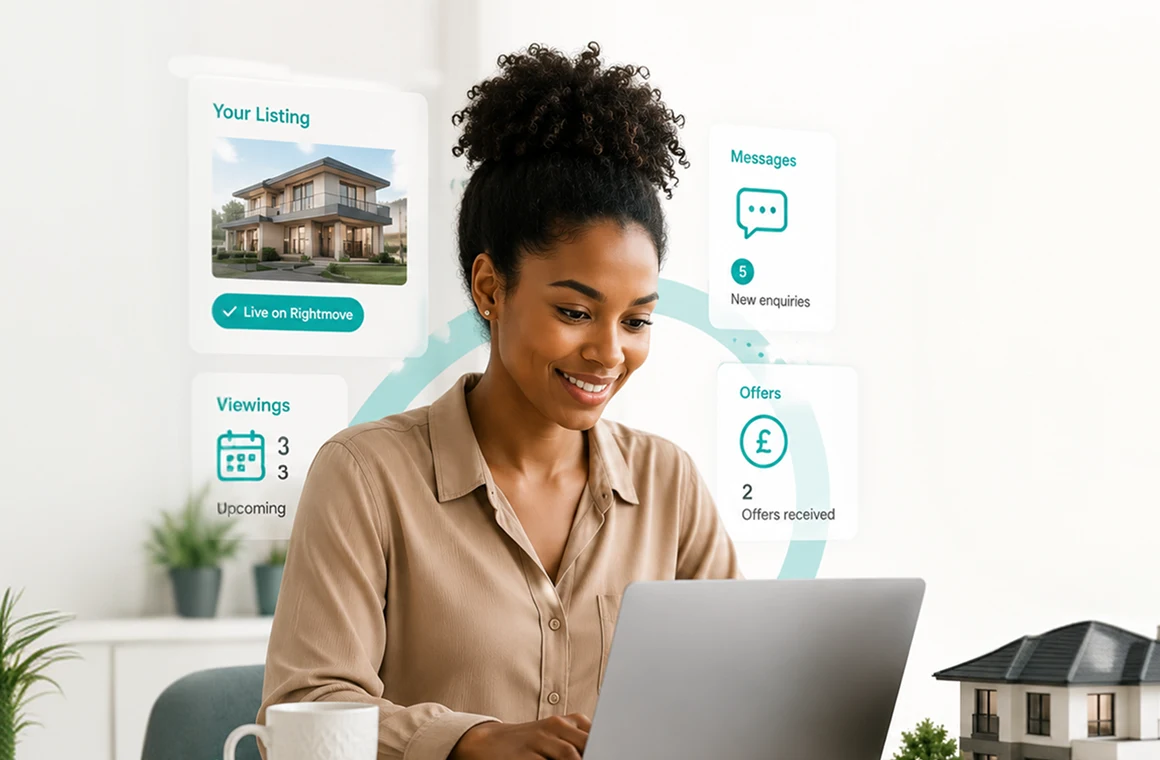
What changes is this: instead of paying 1% to 3% of your final sale price to an intermediary, you keep that money and take on the coordination yourself. Platforms like YooSell exist specifically to give you the tools to do that properly, including Rightmove listing access, AI-powered listing descriptions, a verified buyer system, and a built-in viewings calendar.
How Much Money Can You Actually Save by Selling Privately?
Selling your house yourself saves you the estate agent commission, which is the single largest cost in any UK property sale. According to research by TheAdvisory, based on a survey of over 2,000 UK house sellers, the average high street estate agent fee in 2026 is 1.18% plus VAT, equalling 1.42% including VAT. On a property worth £270,000, that is £3,834 taken from your sale proceeds at completion.
That is the average. Many sellers pay more. And the fee scales directly with your property's value, regardless of how much work the agent actually does on your behalf.
Here is what the savings look like across different property values when you sell yourself through a low fixed-fee platform versus a traditional agent at 1.5% plus VAT:
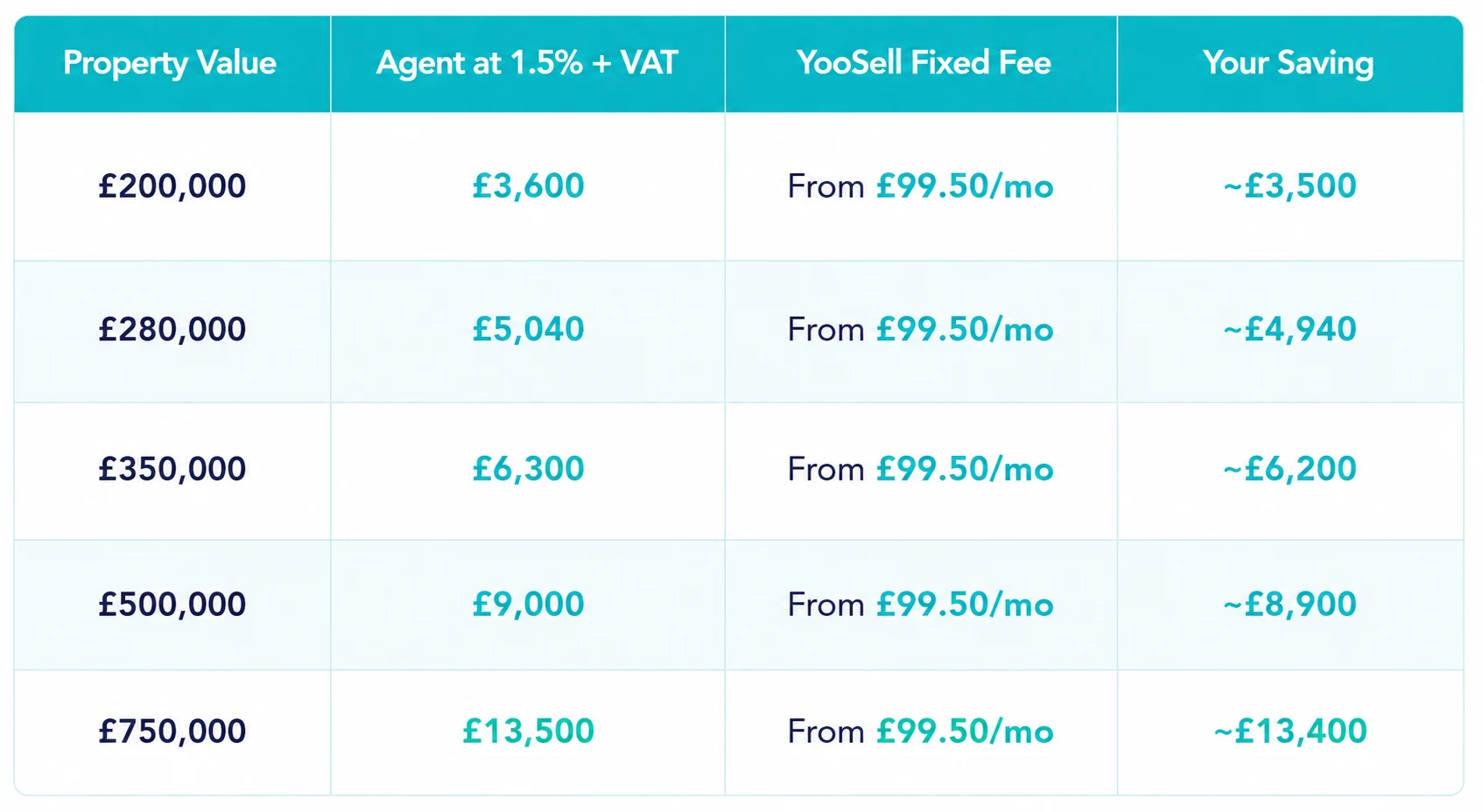
On a typical UK sale at the 2026 average house price of £270,000 (Zoopla House Price Index, May 2026), the saving from selling privately through YooSell rather than using a traditional high street agent runs to roughly £5,000. That is money that would otherwise disappear at completion. It goes to your agent, not you.
Use YooSell's Cost Saving Calculator to see exactly what you'd save on your specific property value.
What Estate Agents Don't Tell You: The Uncomfortable Truths
This is where it gets interesting. Estate agents are good at talking about what they do for you. They are less forthcoming about the structural reasons why their interests and yours are not always the same.
Their Fee Incentive Isn't Aligned With Getting You the Best Price
Think about this carefully. An agent charging 1.5% on a £300,000 sale earns £5,400. If they negotiate hard and get you £310,000 instead, their extra earnings are £150. The extra £10,000 is almost entirely yours, but the additional work and risk of losing the deal falls on them.
As property researcher Neal Hudson of Residential Analysts has noted, the percentage fee model creates a systematic pressure toward quick sales rather than maximum sale price. A faster deal at a slightly lower price is better for an agent's business than a longer negotiation that achieves the best outcome for you.
When you sell your house yourself, your incentive is entirely different. Every extra thousand pounds you negotiate goes directly into your pocket.
Almost Half of Homes Listed With Agents Don't Sell at All
Recent analysis from Zoopla found that almost half of UK homes listed for sale in the past three years did not sell. In many of those cases, sellers had overpriced on agent advice, then gone through repeated reductions that killed buyer confidence. An overpriced listing benefits an agent in the short term (it gets the instruction) but costs the seller time, frustration, and ultimately a lower final price.
When you price your own home using actual comparable sold prices from the Land Registry, rather than aspirational agent valuations designed to win your instruction, you start from a more honest and more effective position.
The "We Have a List of Buyers" Claim Is Mostly Mythology
Agents frequently tell prospective clients they have a database of ready buyers waiting for a property like yours. In reality, over 90% of UK property searches start on Rightmove or Zoopla, according to Property Passport UK's 2026 analysis of portal traffic. By the time an agent lists your home on those portals, their "buyer database" has been made largely redundant by the same portals that private sellers can also access through listing services.
YooSell's Enhanced and Premium plans include a Rightmove listing, meaning you reach exactly the same pool of buyers that any high street agent's listing would reach, without paying the commission.
They Rarely Tell You About the Price Reduction Pressure
Once your property has been on the market for four to six weeks without a sale, the agent's default advice is to reduce your asking price. That advice is often correct in overpriced markets. But it is delivered with a conflict of interest: the agent wants to complete a transaction. A quicker sale at a lower price earns them their fee and frees up their time.
When you sell your house yourself, you set the pace. You decide when to reduce, when to hold, and when to negotiate. That control belongs to you, not to someone earning a percentage on your behalf.
Is It Hard to Sell Your House Yourself in the UK?
Selling property by yourself is not as hard as agents suggest, but it does require organisation, clear communication, and the confidence to handle viewings and negotiations directly. Most sellers who go through the process report that it was more straightforward than they expected.
Here's what you are actually responsible for when selling privately:
Getting an Energy Performance Certificate from a qualified assessor (£60 to £120)
Setting an asking price using comparable sold prices and current market data
Taking good quality photographs and writing an accurate property description
Listing on Rightmove, Zoopla, and other portals via a platform like YooSell
Managing enquiries and arranging viewings around your schedule
Hosting viewings and answering buyer questions honestly
Evaluating offers and negotiating directly with buyers
Instructing a solicitor to handle the legal process (always required)
Responding to buyer and solicitor queries during the conveyancing period
That list looks long, but consider what it replaced. An agent handles those tasks but adds an average of four to twelve weeks to the timeline by batching communications, holding back on weekends, and managing multiple sellers at once. When you handle your own sale, communication is direct and fast.
According to Rightmove's June 2026 House Price Index, properties that did not need a price reduction sold in an average of 36 days. Properties that required a reduction averaged 127 days. Accurate pricing from the start, which is easier when you're working from real data rather than agent estimates, is the single biggest driver of sale speed.
YooSell's free Valuation Calculator pulls comparable sold price data to give you a realistic starting point before you list.
How to Sell Your House Yourself: The 7 Key Steps
Selling property by yourself follows the same broad process as any property sale. The difference is that you're driving it, not an intermediary.
Get your valuation right. Use HM Land Registry sold price data, Rightmove's sold prices tool, and Zoopla's house price search to find three to five comparable properties sold within the past three to six months. That's your market anchor. Cross-reference with YooSell's Valuation Calculator for a combined estimate.
Organise your paperwork. You'll need a valid EPC, your title deeds (or register from HM Land Registry for £3), your planning permissions for any extensions or conversions, building regulations certificates, and FENSA or similar certificates for windows. Having these ready upfront speeds up the conveyancing process significantly.
Create a compelling listing. Professional-quality photographs and an accurate floor plan are non-negotiable. Most buyers make their initial shortlist based entirely on portal photos. YooSell's listing tools include AI-assisted description writing so your listing reads well and covers the key selling points clearly.
Go live on Rightmove. This is where buyers are. Through YooSell's Enhanced or Premium plan, your property appears on Rightmove and other major portals, reaching the same audience as any high street agent's listing.
Manage viewings directly. You know your home better than any agent. You can answer every question about the neighbourhood, the local schools, the parking, the broadband speed, the neighbours. Buyers respond well to sellers who are present, informed, and honest.
Evaluate and negotiate offers. When an offer comes in, take your time. Nothing is legally binding until exchange of contracts in England and Wales. Consider the buyer's financial position (mortgage offer vs. agreement in principle vs. cash), their chain situation, and their proposed timeline, not just the headline figure.
Instruct a solicitor and progress to completion. Your conveyancer handles all the legal steps: drafting the contract, answering the buyer's solicitor's enquiries, liaising with your mortgage lender, and managing the transfer of funds at completion.
What Are the Real Risks of Selling Your House Yourself?
Being honest about the challenges of selling property by yourself matters, because they are real, even if they are overstated by agents with a commercial interest in discouraging you.
The genuine risks are:
Emotional attachment affecting pricing. Most private sellers initially set their asking price too high because of emotional investment in their home. The cure is strict reliance on sold price data, not feelings or agent flattery.
Handling difficult buyers or low-ball offers. Without an intermediary to buffer the conversation, you need to stay calm and professional when buyers push hard on price. This is a learnable skill, but it can be uncomfortable the first time.
Missing legal disclosure requirements. You must disclose all known material facts about your property. If you're unsure what's required, your solicitor can advise before you go to market.
Time commitment. Selling privately genuinely does require time. Responding to enquiries, arranging viewings, and chasing solicitors is work. Most sellers report spending 20 to 30 hours across the full process, but that time directly replaces something that would otherwise have cost them thousands.
None of these risks are reasons not to sell your house yourself. They are reasons to go in prepared.
Private Sale vs Estate Agent: Which Actually Gets the Better Result?
The comparison between selling privately and using a traditional agent often gets framed as a quality question, as though agents consistently achieve better prices that justify their fees. The data doesn't fully support that framing.
According to MoneySuperMarket's 2026 analysis, by avoiding an estate agent, sellers can usually save 1% to 2% of their home's final sale price. On an average UK house price of around £270,000 at the start of 2026, that is between £2,700 and £5,400 in savings.
The key variable is your market position. In a strong, well-priced local market where demand is healthy, a well-prepared private seller consistently achieves comparable results to agent-listed properties. In a difficult local market, or for a complex property, an experienced agent's buyer network and negotiation skill can genuinely add value.
The Midlands market in 2026 sits firmly in the first category. Buyer demand is resilient and supply, while elevated nationally, is being absorbed at above-average rates in affordable regions. Browse currently listed properties on YooSell to see what the active market looks like in your area right now.
Conclusion
The single most important reason to sell your house yourself is financial: estate agent commission is the largest controllable cost in any UK property sale, and every pound of it comes directly out of your proceeds at completion. On a £280,000 home, keeping a 1.5% commission means keeping over £5,000 that would otherwise go to your agent on the day you need the money most.
But the financial case is only part of it. When you sell your house yourself, you also get something agents consistently underplay: control. You set the price from real data, not an aspirational figure designed to win your instruction. You manage your own viewings and give buyers the honest, knowledgeable answers that only a homeowner can provide. You decide when to negotiate, when to hold, and when to accept. You're not waiting for your agent to finish a call, come back from lunch, or work through a queue of other clients.
In 2026, with platforms like YooSell giving private sellers access to Rightmove listings, AI-assisted property descriptions, ID-verified buyers, and integrated viewings management, the practical gap between selling privately and selling through an agent has effectively closed. The fee gap has not.
Here is your clear next step. Use YooSell's free Valuation Calculator to find out what your property is worth in the current market. Then run your numbers through the Cost Saving Calculator to see exactly what you'd save. When you're ready, register and list your property on YooSell in minutes, pay a flat monthly fee from £49.50, and keep 100% of your sale price at completion.
Frequently Asked Questions
Start Selling Your Home Today!
Take control of your sale with YooSell. Get started today and explore how we can help you sell smarter, faster, and with less hassle.