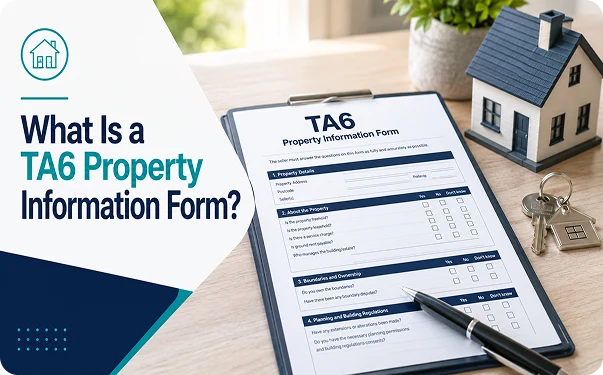
What Is a TA6 Property Information Form? A UK Seller's Guide
The TA6 Property Information Form is the most important disclosure document in any UK residential property sale. Buyers rely on your answers when deciding whether to proceed, and inaccurate answers can lead to legal claims after completion. This guide explains what the TA6 is, what the new 6th edition covers, how to complete each of the 15 sections correctly, and what your legal obligations are as a seller in England and Wales.

Oliver H.
Oliver covers Midlands property trends and practical selling tips for homeowners. He focuses on clear, jargon-free advice that helps private sellers stay in control.
If you are selling a home in England or Wales, you will be asked to complete a TA6 Property Information Form. It is not optional, and it is not a formality. It is a legally relied-upon document that forms part of your contract pack, sits at the heart of the conveyancing process, and directly affects your liability as a seller if anything goes wrong after completion.
Most sellers receive the form from their solicitor, fill it in as best they can, and return it without fully understanding what they have disclosed, what they have missed, or what the consequences of an inaccurate answer could be. That gap in understanding is one of the most common sources of legal problems in residential property sales.
This guide explains what the TA6 is, why it exists, what the 6th edition introduced in 2026 covers, how to complete each section correctly, and what happens if something goes wrong. If you are preparing to sell, start here.
Before you list your property, use the free Valuation Calculator on YooSell to understand your home's current market value alongside your disclosure obligations.
What the TA6 Property Information Form Is
The TA6 is a standardised property information form produced by the Law Society of England and Wales. It is completed by the seller and provided to the buyer's solicitor as part of the contract pack during the conveyancing process.
Its Purpose in the Sale
The TA6 gives the buyer information about your property that they cannot find from a physical inspection, a property search, or the title register alone. It records what you, as the person who has lived in and owned the property, know about its history, condition, and circumstances.
Buyers rely on the answers you give in the TA6 when deciding whether to proceed with the purchase and on what terms. If your answers are inaccurate or misleading, the buyer may have grounds to claim compensation after completion. The Law Society's own explanatory notes state this clearly: buyers can rely on the information you give, and misleading information may lead to a compensation claim.
How It Fits into the Conveyancing Process
Your solicitor will send you the TA6 to complete at the start of the conveyancing process, usually alongside the TA10 Fixtures, Fittings and Contents Form. Both completed forms are included in the contract pack your solicitor sends to the buyer's solicitor. The buyer's solicitor reviews the TA6 carefully and raises formal enquiries based on its contents. If you leave sections incomplete, give vague answers, or disclose something that requires further clarification, the enquiries stage takes longer.
Who the Form Applies To
The TA6 is designed for standard residential property sales in England and Wales. It is used whether the property is freehold or leasehold, whether you are selling with an agent or privately, and whether you have lived in the property yourself or owned it as a landlord. If you are selling a leasehold property, you also complete a TA7 Leasehold Information Form alongside the TA6. The TA6 is not designed for new build sales, where different documentation applies.
The TA6 6th Edition: What Changed in 2026
The TA6 6th edition became mandatory for all solicitors accredited by the Law Society's Conveyancing Quality Scheme from 30 March 2026. It replaced the 5th edition, which was introduced in 2024 and widely criticised by sellers and conveyancers for being too long, too complex, and poorly structured.
Why the Form Was Overhauled
The 5th edition expanded the TA6 to 25 sections and added a large amount of information that was already captured at the marketing stage, such as council tax band, asking price, tenure details, and EPC information. Sellers found it difficult to complete, conveyancers found it generated unnecessary duplication, and the Law Society received significant feedback from over 1,200 stakeholders that the form needed to be simplified.
The 6th edition was developed over several months with a working group of residential conveyancers from a variety of firms. It was user-tested with sellers and conveyancers before being finalised in October 2025.
The Key Changes in the 6th Edition
The most significant changes in the TA6 6th edition compared to the 5th are:
Reduced from 25 Sections to 15
The 6th edition has 15 sections, ten fewer than the 5th edition. The sections removed include council tax, asking price, tenure and ownership charges, physical characteristics of the property, building safety, restrictive covenants, coastal erosion, accessibility, and coalfield and mining areas. These were removed because they are either covered at the marketing stage, captured in other documents such as property searches, or dealt with by the buyer's own enquiries.
Clearer Language and Realistic Phrasing
Many questions in the 6th edition are now phrased as "are you aware" rather than requiring a definitive positive or negative answer. This reflects the realistic position of many sellers, who may have only lived in the property for a few years and cannot reasonably be expected to know everything about its full history.
More "Not Known" Options
A broader range of questions now permits a "not known" response. This reduces the risk of sellers giving inaccurate answers because they feel forced to choose yes or no when the honest answer is that they simply do not know.
New Sections Added
While sections were removed, some new areas were added to reflect current buyer priorities. The 6th edition includes questions on digital connectivity such as broadband speed and mobile coverage, and expanded questions on environmental and flood risk, reflecting growing buyer concern about climate-related property risks.
No Longer Requires EPC Details
The 6th edition does not ask sellers to provide EPC information. This is now handled at the marketing stage by the estate agent or selling platform and does not need to be duplicated in the TA6.
The 15 Sections of the TA6 6th Edition Explained
The TA6 6th edition covers 15 sections. Each is explained below with guidance on what you are expected to provide and the common issues that arise.
Boundaries
The first section asks about the physical boundaries of your property. You must identify which boundaries belong to your property and who is responsible for maintaining each one, whether a fence, wall, hedge, or ditch.
What You Are Asked
You will be asked whether you are aware of any boundary that is irregular, disputed, or does not match the title plan at HM Land Registry. You will also be asked whether any boundary structure has been moved, replaced, or altered during your ownership.
Common Issues in This Section
Boundary questions generate more enquiries than almost any other section of the TA6. Title plans at Land Registry are drawn at a scale that is not precise enough to determine exactly where a boundary falls. If you have had any discussion with a neighbour about where a fence should sit, or if any boundary structure has been moved or rebuilt, disclose this fully. Do not leave boundary questions incomplete.
Disputes and Complaints
This section asks whether you are aware of any disputes or complaints involving the property or affecting your relationship with neighbours.
What You Are Asked
You must disclose any dispute, formal or informal, relating to the property. This includes disputes about boundaries, noise, access, parking, overhanging trees, shared drains, or any other issue that has involved correspondence, solicitors, or any third party. It also covers any disputes with the local authority, utility companies, or other neighbours that relate in any way to the property.
Why Honesty Here Matters Most
Undisclosed neighbour disputes are one of the most common sources of post-completion legal claims against sellers. If a buyer discovers after purchase that you were aware of a significant dispute and did not disclose it, they have strong grounds for a misrepresentation claim. If you have had any issue with any neighbour, however informally resolved, disclose it.
Notices and Proposals
This section asks whether you have received any formal notices affecting the property from any authority, utility company, or third party.
What You Are Asked
Notices covered include planning notices, enforcement notices, notices from the highway authority about road alterations, notices from utility companies about works affecting the property, and any other formal communication from any body that relates to your property or land.
What to Look for in Your Records
Check your files for any formal letters from the local council, the Environment Agency, your water company, or any other authority received during your ownership. Even notices that appear to have been resolved or that relate to proposals that never proceeded should be disclosed.
Alterations, Planning, and Building Control
This is one of the most detailed and practically important sections of the TA6. It covers all works carried out on the property during your ownership that required or may have required planning permission or building regulations approval.
Planning Permission
You must disclose all works carried out that required planning permission and confirm whether the relevant consent was obtained. This includes extensions, loft conversions, outbuildings, changes to the external appearance of the property, and changes of use.
If you are unsure whether a particular piece of work required planning permission, the safest approach is to disclose the work and let your solicitor advise on whether any consent was needed and, if so, whether it was obtained.
Building Regulations Completion Certificate
For all works requiring building regulations approval, you need a completion certificate confirming that the work was inspected and signed off by the local authority building control or an approved inspector. This applies to extensions of any size, loft conversions, new or replacement heating systems, electrical installation or alteration, structural alterations, and new bathrooms or ensuites.
What to Do if You Do Not Have the Certificate
If you cannot locate a planning permission, a building regulations completion certificate, or other consent documentation, tell your solicitor immediately rather than leaving the section blank or answering vaguely. Your solicitor can advise whether indemnity insurance is the appropriate solution. Indemnity insurance is a one-off policy that protects the buyer against any financial loss arising from the absence of a specific consent or certificate.
Guarantees and Warranties
This section asks you to provide details of any guarantees or warranties in place that relate to the property.
Types of Guarantees to Disclose
Common guarantees and warranties that should be disclosed and provided include:
Damp-proofing guarantees from specialist contractors
Timber treatment guarantees
Double glazing installation guarantees
Roof repair or replacement guarantees
Underpinning or structural repair guarantees
NHBC Buildmark or equivalent new build structural warranty for properties less than ten years old
Any other contractor-issued guarantee for work carried out on the property
Transferability of Guarantees
Many guarantees are transferable to a new owner. Buyers value these documents and they can strengthen confidence in your sale. If a guarantee is in place but you are not sure whether it is transferable, provide it anyway and let your solicitor confirm its status.
Insurance
This section covers the property's buildings insurance history and asks about any insurance claims made during your ownership.
What You Are Asked
You must disclose whether any buildings insurance claim has been made on the property during your ownership. If a claim was made, you must provide details of what it covered and what works were carried out as a result.
Why This Matters to Buyers
A history of claims, particularly for subsidence, flooding, or structural damage, is material information for a buyer. Their insurer will ask about claims history when they take out their own buildings insurance policy after purchase. If you fail to disclose a claim and the buyer subsequently has difficulty insuring the property or finds their premium is higher than expected, this can give rise to a claim against you.
Environmental Matters
The 6th edition expanded the environmental section to reflect growing buyer and lender concern about climate-related risks. This section asks about flooding, drainage, and other environmental matters affecting or potentially affecting the property.
Flooding
You must disclose whether the property has ever been affected by flooding during your ownership, whether from surface water, a river, a drain, or any other source. You must also disclose whether you are aware of any risk of flooding affecting the property, even if an actual flood event has not occurred during your ownership.
Flooding history is one of the most material facts a buyer can receive. Mortgage lenders also scrutinise it carefully. An undisclosed flooding history is one of the most serious omissions a seller can make.
Drainage and Sewerage
You must disclose whether the property drains to the public sewer or uses a private system such as a septic tank, cesspit, or sewage treatment plant. If the property uses a private system, you must provide details of its condition, maintenance history, and compliance with current regulations.
Contaminated Land
You must disclose whether you are aware of any contaminated land affecting or near the property. If the property was previously used for industrial purposes or is near a former industrial site, this is worth raising with your solicitor.
Services
This section covers the utilities and services connected to the property.
What You Are Asked
You must confirm which services are connected to the property: mains gas, electricity, mains water, and mains drainage. Where any service is not connected to the main network, you must provide details of the alternative arrangement. You must also disclose whether any services are shared with neighbouring properties and whether any service pipes or cables cross third-party land.
Rights and Informal Arrangements
This section asks about rights of way, access arrangements, and any informal agreements with neighbours or third parties that affect how the property is used.
Formal Rights
Formal rights of way and easements registered on the title will be identified by your solicitor from the title register. The TA6 asks you to supplement this with any practical rights used informally or by custom that may not be formally recorded.
Informal Arrangements
If you have any informal arrangement with a neighbour, such as an agreement to park on their land, to use a shared path, or to maintain a shared drain, disclose it in this section. Informal arrangements that are not disclosed can become the subject of disputes after completion when a buyer discovers that access they expected is not actually theirs to use.
Parking
This section asks about parking arrangements for the property.
What You Are Asked
You must confirm whether parking is available on or near the property and the basis on which it is used. This includes a driveway you own, a garage, a parking space that comes with the property, or street parking in an area where it is unrestricted. If parking is subject to any permit, lease, or licence arrangement, you must provide details.
Parking is a material consideration for many buyers. Where it is available only informally or is shared with another property, this should be clearly stated.
Connectivity
This is a new section added in the 6th edition, reflecting the growing importance of digital connectivity as a purchasing consideration.
What You Are Asked
You must provide information about the broadband connection type and approximate speed available at the property and confirm the level of mobile phone coverage. These are now standard questions on Rightmove listings and in buyer searches, and including accurate information here avoids enquiries and reassures buyers who work from home or rely on a strong connection.
Other Charges
This section covers any ongoing financial charges affecting the property beyond a standard mortgage.
What You Are Asked
You must disclose any estate management charges, rent charges, or other periodic payments that affect the property. On modern freehold properties built on private estates, estate management charges are increasingly common and cover the maintenance of shared roads, landscaping, and communal areas that have not been adopted by the local authority.
Buyers need to know about these charges before committing to a purchase. Failing to disclose an estate management charge is a material omission.
Transactions
This section covers the proposed terms of the sale, including the intended completion date and whether the property is vacant or occupied.
What You Are Asked
You must confirm when you expect the property to be available for completion, whether you have any flexibility on timing, and whether there are any third parties living in the property whose rights could affect the buyer's occupation.
Occupiers
This section asks whether any other adults live in the property who might have rights affecting the transaction.
Why This Section Matters
Where an adult occupier has contributed financially to the property or has been living there for an extended period, they may have an equitable interest in it that affects the sale. Your solicitor needs to know about all adult occupiers so that they can take appropriate steps to ensure any such interests are properly dealt with before exchange of contracts.
Additional Information
The final section of the TA6 gives you a space to provide any additional information that is relevant to the sale but not captured in the earlier sections.
When to Use This Section
Use this section to disclose anything material that does not fit neatly into the other sections. This might include ongoing planning applications near the property, informal discussions with a neighbour about a shared boundary, a known issue with the property that is being actively addressed, or any other circumstance that a buyer would reasonably want to know.
If in doubt about whether something is worth disclosing, the safest answer is always to disclose it. Your solicitor can advise on how to present it.
Your Legal Obligations When Completing the TA6
Completing the TA6 accurately is not just good practice. It is a legal requirement with serious consequences if you get it wrong.
The Misrepresentation Act 1967
Under the Misrepresentation Act 1967, if you give false information in the TA6 that induces the buyer to enter into the contract, the buyer may be entitled to rescind the contract or claim damages. This applies whether the misrepresentation was fraudulent, negligent, or even innocent.
The Consumer Protection from Unfair Trading Regulations 2008
The Consumer Protection from Unfair Trading Regulations prohibit misleading actions and misleading omissions in consumer transactions. Giving a false answer in the TA6 can constitute a misleading action. Failing to disclose a known material fact can constitute a misleading omission. Both can give rise to a claim.
The Digital Markets, Competition and Consumers Act 2024
The Digital Markets, Competition and Consumers Act 2024 provides a further framework prohibiting misleading actions and omissions in consumer transactions. The Law Society has confirmed that the 6th edition TA6 operates within this legal framework and that sellers' legal obligations remain materially unchanged from the previous edition.
What "Are You Aware" Actually Means
Many questions in the 6th edition are framed as "are you aware of". This does not mean you can answer no simply because you have not actively investigated an issue. It means you must answer based on everything you actually know. If you know there was a dispute with a neighbour, you cannot answer no to the disputes question on the basis that you were not formally made aware of it in writing.
The Obligation to Update Your Answers
If circumstances change between when you complete the TA6 and the point of exchange, you have an obligation to update your answers. For example, if a new dispute arises with a neighbour after you have submitted the form but before exchange of contracts, you must inform your solicitor so the TA6 can be updated.
Common Mistakes Sellers Make on the TA6
Understanding where sellers most commonly go wrong helps you avoid the same pitfalls.
Leaving Sections Blank
A blank answer to a question is not a neutral response. It is an incomplete disclosure that the buyer's solicitor will flag in their enquiries. If you do not know the answer to a question, use the "not known" option where available. If no such option exists, discuss the question with your solicitor before leaving it blank.
Being Vague About Building Works
Answers such as "some work was done" or "there may have been an extension" are not adequate. Buyers and their solicitors need specific information: what was done, when, by whom, whether planning permission was required, and whether it was obtained. If you do not have all the details, provide what you do know and tell your solicitor what documentation you are unable to locate.
Assuming Old Work Is Too Old to Matter
Some sellers assume that building works or planning issues from many years ago are no longer relevant. This is not always the case. While time limits apply to certain types of enforcement action, the absence of documentation for older works can still generate enquiries and require indemnity insurance. Disclose all works regardless of how long ago they were carried out.
Not Reading the Explanatory Notes
The Law Society publishes detailed explanatory notes specifically to help sellers understand what each question in the TA6 is asking. Your solicitor must now send you these notes alongside the form under the updated conveyancing protocol. Read them before completing the form.
Completing the Form in a Hurry
The TA6 is a legal document. Completing it quickly without proper thought increases the risk of errors, omissions, and inconsistencies. Set aside sufficient time, read each question carefully, and refer to your records before answering.
How to Prepare for the TA6 Before You List
The best time to prepare for the TA6 is before your property goes on the market, not after you have accepted an offer. Gathering the relevant documents and thinking through each section in advance means you can submit a complete and accurate form quickly once the conveyancing process begins.
Documents to Find Before You Start
Locate the following documents and have them ready before your solicitor sends the TA6:
Planning permissions and building regulations completion certificates for any extensions, loft conversions, or structural alterations
FENSA or CERTASS certificates for replacement windows or doors installed since April 2002
Gas Safe certificates for boiler installations or gas appliance work
NAPIT or NICEIC certificates for electrical installation or alteration
Damp-proofing, timber treatment, roof repair, or underpinning guarantees
NHBC Buildmark or equivalent structural warranty if the property is less than ten years old
Any correspondence with neighbours about boundaries, disputes, or shared structures
Any formal notices received from the local authority, Environment Agency, or utility companies
Walk Through Your Property Before You Complete
Walk through the property systematically before completing the TA6. Look at each room and ask yourself whether anything you see relates to any of the 15 sections. Pay attention to the garden and boundaries, the loft if accessible, the garage or outbuildings, and any areas where work has been done. This physical review often surfaces relevant information that you would not recall sitting at a desk.
Discuss Any Uncertainties with Your Solicitor
If you are unsure whether something is disclosable, always ask your solicitor. The cost of getting a disclosure wrong vastly exceeds the cost of a brief conversation. Your solicitor cannot advise you on what happened at your property, but they can advise on whether a particular type of information needs to be disclosed and how to frame an answer appropriately.
The TA6 and the TA10: Understanding Both Forms
The TA6 is almost always completed alongside the TA10 Fixtures, Fittings and Contents Form. Understanding how the two relate helps you avoid gaps in your disclosure.
What the TA10 Covers
The TA10 is a separate form that records exactly what is and is not included in the sale price. It works through the property room by room and asks you to confirm whether items such as kitchen appliances, fitted wardrobes, carpets, curtains, curtain poles, light fittings, garden structures, and other items are included or excluded.
Why Getting the TA10 Right Matters
Disputes about what was agreed to be included in a sale are a common source of friction on and around completion day. A buyer who expects the kitchen appliances to be included because they were present in the listing photographs and the seller removes them before completion has legitimate grounds for complaint. The TA10 removes ambiguity by creating a written record of what was agreed.
The TA7 for Leasehold Properties
If you are selling a leasehold property, you also complete a TA7 Leasehold Information Form alongside the TA6. The TA7 5th edition, which became mandatory on the same date as the TA6 6th edition, covers the specific legal and financial aspects of leasehold ownership including the lease term, service charge history, ground rent, and the management of the building. It has been updated to align with the changes in the TA6 6th edition.
Selling Your Home with YooSell
If you are selling your home in Leicestershire or the Midlands, YooSell is a self-service home-selling platform that gives you full control of your sale without paying traditional estate agent commission.
Why Sellers Choose YooSell
YooSell lets you list, manage, and complete your sale directly. You set your asking price, manage viewings through a built-in booking diary, communicate with verified buyers through the platform, and access trusted conveyancing professionals directly from your seller dashboard when you are ready to instruct a solicitor.
There is no percentage commission taken at completion. You pay only a simple fixed monthly fee.
See how the full process works on the How It Works page or explore plan options on the Pricing page.
Integrated Conveyancing Access
Once you accept an offer on YooSell, you can access trusted conveyancers directly from your seller dashboard. This means you do not need to source a solicitor independently. The platform connects you with regulated professionals who can guide you through completing the TA6 accurately and progressing the transaction to exchange and completion.
Verified Buyers for a More Certain Sale
Every buyer on YooSell completes identity and financial verification before they can make an offer. This means you deal only with buyers who are financially confirmed and serious, reducing the risk of a sale collapsing after offer acceptance.
List on Rightmove Through YooSell
You can list your property directly on Rightmove through YooSell by choosing the Enhanced or Premium plan. Visit the YooSell Rightmove page for full details on how it works.
Free Tools to Support Your Sale
Valuation Calculator: get a data-driven estimate of your property's current market value
Cost Saving Calculator: see exactly how much you save compared to a traditional estate agent
Stamp Duty Calculator: understand the buyer's SDLT liability at the April 2025 rates
Mortgage Calculator: plan your onward purchase
Frequently Asked Questions
Read Our Blog
Tips, insights and expert advice to help you sell smarter.

Slough House Prices & Property Market Analysis 2026
Slough house prices averaged £334,000 in May 2026 according to ONS data, down modestly from £348,000 a year earlier. The market has softened in the short term, with flat prices falling 7.8% and transaction volumes down significantly. Average monthly rents, however, have risen to £1,572, strengthening the case for buying over renting. The Elizabeth Line puts Slough to Paddington in around 15 minutes, keeping buyer demand structurally strong. For buyers with a medium-term horizon, Slough remains one of the better-value commuter markets in the South East.

Nottingham House Prices 2026: What Buyers Should Know
Nottingham house prices in 2026 are holding steady, with the ONS recording an average of £192,000 in the city area as of June 2026. First-time buyers are paying around £177,000 on average, making Nottingham one of the more accessible cities in the East Midlands. Prices have risen 18.2% over the past five years, despite a brief flat period in 2025 and early 2026. Average monthly rents have reached £1,011, strengthening the financial case for buying over renting. West Bridgford commands the highest prices while areas like Sherwood and Bulwell offer strong value for budget-conscious buyers.

Why YooSell Is the Best Platform in the UK to List Property on Rightmove
You can list your property on Rightmove without an estate agent by using a Rightmove-registered listing platform such as YooSell. Private individuals cannot list directly on Rightmove, but portal-approved services can. YooSell includes Rightmove listing on all three plans from £29 per month, with the first month free, zero commission at completion, and ID-verified buyers as standard. Rightmove receives approximately 52.9 million monthly visits and accounts for around 70% of all time UK buyers spend on property portals, making it the most important portal for any UK seller in 2026.
Start Selling Your Home Today!
Take control of your sale with YooSell. Get started today and explore how we can help you sell smarter, faster, and with less hassle.