
What Is a Memorandum of Sale? A Complete UK Guide
A memorandum of sale is issued within days of an offer being accepted on a property in England and Wales. It records the agreed price, buyer and seller details, and solicitor contacts, and it is the document that starts the conveyancing process. This guide explains what it is, what it must contain, why accuracy matters, and exactly what happens once it is issued.

Arthur B.
Arthur writes about conveyancing, paperwork, and the steps that keep a sale moving. His guides help buyers and sellers avoid common delays.
Introduction: The Document That Starts Your Sale
You have accepted an offer on your home. The buyer is ready. The price is agreed. Most sellers assume the hard work is done. But in England and Wales, accepting an offer is not the start of the legal process. A specific document must be issued first. That document is the memorandum of sale.
The memorandum of sale is issued within hours or days of an accepted offer. It records who is buying, who is selling, at what price, and who the legal representatives are on each side. Without it, neither solicitor can begin work. With it, the conveyancing clock starts. Understanding what the memorandum of sale is, what it should contain, why accuracy matters, and what happens after it is issued gives you a clear picture of this critical early stage of your sale. It also helps you prepare the information needed to ensure it is issued quickly and correctly, which is one of the most effective ways to keep your transaction moving.
If you are still deciding whether to list your property or want to understand the full private sale process before you do, explore how YooSell works from listing through to completion.
What a Memorandum of Sale Is
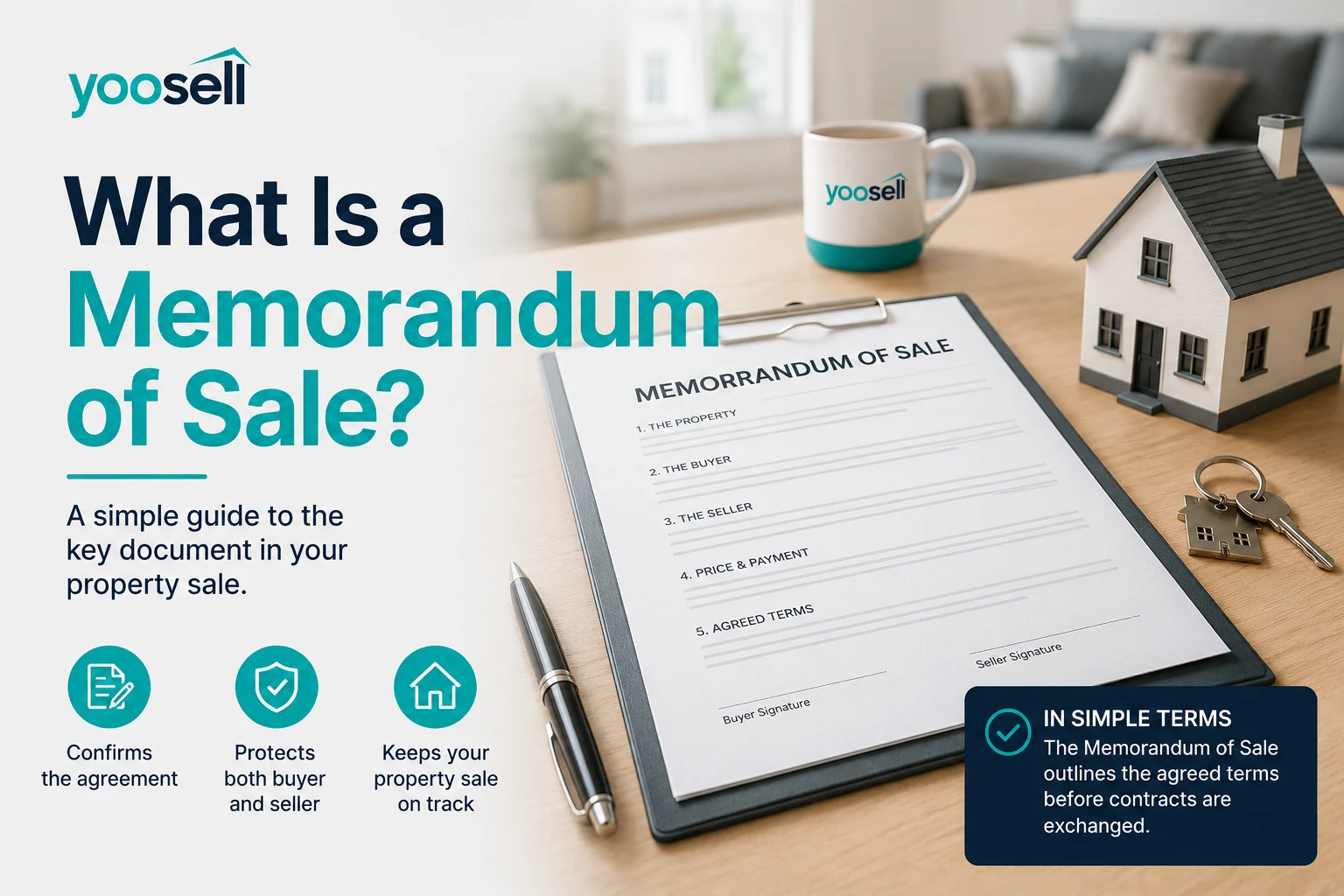
A memorandum of sale is a written document that formally records the key details of an agreed property sale. It is issued after a seller accepts a buyer's offer and before the legal conveyancing process begins in earnest. It is sometimes called a sales memorandum, a sale advice, or a sale notification.
Its Role in the Property Transaction
The memorandum of sale is the handshake that starts the legal process. It gives both solicitors the information they need to open their files and begin work. It confirms the agreed price, identifies the parties on both sides, records the contact details of the legal representatives, and sets out any key conditions or inclusions agreed as part of the offer.
Without a memorandum of sale, solicitors cannot begin preparing the contract pack, investigating the title, or ordering searches. The document is the trigger that moves the transaction from the marketing stage into the legal stage.
Is It Legally Binding?
No. A memorandum of sale is not a legally binding document in England and Wales. Accepting an offer and issuing a memorandum of sale does not commit either the buyer or the seller to the transaction in any enforceable way. Either party can withdraw from the sale at any point before exchange of contracts without facing legal consequences, though both will lose any money they have spent on surveys, searches, and legal fees up to that point.
The legally binding moment in a property transaction in England and Wales comes at exchange of contracts, which typically happens weeks or months after the memorandum of sale is issued. Until that point, the transaction can fall through without penalty for either party, which is one of the defining characteristics of the English property sale system compared to Scotland, where a binding contract is formed at an earlier stage.
When Is It Issued?
The memorandum of sale is issued after an offer has been accepted and before conveyancing begins. In most cases it is issued within twenty-four to seventy-two hours of offer acceptance. Delays can occur if one or both parties have not yet instructed a solicitor, if the buyer has not confirmed their mortgage position, or if key details such as the buyer's solicitor's contact information are not yet available.
This is one of the reasons it is advisable to instruct your solicitor before you accept an offer, not after. Sellers who have already chosen their conveyancer can have the memorandum of sale issued and acted upon much faster than those who need to find one after the fact.
Who Issues the Memorandum of Sale?
In a traditional estate agent-led sale, the memorandum of sale is prepared and issued by the estate agent acting for the seller. The agent sends copies to all relevant parties as soon as it is ready.
Who Issues It in a Private Sale
If you are selling your property privately without a traditional estate agent, the memorandum of sale does not issue itself. In a private sale, the document is typically prepared by the seller's solicitor once the seller instructs them that an offer has been accepted and provides the relevant details. Alternatively, the platform through which the sale is being managed may generate the memorandum automatically once an offer is formally accepted.
When you sell through YooSell, the platform handles the offer management process digitally. Once you accept an offer, the relevant details are captured and can be passed directly to your solicitor to issue the memorandum of sale without delay.
Who Receives It
Once issued, the memorandum of sale is sent to all parties involved in the transaction:
The seller
The buyer
The seller's solicitor or conveyancer
The buyer's solicitor or conveyancer
The estate agent, platform, or intermediary managing the sale where applicable
Each party uses it to open their file, begin their work, and confirm that everyone is starting from the same set of agreed facts.
What the Memorandum of Sale Contains
A well-prepared memorandum of sale contains all the information each party needs to begin the conveyancing process without having to chase for missing details. Knowing what should be included helps you ensure nothing is missing when yours is issued.
The Property Address
The full registered address of the property being sold, including the postcode. This should match the address on the Land Registry title register exactly.
The Agreed Sale Price
The purchase price the buyer has offered and the seller has accepted. This should be written in full as a figure, not abbreviated. Any agreed variations from the original asking price, such as a price reduction following a survey or a negotiated adjustment, should be reflected accurately.
The Buyer's Details
The full legal name or names of the buyer, their address, and their contact details. Where there are two buyers purchasing jointly, both names must be included as they will appear on the title register after completion. The buyer's mortgage position should also be noted: whether they are purchasing with a mortgage, as a cash buyer, or under a help-to-buy or shared ownership arrangement, as this affects the conveyancing requirements on both sides.
The Seller's Details
The full legal name or names of the seller, matching the names on the current title register for the property. If the property is registered in a name that differs from how you currently use it, for example following a change of name through marriage, this should be flagged to your solicitor at this point so it can be resolved during conveyancing.
The Seller's Solicitor Details
The name of the firm, the address, telephone number, email address, and the name of the individual solicitor or conveyancer handling your file. If you have not yet instructed a solicitor, the memorandum of sale cannot be fully completed. This is another reason to instruct early.
The Buyer's Solicitor Details
The same level of detail for the legal representative acting for the buyer. If the buyer has not yet instructed a solicitor, their details will be left blank and filled in as soon as they are available. A missing solicitor on one side delays the start of conveyancing work on both sides.
The Tenure of the Property
Whether the property is freehold or leasehold. For leasehold properties, the remaining term of the lease should be noted, as this affects the conveyancing requirements and the buyer's mortgage application.
Fixtures, Fittings, and Agreed Inclusions
Any items agreed to be included in or excluded from the sale price, such as kitchen appliances, fitted wardrobes, garden structures, or specific furniture. This should be consistent with the TA10 Fixtures, Fittings and Contents Form that will be completed as part of the conveyancing process. Discrepancies between what is recorded in the memorandum and what the TA10 says can cause confusion at a later stage.
Chain Position
Whether there is a chain, how many transactions are linked to this one, and whether any parties in the chain have related transactions already agreed. Chain information is relevant to realistic completion timelines and helps all solicitors understand the wider picture from the outset.
Target Completion Date
Where a preferred or target completion date has been discussed and agreed in principle between buyer and seller at the time of offer acceptance, this can be recorded in the memorandum. This is not contractually binding at this stage, but it gives all parties a shared expectation to work towards.
Conditions of Sale
Any specific conditions attached to the agreed offer, such as the buyer requiring a satisfactory survey result, the inclusion of specific items, or a requirement for a short or extended completion period.
Why Accuracy in the Memorandum of Sale Matters
The memorandum of sale is the reference document against which all subsequent conveyancing work is measured. If it contains errors, those errors can propagate through the legal process and cause problems at a later stage.
Price Errors
A price recorded incorrectly in the memorandum of sale will eventually come to light when the draft contract is prepared by the seller's solicitor, but catching it earlier is better. An error in the agreed price, however small, creates a discrepancy that requires correction before exchange and can generate unnecessary back-and-forth between solicitors.
Name Errors
Buyer names that do not match the names on their identification documents create problems at the Land Registry registration stage. Seller names that do not match the current title register need to be explained and evidenced during conveyancing. Both types of error are easier to resolve early in the process than they are once contracts are being prepared.
Missing or Incorrect Solicitor Details
If solicitor contact details are wrong, the memorandum of sale is sent to the wrong firm or the wrong person. This can waste days at the very start of the conveyancing process before either side realises the error. Confirm solicitor details precisely before the memorandum is issued.
Fixture Discrepancies
Where items agreed to be included in the sale are not accurately recorded in the memorandum, disputes can arise around completion when the buyer expects an item to be present that the seller believed was excluded. The memorandum of sale is the earliest opportunity to establish a written record of what has been agreed, which the TA10 then formalises.
What Happens After the Memorandum of Sale Is Issued
The memorandum of sale is the starting gun for the conveyancing process. Once it has been issued and received by both solicitors, the following steps begin in parallel.
The Seller's Solicitor Begins Preparing the Contract Pack
Your solicitor obtains official copies of the title register and title plan from HM Land Registry and begins preparing the draft contract for sale. They will send you the TA6 Property Information Form and the TA10 Fixtures, Fittings and Contents Form to complete and return as soon as possible. The sooner you return these, the sooner the contract pack can be sent to the buyer's solicitor.
The Buyer's Solicitor Orders Searches
The buyer's solicitor typically orders the standard set of property searches shortly after receiving the memorandum of sale. These include the local authority search, the drainage and water search, and the environmental search. Search results can take between a few days and several weeks to return depending on the local authority. Getting the memorandum of sale issued quickly means searches can be ordered promptly, which reduces the overall conveyancing timeline.
The Property Is Marked as Sold Subject to Contract
Once the memorandum of sale is issued, the listing is updated to reflect that the property is now sold subject to contract. On Rightmove and other portals, this typically means the property status changes to under offer or sold subject to contract. In a private sale, the seller would update their listing accordingly.
Surveys and Mortgage Valuation Are Arranged
The buyer arranges any survey they have decided to commission. The mortgage lender instructs an independent valuation of the property to confirm it is worth the agreed purchase price as security for the loan. Both of these steps proceed in parallel with the legal work.
Both Sides Progress Towards Exchange
Over the following weeks, both solicitors work through the legal process. The seller's solicitor sends the contract pack. The buyer's solicitor reviews it, receives search results, and raises enquiries. The seller responds to those enquiries. Both parties sign their respective contracts. Once all outstanding matters are resolved, exchange of contracts takes place, which is the point at which the transaction becomes legally binding.
The Memorandum of Sale and Gazumping
One of the most frustrating realities of the English property system is that the memorandum of sale offers no protection against gazumping. Gazumping occurs when a seller accepts a higher offer from a different buyer after already accepting an offer from the original buyer, but before exchange of contracts.
Why the Memorandum Offers No Legal Protection
Because the memorandum of sale is not legally binding, neither side is committed to the transaction it records. A seller can legally accept a new and higher offer at any point up to exchange, even if the original buyer has spent money on surveys and legal fees based on the original agreement. This is a well-known limitation of the English property system that has been the subject of repeated calls for reform.
What Sellers Can Do to Protect Buyers Fairly
While gazumping is legal, it is widely considered poor practice and can damage your reputation as a seller, particularly in a private sale context where you interact directly with buyers rather than through an agent. If you accept an offer in good faith, moving as quickly as possible towards exchange is the best way to protect both sides. The longer the gap between offer acceptance and exchange, the greater the risk of the transaction falling apart for any reason.
Exclusivity Agreements as an Alternative
Some buyers request an exclusivity agreement or lock-out agreement as a condition of proceeding after an offer is accepted. This is a side agreement between buyer and seller that commits the seller not to accept other offers for a defined period, typically four to six weeks. Unlike the memorandum of sale itself, an exclusivity agreement can be drafted as a legally binding contract if both parties agree to that. Not all sellers are willing to sign one, but they are more common on higher-value properties and in competitive markets.
The Memorandum of Sale in a Private Sale Without an Agent
Selling privately without a traditional estate agent changes who prepares and issues the memorandum of sale, but it does not remove the need for one. A private sale still requires a memorandum to start the conveyancing process.
How It Works Without an Agent
In a private sale, the memorandum of sale is typically generated in one of two ways. Either the seller's solicitor prepares it based on the information the seller provides after accepting an offer, or the selling platform through which the sale is managed generates it automatically when an offer is accepted and the details are complete.
In both cases, the key requirement is that all the necessary information is available promptly: buyer details including their solicitor's contact information, the agreed price, any conditions, and the confirmed tenure and fixture arrangements.
The Importance of Buyer Verification Before Acceptance
In a traditional agent sale, the agent typically verifies the buyer's financial position before accepting an offer. In a private sale, this step falls to the seller. Accepting an offer from an unverified buyer means the memorandum of sale may be issued for a transaction that subsequently fails because the buyer cannot actually proceed financially.
Every buyer on YooSell completes identity and financial verification before they can make an offer. This means that when you accept an offer on YooSell and the memorandum of sale is issued, the buyer's financial position has already been confirmed and the transaction starts on a significantly more secure footing.
Understanding your net proceeds clearly before and after the transaction completes helps you plan your onward move. Factor in your selling platform fee, conveyancing costs, and any outstanding mortgage redemption when assessing your financial position.
How to Prepare for the Memorandum of Sale as a Seller
Being prepared before the memorandum of sale is issued reduces the time between offer acceptance and the start of conveyancing work. These are the practical steps that help.
Instruct Your Solicitor Before You Accept an Offer
The single most effective preparation step is to identify and instruct a qualified solicitor or licensed conveyancer before your property is even on the market. When an offer is accepted, your solicitor can begin work immediately rather than waiting for you to find and instruct one. This alone can shave one to two weeks off the early stages of the transaction.
Confirm Your Solicitor's Contact Details in Advance
When the memorandum of sale is being prepared, the issuing party needs your solicitor's full contact details including the firm name, address, telephone number, and email address of the specific handler. Having these details confirmed and ready prevents delays caused by chasing incomplete information.
Know What You Are Including and Excluding from the Sale
Before accepting an offer, have a clear position on what fixtures, fittings, and contents are included in the sale price. Items agreed at offer stage should be consistent with the TA10 that your solicitor will ask you to complete shortly after the memorandum is issued. Use the YooSell property guides to understand what the TA10 covers and how to complete it accurately.
Provide Accurate Buyer Details
When you accept an offer, make sure you have confirmed the buyer's full legal name, their address, and crucially the contact details of their solicitor if they have already instructed one. A memorandum of sale issued with incomplete buyer details is less useful than one that captures everything correctly from the start.
Check That Your Name on the Title Is Correct
Before the memorandum is issued, confirm that the name recorded in the current title register for your property is the name that will appear on all sale documents. If there has been a change of name through marriage, divorce, or deed poll since the property was registered, your solicitor needs to know this at the outset so they can prepare the correct evidence for HM Land Registry.
Common Questions Sellers Have About the Memorandum of Sale
Does a Slow Memorandum Delay the Whole Transaction?
Yes. Every day between offer acceptance and the memorandum of sale being issued and received by both solicitors is a day in which no legal work can formally begin. A memorandum issued within twenty-four hours of offer acceptance gives everyone a head start. A memorandum that takes a week to issue because one party does not have a solicitor yet sets the whole transaction back before it has started.
Can the Details in the Memorandum Change After It Is Issued?
Yes. It is not uncommon for a memorandum of sale to be issued and then updated when, for example, a buyer changes their solicitor, a price renegotiation follows a survey, or an additional item is agreed to be included in the sale. When changes occur, an updated memorandum should be issued and sent to all parties so everyone is working from the same current version.
What Happens If the Sale Falls Through After the Memorandum Is Issued?
If the transaction collapses after the memorandum of sale has been issued but before exchange of contracts, there are no legal consequences for either party arising from the memorandum itself. However, both parties will have lost any money spent on legal fees, searches, and surveys up to that point. The seller can re-list the property and the buyer can proceed with another purchase.
Does the Memorandum of Sale Apply in Scotland?
No. Scotland has a different legal system for property transactions. In Scotland, the memorandum of sale equivalent is a formal offer submitted by the buyer's solicitor, and once accepted through a process of formal letters called missives, the transaction becomes legally binding at a much earlier stage than in England and Wales. The memorandum of sale as described in this guide applies specifically to England and Wales.
Selling Your Home with YooSell
YooSell is a self-service home-selling platform for homeowners in Leicestershire and the Midlands that gives you full control of your sale from listing to completion, without paying traditional estate agent commission.
Why Sellers Choose YooSell
YooSell lets you list, manage, and complete your sale directly. You set your asking price, manage viewings through a built-in booking diary, receive offers from verified buyers through the platform, and access trusted conveyancing professionals directly from your seller dashboard when you need them. There is no percentage commission taken at completion.
See the full plan options on the Pricing page.
Verified Buyers Mean a More Reliable Memorandum
When you accept an offer on YooSell, the buyer has already completed identity and financial verification. This means the memorandum of sale that follows is based on a buyer whose position has been confirmed, reducing the risk of the transaction collapsing shortly after the memorandum is issued because the buyer cannot proceed.
List on Rightmove Through YooSell
You can list your property directly on Rightmove through YooSell by choosing the Enhanced or Premium plan, giving your home maximum exposure on the UK's largest property portal. Visit the YooSell Rightmove page for full details.
Free Tools to Support Your Sale
Valuation Calculator: get a data-driven estimate of your property's current market value before listing
Mortgage Calculator: plan your onward purchase costs
Stamp Duty Calculator: understand the buyer's SDLT liability at the April 2025 rates
Cost Saving Calculator: see exactly how much you save compared to a traditional agent's commission
Frequently Asked Questions
Read Our Blog
Tips, insights and expert advice to help you sell smarter.

Slough House Prices & Property Market Analysis 2026
Slough house prices averaged £334,000 in May 2026 according to ONS data, down modestly from £348,000 a year earlier. The market has softened in the short term, with flat prices falling 7.8% and transaction volumes down significantly. Average monthly rents, however, have risen to £1,572, strengthening the case for buying over renting. The Elizabeth Line puts Slough to Paddington in around 15 minutes, keeping buyer demand structurally strong. For buyers with a medium-term horizon, Slough remains one of the better-value commuter markets in the South East.

Nottingham House Prices 2026: What Buyers Should Know
Nottingham house prices in 2026 are holding steady, with the ONS recording an average of £192,000 in the city area as of June 2026. First-time buyers are paying around £177,000 on average, making Nottingham one of the more accessible cities in the East Midlands. Prices have risen 18.2% over the past five years, despite a brief flat period in 2025 and early 2026. Average monthly rents have reached £1,011, strengthening the financial case for buying over renting. West Bridgford commands the highest prices while areas like Sherwood and Bulwell offer strong value for budget-conscious buyers.

Why YooSell Is the Best Platform in the UK to List Property on Rightmove
You can list your property on Rightmove without an estate agent by using a Rightmove-registered listing platform such as YooSell. Private individuals cannot list directly on Rightmove, but portal-approved services can. YooSell includes Rightmove listing on all three plans from £29 per month, with the first month free, zero commission at completion, and ID-verified buyers as standard. Rightmove receives approximately 52.9 million monthly visits and accounts for around 70% of all time UK buyers spend on property portals, making it the most important portal for any UK seller in 2026.
Start Selling Your Home Today!
Take control of your sale with YooSell. Get started today and explore how we can help you sell smarter, faster, and with less hassle.