
The Complete UK Conveyancing Process: A Seller's Step-by-Step Guide
The conveyancing process can feel opaque for sellers, but understanding each stage from offer acceptance to completion puts you in control of your sale. This step-by-step guide explains every key stage of the UK conveyancing process in plain English, covering what your solicitor does, what you need to provide, and how to keep things moving as efficiently as possible.

Arthur B.
Arthur writes about conveyancing, paperwork, and the steps that keep a sale moving. His guides help buyers and sellers avoid common delays.

Introduction: What Sellers Need to Know About Conveyancing
Accepting an offer on your home is a significant milestone. But in England and Wales, it marks the beginning of the legal process rather than the end of it. Between an accepted offer and the day you hand over the keys, a structured chain of legal work takes place on both sides of the transaction. That process is called conveyancing.
For many sellers, conveyancing feels like something that happens to them rather than something they actively participate in. Solicitors communicate in technical language, timelines are unpredictable, and requests for information arrive without much context. Understanding what is actually happening at each stage gives you far more confidence, helps you respond quickly to requests, and puts you in a position to chase progress rather than simply waiting.
This guide explains the complete conveyancing process from a seller's perspective, covering every stage from accepting an offer to receiving the sale proceeds on completion day. It applies to residential property sales in England and Wales. Scotland uses a different legal system and the process there works differently.
What Conveyancing Is and Why It Exists
Conveyancing is the legal process of transferring ownership of a property from one person to another. It exists because land ownership in England and Wales is a matter of public record, backed by statute, and governed by centuries of property law. Before money changes hands and ownership transfers, the law requires that the property's legal status has been properly examined, all relevant risks have been disclosed, and both parties have formally committed to the transaction through a binding contract.
The process protects both the buyer and the seller. For the buyer, it ensures they know exactly what they are buying, that the seller has the legal right to sell, and that no hidden legal issues will affect their ownership after completion. For the seller, it ensures the transaction is conducted lawfully, that any outstanding mortgage is properly redeemed, and that the sale proceeds are received securely.
Who Carries Out Conveyancing
Conveyancing is carried out by either a solicitor or a licensed conveyancer. Solicitors are regulated by the Solicitors Regulation Authority. Licensed conveyancers are regulated by the Council for Licensed Conveyancers. Both are qualified to handle residential property transactions. The difference in practice is that solicitors can offer broader legal services if issues arise that require expertise beyond property law, while licensed conveyancers focus exclusively on property transactions and are often competitively priced for straightforward sales.
As a seller, you instruct your own solicitor. The buyer instructs theirs separately. The two solicitors communicate with each other throughout the process, but each represents only their own client's interests.
How Long Conveyancing Takes
The conveyancing process typically takes between twelve and sixteen weeks from offer acceptance to completion in England and Wales for a standard residential sale. Chain-free cash purchases can sometimes complete in eight weeks or fewer. Sales involving long chains, leasehold properties, unusual title issues, or slow local authority search returns can take considerably longer.
The timeline is largely shaped by how quickly all parties respond to requests, how complex the legal title is, and how smoothly the chain progresses. As a seller, staying responsive and preparing your paperwork early are the most effective ways to keep the process moving.
The Seller's Conveyancing Process at a Glance
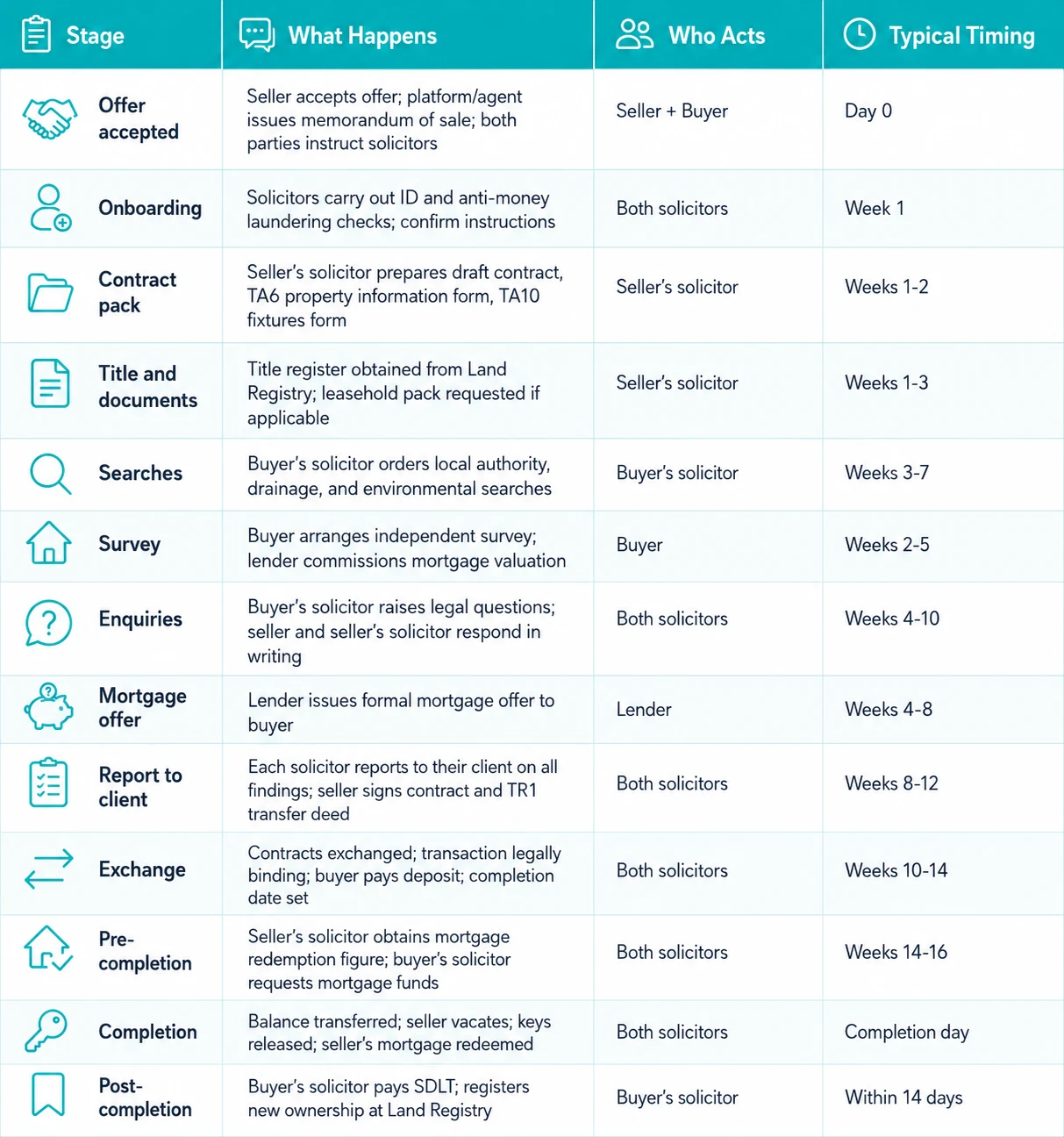
The table below summarises every key stage of the conveyancing process from the seller's perspective, who acts at each stage, and a realistic guide to when each step typically occurs. The sections that follow explain each stage in detail.
Choosing and Instructing Your Conveyancer
The quality and responsiveness of your conveyancer is one of the most significant factors affecting how smoothly your sale progresses. Choosing well before you have an accepted offer means you can move immediately when the time comes.
When to Instruct Your Solicitor
Many sellers wait until after an offer has been accepted before searching for a conveyancer. This is a common mistake that can add one to two weeks to the process unnecessarily. The best practice is to identify and instruct your solicitor as soon as you decide to sell, ideally while your property is still on the market. Your solicitor can begin gathering title documents and preparing paperwork before a buyer is even found, which shortens the period between offer acceptance and exchange.
What to Look for in a Conveyancer
When choosing a conveyancer for your sale, focus on the following:
Regulation by the SRA or CLC, confirming they are legally authorised to practise property law
A clear, fixed fee structure with no hidden extras or percentage-based charges
A named contact who will handle your file, rather than a call centre model
Realistic stated turnaround times and clear communication about how they will keep you updated
Relevant experience with the type of property you are selling, particularly if it is leasehold or has unusual title features
If a referral fee has been paid to a third party for recommending your conveyancer, your solicitor is legally required to disclose this. It does not automatically mean the service is poor, but it is worth being aware of.
Instructing Your Solicitor
Once you have chosen a conveyancer, you will receive a letter of engagement and terms of business setting out their fees and the scope of their work. Review this carefully before signing. You will also be asked to complete identity verification, which is a legal requirement under anti-money laundering regulations. This applies to all sellers regardless of their circumstances and is carried out at the start of every transaction.
If you are selling through YooSell, you can access trusted conveyancing professionals directly through your seller dashboard, removing the need to source a solicitor independently. Find out more on the How It Works page.
Stage One: Offer Accepted and the Memorandum of Sale
When you accept a buyer's offer, the first formal document in the conveyancing process is the memorandum of sale. This is issued by whoever is managing the sale, whether that is an estate agent, a private selling platform, or your solicitor directly.
What the Memorandum of Sale Contains
The memorandum of sale records the agreed purchase price, the full addresses of both parties, and the contact details of both solicitors. It is the formal signal for both legal teams to begin their work. Check it carefully as soon as you receive it. Errors in names, the purchase price, or solicitor details can cause unnecessary delays if they are not corrected promptly.
What Happens in England and Wales at This Point
In England and Wales, an accepted offer is not legally binding. Either party can withdraw from the transaction at any point before exchange of contracts without legal penalty, though this can involve significant practical and financial disruption, including the loss of costs already incurred such as survey and legal fees. This system is different from Scotland, where a binding contract is formed earlier in the process.
Because no commitment exists before exchange, the period between offer acceptance and exchange carries risk for both sides. Working efficiently to progress towards exchange is in everyone's interest.
Stage Two: Onboarding and Identity Checks
Before any legal work can begin on your file, your solicitor must verify your identity and carry out anti-money laundering checks. This is a statutory requirement under the Money Laundering, Terrorist Financing and Transfer of Funds Regulations 2017 and applies to every seller regardless of their circumstances.
What You Will Need to Provide
Your solicitor will ask you to provide:
Valid photographic identification such as a passport or driving licence
Proof of your current address such as a recent utility bill, bank statement, or official letter
Confirmation of how you came to own the property, particularly if it was inherited or gifted
Evidence of any third-party funds that will be involved in the transaction
Some firms carry out these checks digitally using identity verification services, which makes the process faster. Others require original documents by post. Confirm with your solicitor what their process is and respond promptly to avoid delaying the start of your file.
Source of Funds and Beneficial Ownership
If the property is owned jointly or if there are any trust arrangements affecting the title, your solicitor will need to understand the ownership structure fully. This is relevant not only for the legal transfer itself but for calculating how the sale proceeds will be distributed on completion. Any discrepancies between who is named on the title and who has a financial interest in the property need to be resolved before exchange.
Stage Three: Preparing the Contract Pack
The contract pack is the collection of documents your solicitor prepares and sends to the buyer's solicitor. It is the foundation of the entire transaction. The sooner and more thoroughly you provide the information needed to compile it, the faster the process will move.
The Draft Contract
Your solicitor will obtain official copies of the title register and title plan from HM Land Registry. They will use these to draft a contract for sale setting out the purchase price, the property's description, the completion date (to be inserted later), and the standard conditions of sale. The buyer's solicitor reviews this contract and may raise questions or propose amendments.
The TA6 Property Information Form
The TA6 is one of the most important documents in your sale. It is a detailed property information form that you, as the seller, complete and return to your solicitor. It covers:
Boundaries: which boundaries belong to the property and who is responsible for maintaining them
Disputes and complaints: any current or historical disputes with neighbours or third parties
Notices: any planning notices, enforcement notices, or other formal communications about the property
Alterations: any building works carried out during your ownership, including planning permissions and building regulations completion certificates
Guarantees and warranties: any existing guarantees for works such as damp-proofing, timber treatment, double glazing, or roof repairs
Environmental matters: whether the property has ever been affected by flooding, and any awareness of contaminated land
Rights and informal arrangements: any informal access arrangements with neighbours or other parties
Complete the TA6 as fully and accurately as you can. Sellers have a legal duty to disclose known material facts that might affect the buyer's decision. Omissions or inaccuracies can expose you to legal claims after completion if a buyer suffers loss as a result of something you failed to disclose.
The TA10 Fixtures, Fittings and Contents Form
The TA10 records exactly what is included in the sale and what you intend to take with you. This covers fitted items such as kitchen units, bathroom fittings, built-in wardrobes, and light fittings, as well as freestanding items you may choose to leave. Complete this form carefully to avoid disputes after exchange about what was agreed to be included.
Additional Forms for Leasehold Properties
If you are selling a leasehold property, your solicitor will also need a TA7 leasehold information form and a management information pack from the management company or freeholder. The management pack includes details of service charges, ground rent, building insurance, planned maintenance works, and the accounts for the building. Requesting this pack early is important because it can take several weeks to arrive and the buyer's solicitor cannot finalise their enquiries until it has been received.
The Energy Performance Certificate
Every property being sold in England and Wales must have a valid Energy Performance Certificate (EPC). An EPC must be no more than ten years old and must be made available to prospective buyers before a sale can proceed. If your EPC has expired or is about to expire, arrange a new one through an accredited domestic energy assessor before listing.
Stage Four: The Buyer's Searches
Once the contract pack has been received and reviewed, the buyer's solicitor will order a series of property searches. These are enquiries made to various authorities and organisations to reveal any registered legal or environmental issues affecting the property.
What the Searches Cover
The standard set of searches for a residential sale typically includes:
Local authority search: reveals planning history, planning obligations, road adoption, listed building status, conservation area designation, and other matters registered against the property by the local council
Drainage and water search: confirms whether the property is connected to mains water and drainage, and whether any public sewer runs through the land
Environmental search: checks for proximity to contaminated land, flood risk zones, landfill sites, and former industrial activity
Depending on the location of the property, additional searches may be recommended. These can include coal or mining searches in areas with former mineral extraction activity, chancel repair searches for properties near certain churches, and flood risk reports for properties near watercourses.
Your Role During the Search Stage
The searches are ordered and reviewed by the buyer's solicitor. As a seller, your direct involvement is limited at this stage. However, if any search reveals an issue, your solicitor will ask you about it. Common examples include planning permissions that require clarification, boundary queries that arise from the title plan, or notices registered by the local authority that you may not have been aware of.
Responding to any such queries promptly and providing all relevant documentation as quickly as possible is the most effective way to prevent delays at this stage.
Stage Five: Solicitor Enquiries
After reviewing the contract pack and search results, the buyer's solicitor will raise a series of written enquiries. These are formal legal questions seeking clarification or additional information about the property. Responding to enquiries thoroughly and quickly is one of the most important things you can do as a seller to keep the transaction moving.
What Enquiries Cover
Enquiries can cover a very wide range of topics. Common examples include:
Requests for copies of planning permissions and building regulations completion certificates for any works carried out
Questions about the boundaries of the property, particularly if the title plan is unclear
Requests for indemnity insurance where a planning or building regulations issue is identified and retrospective approval is not practicable
Clarification of any rights of way, easements, or restrictive covenants affecting the property
Evidence of compliance with any conditions attached to planning permissions
For leasehold properties, questions about the terms of the lease and the management of the building
How to Respond to Enquiries
Your solicitor will pass enquiries to you where they require information only you can provide. Respond as quickly and completely as you can. If you do not have a document that is being requested, such as a completion certificate for an extension, tell your solicitor immediately so they can advise on whether indemnity insurance or another solution is appropriate.
Prolonged back-and-forth on enquiries is one of the most common reasons conveyancing takes longer than it should. Gathering certificates, guarantees, warranties, and other documents before your sale is even listed, if possible, significantly reduces the time spent at this stage.
Documents Worth Gathering in Advance
Planning permissions and building regulations completion certificates for any extensions, loft conversions, or structural alterations
FENSA or CERTASS certificates for replacement windows and doors
Gas Safe certificates for boiler installations or gas work
NAPIT or NICEIC certificates for electrical work
Damp-proofing, timber treatment, or structural guarantees
New home warranty documentation if the property was built within the last decade
Lease documents, ground rent demands, and service charge statements for leasehold properties
Stage Six: Dealing with Your Existing Mortgage
If you have an outstanding mortgage on the property you are selling, it must be fully redeemed on completion day. Your solicitor will obtain an official mortgage redemption statement from your lender confirming the exact amount required to repay the mortgage in full on a given date, including any accrued interest and administration fees.
Obtaining the Redemption Figure
Your solicitor will request the redemption figure from your mortgage lender as the transaction approaches exchange and completion. The figure is calculated to the anticipated completion date. If completion is delayed, a revised redemption figure may need to be obtained.
Early Repayment Charges
If your mortgage is still within a fixed or tracker rate period, repaying it in full before the end of that period may trigger an early repayment charge. Check the terms of your mortgage before proceeding if this may apply to your situation. Your solicitor can advise on the mechanics of the redemption, but the decision about whether to accept an early repayment charge is a financial one that you will need to make yourself or with independent financial advice.
Porting Your Mortgage
If you are buying a new property at the same time as selling your current one and your mortgage is portable, it may be possible to transfer your existing mortgage product to the new property rather than redeeming it. This is a matter to discuss directly with your mortgage lender and is subject to their criteria. If porting is an option, your solicitor needs to be aware of this as it affects the financial arrangements on completion day.
Stage Seven: Exchange of Contracts
Exchange of contracts is the most significant milestone in the conveyancing process. It is the point at which the transaction becomes legally binding for both buyer and seller. Once contracts are exchanged, neither party can withdraw without serious legal and financial consequences.
What Happens at Exchange
Both solicitors hold signed copies of the contract. On the day of exchange, your solicitor calls the buyer's solicitor and they read the contracts to each other over the telephone. Both solicitors confirm the contracts are identical and that exchange is taking place. The buyer's solicitor transfers the agreed deposit, typically ten percent of the purchase price, to your solicitor's client account. A completion date is set and written into the contracts at this point.
If either party pulls out after exchange, serious consequences follow. If the buyer withdraws, they lose their deposit. If you as the seller withdraw, you can be sued for breach of contract and may face a claim for the buyer's wasted costs as well as damages. This mutual financial commitment is what makes exchange such a decisive moment.
The Gap Between Exchange and Completion
The period between exchange and completion is typically between one and four weeks. It can be longer if the chain has agreed a specific completion date further ahead to align with practical arrangements such as school terms or notice periods on rented accommodation. Once exchange has taken place, both parties can make firm removal and accommodation arrangements with confidence, knowing the date is fixed.
Managing a Chain at Exchange
If your sale is part of a chain, all transactions in the chain must exchange simultaneously. Every buyer and seller, and every solicitor acting for them, must be ready to exchange on the same day. This coordination is handled between solicitors and requires all outstanding issues in every transaction to have been resolved. A delay in any one transaction holds up exchange for everyone in the chain.
Stage Eight: Pre-Completion Preparations
The period between exchange and completion involves several important tasks on both sides of the transaction.
What Your Solicitor Does
Your solicitor will obtain a final mortgage redemption figure from your lender calculated to the actual completion date. They will prepare a completion statement setting out all the financial elements of the transaction: the sale price, your legal fees, the mortgage redemption amount, and any other costs to be deducted from the proceeds. They will send this to you for review before completion.
Your solicitor will also prepare a draft transfer deed, known as a TR1. This is the formal legal document that transfers ownership of the property from your name to the buyer's name. You will be required to sign this before completion.
What You Need to Do
In the run-up to completion, your responsibilities as a seller include:
Signing the transfer deed (TR1) and returning it to your solicitor when asked
Confirming the completion statement is accurate and matches your understanding of the financial arrangements
Arranging the practical aspects of vacating the property, including removals and meter readings
Confirming with your solicitor the arrangements for how the keys will be handed over on completion day
Notifying utility providers, your local council, and other relevant parties of your change of address
Building Insurance
As the seller, your buildings insurance policy should remain in place up to completion. From exchange of contracts, the buyer carries the risk in the property and most buyers arrange insurance from exchange. However, it is standard practice for sellers to maintain their own cover until completion as a precaution in case of any issue on completion day.
Stage Nine: Completion Day
Completion day is when ownership formally transfers from you to the buyer. It is the day you receive the sale proceeds and vacate the property.
What Happens on Completion Day
On the morning of completion, the buyer's solicitor requests the mortgage funds from the lender. Once received, they transfer the balance of the purchase price to your solicitor by electronic bank transfer (CHAPS). This is the full purchase price minus the deposit already paid at exchange.
Once your solicitor confirms receipt of the funds, completion occurs. Your solicitor then:
Releases keys to the buyer or the buyer's representative
Redeems your existing mortgage by transferring the redemption amount to your lender
Transfers the net sale proceeds to you
Sends the title deeds and signed transfer deed to the buyer's solicitor
When to Vacate the Property
Contracts typically require the seller to vacate by a specified time on completion day, usually 1pm or 2pm, so that the buyer can access the property once funds have cleared. Make sure your removal arrangements are planned around this requirement. A delay in vacating can cause practical problems for buyers, removal companies, and any chain below you.
What If Funds Are Delayed
Occasionally, mortgage funds from the buyer's lender arrive late on completion day. This can cause the completion to be delayed by a few hours. While frustrating, this is relatively common and does not mean the sale has failed. Your solicitor will communicate with you throughout the day if there are any timing issues. Most delays resolve the same day.
Stage Ten: Post-Completion
Once you have received the sale proceeds and vacated the property, a small number of legal steps take place in the days following completion.
Land Registry Registration
The buyer's solicitor is responsible for registering the change of ownership at HM Land Registry. This must happen within a specified period following completion. Until registration is complete, the buyer is the legal owner by virtue of the completed transfer deed, but the Land Registry record will not yet show them as the registered proprietor. This is normal and the buyer does not need to take any action.
Stamp Duty Land Tax
The buyer's solicitor submits an SDLT return to HMRC and pays any stamp duty owed within fourteen days of completion. This is the buyer's obligation, not the seller's. As a seller, you have no SDLT liability on a straightforward sale of your main residence.
Keeping Records
Keep copies of all the documents relating to your sale, including the completion statement, the contract, the title register at the point of sale, and any certificates and guarantees you provided during the transaction. These may be needed if any question arises about the sale in the future.
Conveyancing Considerations for Leasehold Sellers
Selling a leasehold property involves additional steps beyond those required for a freehold sale. Buyers and their solicitors will scrutinise the lease and the building management in considerable detail, and the additional paperwork can extend the conveyancing timeline by several weeks if not organised in advance.
The Management Information Pack
As a leasehold seller, you are responsible for providing a management information pack from the freeholder or managing agent. This pack contains the service charge accounts, building insurance documents, details of any planned major works, and other information the buyer's solicitor needs to advise their client on the cost and risks of owning the leasehold.
Management packs can take several weeks to arrive, particularly from larger managing agents or housing associations. Request it as early as possible, ideally as soon as your property goes on the market.
Lease Length
If the remaining lease on your property has fewer than eighty years left, buyers may have difficulty obtaining a mortgage and may require you to extend the lease before they can proceed or as a condition of the sale. If the lease has fewer than seventy years remaining, the challenges are more pronounced. Speak to your solicitor at an early stage if your lease is approaching these thresholds.
Notices and Consents
Leases often contain provisions requiring the leaseholder to notify the freeholder of a sale and in some cases to obtain their consent. Your solicitor will check the terms of your lease and arrange for any required notices to be served and consents obtained. Failing to comply with these provisions can delay exchange and completion.
What Causes Delays in Conveyancing and How to Avoid Them
Understanding the most common sources of delay in conveyancing allows you to take practical steps to minimise their impact on your sale.
Slow Responses to Solicitor Requests
The single most controllable cause of delay is the time it takes parties to respond to their solicitor's requests. Every time your solicitor asks you for a document, a signature, or an instruction and you delay responding, the whole transaction pauses. Treat all solicitor requests as urgent and respond the same day wherever possible.
Missing Documents
Planning permissions, building regulations completion certificates, FENSA certificates, electrical installation certificates, and similar documents are frequently requested during enquiries. Sellers who cannot locate them add weeks to the process while alternatives are sought. Gather all relevant certificates and guarantees before your property is listed and give them to your solicitor at the outset.
Leasehold Complications
Managing information packs that arrive late, short leases, unresolved service charge disputes, and complex lease terms all extend leasehold conveyancing. Ordering the management pack early and checking the lease length well in advance of a sale are the most effective preventive measures.
Survey Issues
If the buyer's survey reveals problems with the property, a period of renegotiation may follow. The seller may be asked to reduce the price, carry out remedial work, or provide indemnity insurance. Having the property in good order and being ready to deal with any issues that arise pragmatically reduces the risk of a sale collapsing at this stage.
Chain Complications
A sale that is part of a long chain is vulnerable to delays caused by other transactions in the chain. As a seller, you have limited direct control over other parties in the chain, but moving your own transaction as quickly as possible towards exchange reduces the time window in which the chain can break.
Selling Your Home with YooSell
If you are selling your home in Leicestershire or the Midlands, YooSell gives you the tools and support to manage your sale directly, with access to trusted conveyancing professionals through your dashboard when you need them.
Why Sellers Choose YooSell
YooSell is a self-service home-selling platform that lets you list, manage, and complete your sale without paying traditional estate agent commission. You set your price, manage viewings through a built-in booking calendar, and communicate directly with verified buyers through the platform. There is no percentage commission taken at completion, only a fixed monthly listing fee.
Find out how the process works on the How It Works page or explore plan options on the Pricing page.
Integrated Conveyancing Support
Once you accept an offer on YooSell, you can access trusted conveyancers directly through your seller dashboard. This means you do not need to search for a solicitor independently, the platform connects you with regulated professionals who can manage the legal process from offer acceptance to completion.
Verified Buyers for a More Certain Sale
Every buyer on YooSell completes identity and financial verification before they can make an offer. This means you are only dealing with buyers whose finances have been confirmed, reducing the risk of a sale collapsing because a buyer was unable to proceed financially.
List on Rightmove Through YooSell
You can list your property directly on Rightmove through YooSell, giving your home visibility on the UK's largest property portal and helping you attract more qualified buyers. Visit the YooSell Rightmove page for full details on how it works.
Free Tools to Plan Your Sale
YooSell provides free calculators to support every aspect of your move. The Valuation Calculator helps you price your property accurately. The Cost Saving Calculator shows how much you save compared to a traditional agent. The Stamp Duty Calculator works out the buyer's SDLT liability, and the Mortgage Calculator helps you plan your onward purchase.
Frequently Asked Questions
Read Our Blog
Tips, insights and expert advice to help you sell smarter.

Slough House Prices & Property Market Analysis 2026
Slough house prices averaged £334,000 in May 2026 according to ONS data, down modestly from £348,000 a year earlier. The market has softened in the short term, with flat prices falling 7.8% and transaction volumes down significantly. Average monthly rents, however, have risen to £1,572, strengthening the case for buying over renting. The Elizabeth Line puts Slough to Paddington in around 15 minutes, keeping buyer demand structurally strong. For buyers with a medium-term horizon, Slough remains one of the better-value commuter markets in the South East.

Nottingham House Prices 2026: What Buyers Should Know
Nottingham house prices in 2026 are holding steady, with the ONS recording an average of £192,000 in the city area as of June 2026. First-time buyers are paying around £177,000 on average, making Nottingham one of the more accessible cities in the East Midlands. Prices have risen 18.2% over the past five years, despite a brief flat period in 2025 and early 2026. Average monthly rents have reached £1,011, strengthening the financial case for buying over renting. West Bridgford commands the highest prices while areas like Sherwood and Bulwell offer strong value for budget-conscious buyers.
Why YooSell Is the Best Platform in the UK to List Property on Rightmove
You can list your property on Rightmove without an estate agent by using a Rightmove-registered listing platform such as YooSell. Private individuals cannot list directly on Rightmove, but portal-approved services can. YooSell includes Rightmove listing on all three plans from £29 per month, with the first month free, zero commission at completion, and ID-verified buyers as standard. Rightmove receives approximately 52.9 million monthly visits and accounts for around 70% of all time UK buyers spend on property portals, making it the most important portal for any UK seller in 2026.
Start Selling Your Home Today!
Take control of your sale with YooSell. Get started today and explore how we can help you sell smarter, faster, and with less hassle.