Property Chains Explained: How They Affect Your House Sale
Most UK house sales involve a property chain, where your completion depends on other buyers and sellers completing their own transactions. Understanding how chains work, what causes them to stall or collapse, and what practical steps you can take to protect your own sale is essential preparation for any homeowner looking to move in 2026.

George K.
George specialises in local area insights across Leicestershire and the wider Midlands. He highlights schools, transport, and neighbourhood character for relocating buyers.
You accept an offer. Your buyer seems solid. You start planning the move. Then nothing happens for six weeks because someone three transactions away cannot get their mortgage sorted.
This is the reality of selling in a property chain. For most homeowners in England and Wales, selling involves being linked to other buyers and sellers whose circumstances, finances, and decisions directly affect whether and when your own sale completes. It is one of the most distinctive and often frustrating features of the UK property market.
Understanding what a property chain is, how it works, what causes it to stall or collapse, and what practical steps you can take to protect your sale puts you in a far stronger position than sellers who simply hope for the best and wait.
This guide explains everything you need to know about property chains in plain English, with practical advice tailored to sellers at every stage of the process.
Before you list, use the free Cost Saving Calculator on YooSell to understand your full financial picture and how selling without a traditional agent's commission affects your net proceeds.
What a Property Chain Is?
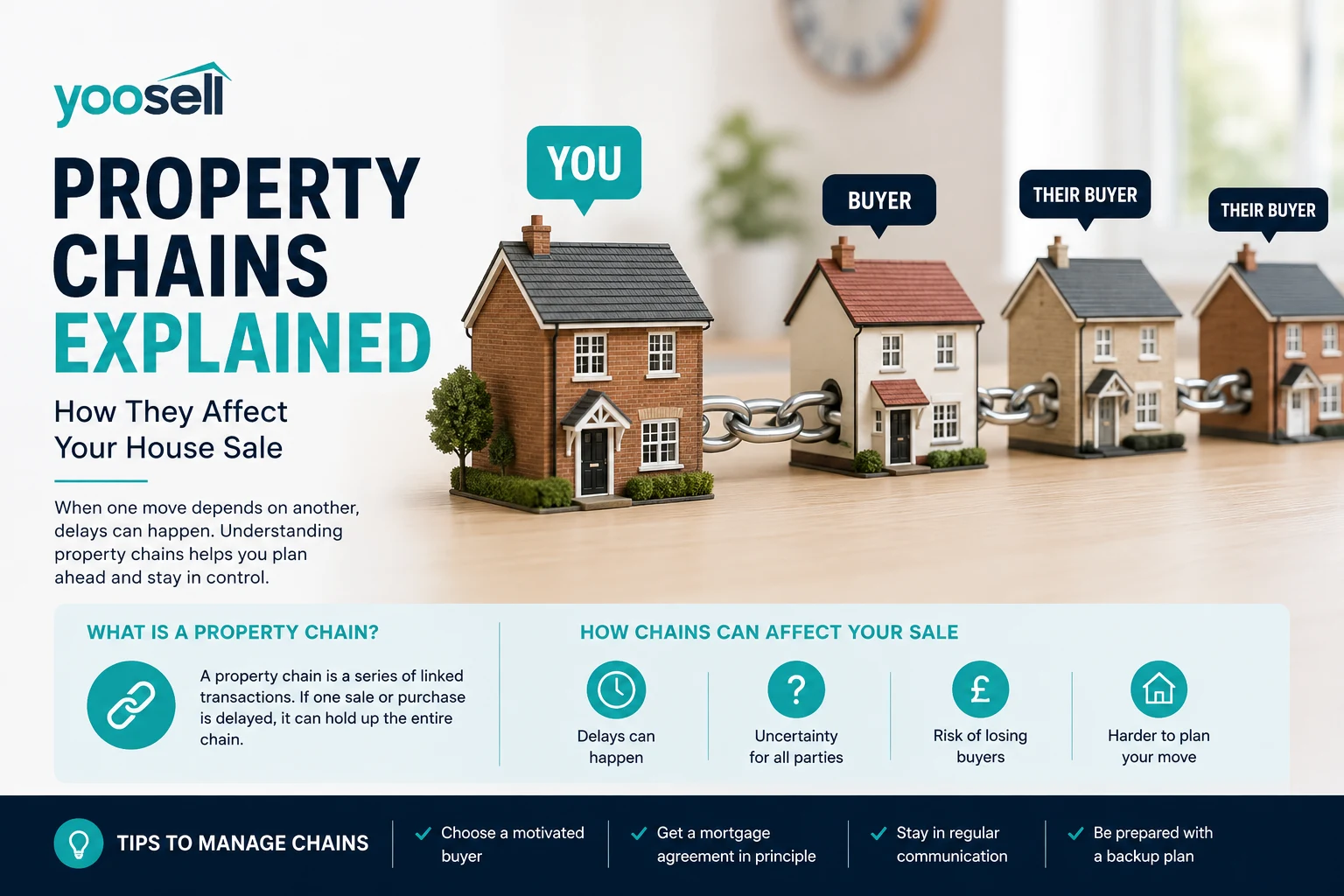
A property chain is a sequence of linked property transactions in which each sale depends on another sale completing. Most homeowners need to sell their current property before they can afford to buy their next one. When their buyer is also selling, and that buyer's buyer is also selling, a chain forms.
A Simple Example of How a Chain Works
Consider four households:
Household A is a first-time buyer purchasing a flat from Household B
Household B is selling their flat to buy a house from Household C
Household C is selling their house to buy a larger home from Household D
Household D is downsizing to an empty property and has nowhere to sell to
In this example, the chain has four links. Household A is at the bottom of the chain and Household D is at the top. For the chain to complete, all four transactions must exchange and complete on the same day. If any one of the four transactions fails or stalls, every other transaction in the chain is affected.
Where Chains Begin and End
Every property chain starts with a buyer who is not selling a property: typically a first-time buyer, a cash buyer with no property to sell, or someone who has already sold and is renting. This is the beginning of the chain.
Every chain ends with a seller who is not buying a property: typically someone moving into rented accommodation, moving abroad, downsizing to a property they have already purchased, or a developer or landlord selling an empty property.
Properties at the end of the chain, where the seller has nothing to buy, are described as chain-free. Buyers and sellers at either end of a chain carry fewer dependencies than those in the middle, but they are still affected if a problem arises elsewhere in the chain.
How Common Are Property Chains in the UK?
Property chains are not the exception in England and Wales. They are the norm. The majority of residential property transactions involve at least one linked sale and purchase.
The Average Chain Length
Most property chains in the UK involve three to four transactions, though chains of five or six are common and chains of seven or more are not unheard of in active markets. Shorter chains complete faster and with less risk. Longer chains introduce more potential points of failure and more parties whose behaviour is outside your control.
The Fall-Through Rate
Property chain collapses are a significant and measurable problem in the UK market. According to industry data, approximately one in four property sales in the UK falls through before completing. Fall-through rates have risen over recent years: data from 2024 showed approximately 29.8 percent of agreed sales collapsing before exchange, compared to 16 percent in 2022.
Research into 2025 transactions identified the most common causes of fall-throughs:
Buyers changing their minds accounted for around 36 percent of collapses
Mortgage issues, including down-valuations and withdrawn offers, accounted for around 33 percent
Survey problems, where buyers walked away or renegotiated after a bad result, accounted for around 18 percent
Each of these causes can arise at any point in the chain, not just at your end of it.
The Time It Takes
The average time to exchange contracts in the UK reached 4.1 months in 2025, up from 3.0 months in 2019. The full journey from listing to completion averages around 179 days. The UK is consistently identified as having one of the slowest property transaction processes in the world. Property chains are a significant contributing factor because each additional link adds a potential source of delay.
How a Property Chain Affects Your Sale as a Seller
Being in a chain means your sale is partially outside your control. Understanding specifically how the chain affects your position helps you anticipate problems and respond to them effectively.
Your Completion Date Is Not Yours to Set Alone
In a chain, the completion date must work for every transaction simultaneously. This means you cannot simply set the date that suits you best. If your buyer needs more time to complete the sale of their own property, your completion date moves accordingly. If the seller you are buying from needs time to find somewhere to move to, your date moves again. Agreeing a completion date in a chain is a negotiation between multiple parties, and the outcome reflects the constraints of the weakest or slowest link.
Speed Is Determined by the Slowest Party
A chain moves at the speed of its slowest member. If one solicitor in the chain is slow to respond to enquiries, one party's local authority search is delayed, or one buyer is waiting for a mortgage offer that keeps getting pushed back, the whole chain waits. It does not matter how quickly you or your solicitor act if someone else in the chain is creating a bottleneck.
Legal Commitment Arrives Late
In England and Wales, no one in a property chain is legally committed to anything until exchange of contracts. Up until that point, any party can withdraw without legal consequences, though they will lose any costs already spent on surveys, searches, and legal fees. In a chain, this means your sale remains vulnerable to collapse not just at your own end but at any point in the chain, for the entire period between offer acceptance and exchange.
Simultaneous Exchange Is Required
For all transactions in a chain to be legally binding, all contracts must be exchanged simultaneously on the same day. This is called simultaneous exchange. It requires every solicitor in every transaction to have resolved all outstanding legal issues and be ready to exchange on the same day. Coordinating this across four, five, or six firms is one of the most complex logistical challenges in a chain, and it is a common cause of last-minute delays even when everything appeared to be ready.
Types of Property Chain Positions
Your position within the chain has a direct bearing on your exposure to risk and your ability to influence the pace of the transaction.
Chain-Free Sellers
If you are selling a property with no onward purchase, because you are moving into rented accommodation, emigrating, or moving in with someone else, you are chain-free at your end of the transaction. Chain-free sellers are popular with buyers and agents because they remove one source of dependency. However, you are still subject to whatever chain exists below you on the buying side.
Chain-Free Buyers
A buyer who is a first-time buyer, a cash buyer, or someone who has already sold and is renting is chain-free at their end. For sellers, accepting an offer from a chain-free buyer significantly reduces the risk that a problem in the buyer's situation will delay your sale. It does not eliminate chain risk if you are also buying a property.
Middle of the Chain
Most homeowners find themselves in the middle of a chain: selling to one party and buying from another. This is the position of greatest exposure because you are dependent on everyone both above and below you. Delays or collapses at either end affect your transaction.
Top of the Chain
The top of the chain is the seller who is not buying anything onward. This position carries the least dependency risk but the greatest responsibility for setting a realistic timeline, since a seller who moves slowly on their end without an onward purchase creates unnecessary delays for everyone below them.
The Most Common Causes of Chain Delays and Collapses
Understanding what most commonly goes wrong in a property chain helps you anticipate risks and take practical steps to reduce your exposure.
Mortgage Problems
Mortgage issues are one of the leading causes of chain collapse. A buyer whose mortgage application is declined, whose offer is withdrawn by the lender, or whose property is down-valued by the lender's surveyor may have to renegotiate or withdraw entirely. In a chain, a mortgage problem at any link affects every other transaction.
Down-valuations are particularly disruptive. When a lender's surveyor values a property below the agreed purchase price, the lender will only lend against the surveyor's figure. The buyer must either fund the gap themselves, negotiate a reduced price with the seller, or withdraw. Any of these outcomes creates disruption for the chain.
Survey Issues
A survey that reveals significant structural problems, dampness, or other defects can lead a buyer to withdraw or to seek a significant price reduction. If the seller does not agree to the reduction and the buyer withdraws, the chain collapses at that point. Survey problems that were not known before listing are easier to handle when sellers have prepared their property and gathered relevant certificates in advance.
Solicitor Delays
Slow conveyancing is one of the most frustrating and common causes of chain delays. Solicitors who are managing high volumes of work, who fail to respond to enquiries promptly, or who do not proactively chase progress create bottlenecks that slow the entire chain. One slow firm in a five-link chain can add weeks to the transaction for every other party.
Local Authority Search Delays
Local authority searches are a mandatory part of the conveyancing process and their turnaround time varies enormously by council. Some councils return results in 48 hours. Others take five to six weeks or longer. A slow search in any transaction in the chain delays exchange for everyone.
A Party Changing Their Mind
A buyer or seller who decides to withdraw from the transaction for personal reasons, whether because they have found a different property, had a change of circumstances, or simply changed their mind, causes a chain to collapse at that point. There is no legal remedy available before exchange of contracts in England and Wales. This remains one of the most significant weaknesses of the current system.
Chains That Are Too Long
Longer chains are statistically more likely to experience a problem than shorter ones. Each additional link introduces another party whose mortgage, solicitor, survey, and motivation can fail. A chain of seven transactions has seven times the failure opportunities of a chain-free single sale.
How to Protect Your Sale in a Property Chain
While no seller can fully eliminate chain risk, there are practical steps that meaningfully reduce your exposure and keep your transaction moving as efficiently as possible.
Instruct Your Solicitor Before You Accept an Offer
Instructing a qualified conveyancer before you list your property, or at the very latest as soon as you accept an offer, gives your solicitor the maximum time to prepare the contract pack and gather your documents. A seller whose solicitor is ready and active from day one contributes to chain momentum rather than creating delay at the outset.
Use YooSell to access trusted conveyancers directly from your seller dashboard as soon as an offer is accepted, without needing to find one independently.
Prepare Your Documents in Advance
Solicitor enquiries are one of the most common sources of delay within individual transactions. Many enquiries ask for documents such as planning permissions, building regulations certificates, FENSA certificates, or Gas Safe records that sellers cannot locate quickly. Gathering these documents before listing means your solicitor can respond to enquiries within days rather than weeks.
The YooSell property guides cover every document you are likely to need and when to provide it.
Choose a Buyer Whose Chain Position Is Strong
When you receive offers, assess the buyer's chain position as carefully as their offered price. A slightly lower offer from a chain-free buyer or a buyer with a short, simple chain may represent a better outcome than a higher offer from a buyer at the bottom of a long or uncertain chain. The risk of losing several weeks or months to chain complications, or of the whole transaction collapsing, must be weighed against any price difference.
Every buyer on YooSell completes identity and financial verification before making an offer. This means you know from the outset that the buyer is financially qualified, which removes one of the most common sources of chain collapse.
Set Realistic Timeline Expectations
One of the most productive things you can do in a chain is to communicate realistic timeline expectations to all parties from the start. If your solicitor is aware that other parties in the chain have slow local authority searches, a pending survey, or an outstanding mortgage application, they can calibrate their own work accordingly and avoid creating false urgency that leads to disappointment.
Stay Responsive Throughout the Process
Your responsiveness is the single biggest factor within your control. Every time your solicitor asks you for information, a document, or a decision, respond the same day if possible. Every day you leave a request unanswered is a day added to the overall timeline for every party in the chain.
Push for Exchange as Quickly as Possible
The period between offer acceptance and exchange is the riskiest period in the entire chain. During this time, any party can withdraw without legal consequence. The best protection against a chain collapse is to reach exchange as quickly as possible, which requires everyone to work efficiently and to flag problems early rather than letting them fester.
What to Do If Your Chain Is Stalling
Even when you do everything right, chains stall. Knowing what to do when progress slows reduces the risk of a stall becoming a collapse.
Identify Where the Delay Is Coming From
The first step is to establish where in the chain the delay is originating. Ask your solicitor to find out from the other solicitors in the chain which transaction is behind and why. This information is not always forthcoming, but asking directly is more productive than waiting.
Apply Appropriate Pressure
Once you know where the delay is, targeted pressure can be applied. This might mean your solicitor chasing the relevant firm directly, or it might mean agreeing with other parties in the chain to set a fixed exchange deadline that creates urgency without being unreasonable.
Consider Bridge Finance for Flexibility
In some cases, a seller who is also buying can break a deadlock by using bridging finance to proceed with their onward purchase before their current sale completes. This removes the dependency between the sale and the purchase and can allow both to proceed independently. Bridging finance carries costs and risks and should only be considered with independent financial advice.
Be Prepared to Re-Market if Necessary
If a buyer withdraws and the chain collapses below you, re-marketing your property as quickly as possible is the most effective response. The longer your property sits unlisted following a collapsed sale, the more buyers may assume there is a problem with it. If you are already listed on Rightmove through YooSell, relisting after a collapse is straightforward.
Visit the YooSell Rightmove page to see how the Rightmove listing works and what is included in each plan.
Chain-Free Sales: What They Are and When They Are Possible
A chain-free sale is one in which there is no dependency on another transaction at one or both ends. They are faster, lower-risk, and generally more attractive to all parties.
When a Sale Is Genuinely Chain-Free
For a sale to be chain-free at the seller's end, the seller must have no onward purchase linked to the sale. This is the case when:
The seller is moving into rented accommodation temporarily while searching for their next property
The seller is relocating abroad
The seller is moving in with a partner or family member
The seller has already completed their onward purchase separately
For a sale to be chain-free at the buyer's end, the buyer must have no property of their own to sell. This is the case for first-time buyers, cash buyers with no linked sale, and buyers who have already sold and are purchasing from a chain-free position.
The Benefits of a Shorter or Chain-Free Transaction
A chain-free sale between a seller with no onward purchase and a first-time buyer or cash buyer is the simplest and fastest type of residential transaction. With no chain dependencies, the conveyancing can complete in as few as eight to ten weeks from offer acceptance in straightforward cases. This compares favourably to the 4.1-month average that includes chain-affected transactions.
Is a Chain-Free Sale Always Better?
Not necessarily. A chain-free buyer may offer less than a buyer in a chain who is willing to pay more. Whether to accept a lower offer in exchange for chain-free certainty depends on your financial position, your timeline, and your appetite for risk. Use the free Valuation Calculator on YooSell to establish your property's current market value before weighing offers against chain position.
Property Chains and the Government's Reform Proposals
The property chain system in England and Wales has long been criticised for its inefficiency and fragility. In 2026, the government has published reform proposals that, if implemented, would change how the system works.
The Government's Proposals
The government's consultation on home buying and selling reform, with a full roadmap expected in 2026, includes proposals to require sellers and estate agents to provide comprehensive property information upfront at the time of listing. This would include title information, seller ID verification, planning consents, EPC ratings, and other material information that currently only surfaces during the conveyancing process.
The intention is to front-load the information gathering that currently happens during the conveyancing period, reducing the time needed between offer acceptance and exchange and making the process less vulnerable to late-stage collapses triggered by information that should have been available earlier.
Project 28 and the 28-Day Exchange Target
An industry coalition known as Project 28 has set a target of reducing the average time to exchange to 28 days from offer acceptance for straightforward transactions. The National Property Transaction Network trials showed that digital sale-ready packs reduced exchange times by around 35 percent in participating transactions. These initiatives are relevant for sellers because they signal the direction of change and the benefit of being prepared with complete documentation from the outset.
What This Means for Sellers Today
The reform proposals reinforce a principle that experienced sellers and agents have always known: providing complete, accurate information as early as possible in the process is the single most effective way to reduce chain delays. Sellers who gather their documents, complete their TA6 accurately, and instruct their solicitor early are already aligned with the direction the system is moving in.
Selling Your Home with YooSell
YooSell is a self-service home-selling platform for homeowners in Leicestershire and the Midlands that gives you full control of your sale from listing to completion, without paying traditional estate agent commission.
Why Sellers Choose YooSell
YooSell lets you list, manage, and complete your sale directly. You set your asking price, manage viewings through a built-in booking diary, receive offers from verified buyers, and access trusted conveyancing professionals directly from your seller dashboard. There is no percentage commission taken at completion.
See all plan options on the Pricing page.
Verified Buyers Reduce Chain Risk
Every buyer on YooSell completes identity and financial verification before they can make an offer. This addresses one of the most common causes of chain collapse: a buyer whose financial position was not confirmed before their offer was accepted. When you accept an offer on YooSell, you know the buyer has already been verified, which gives your chain a more solid foundation from day one.
Integrated Conveyancing for Faster Progress
Once an offer is accepted on YooSell, you can access trusted conveyancers directly from your seller dashboard. Having a conveyancer in place immediately after offer acceptance means the conveyancing clock starts sooner, your solicitor can begin gathering documents and preparing the contract pack without delay, and you are contributing to chain momentum rather than creating a bottleneck.
Free Tools to Support Your Sale
Stamp Duty Calculator: understand the buyer's SDLT liability at the April 2025 rates before you accept an offer
Mortgage Calculator: plan your onward purchase costs alongside your sale
Find a Home: browse verified listings across Leicestershire and the Midlands
Frequently Asked Questions
Read Our Blog
Tips, insights and expert advice to help you sell smarter.
Slough House Prices & Property Market Analysis 2026
Slough house prices averaged £334,000 in May 2026 according to ONS data, down modestly from £348,000 a year earlier. The market has softened in the short term, with flat prices falling 7.8% and transaction volumes down significantly. Average monthly rents, however, have risen to £1,572, strengthening the case for buying over renting. The Elizabeth Line puts Slough to Paddington in around 15 minutes, keeping buyer demand structurally strong. For buyers with a medium-term horizon, Slough remains one of the better-value commuter markets in the South East.

Nottingham House Prices 2026: What Buyers Should Know
Nottingham house prices in 2026 are holding steady, with the ONS recording an average of £192,000 in the city area as of June 2026. First-time buyers are paying around £177,000 on average, making Nottingham one of the more accessible cities in the East Midlands. Prices have risen 18.2% over the past five years, despite a brief flat period in 2025 and early 2026. Average monthly rents have reached £1,011, strengthening the financial case for buying over renting. West Bridgford commands the highest prices while areas like Sherwood and Bulwell offer strong value for budget-conscious buyers.
Why YooSell Is the Best Platform in the UK to List Property on Rightmove
You can list your property on Rightmove without an estate agent by using a Rightmove-registered listing platform such as YooSell. Private individuals cannot list directly on Rightmove, but portal-approved services can. YooSell includes Rightmove listing on all three plans from £29 per month, with the first month free, zero commission at completion, and ID-verified buyers as standard. Rightmove receives approximately 52.9 million monthly visits and accounts for around 70% of all time UK buyers spend on property portals, making it the most important portal for any UK seller in 2026.
Start Selling Your Home Today!
Take control of your sale with YooSell. Get started today and explore how we can help you sell smarter, faster, and with less hassle.