
Leasehold vs Freehold: A Complete UK Seller's Guide for 2026
Whether you are selling a freehold house or a leasehold flat, understanding your tenure makes a significant difference to how smoothly your sale progresses. This complete guide explains the difference between leasehold and freehold in plain English, covers the key changes introduced by the Leasehold and Freehold Reform Act 2024, and gives sellers a practical checklist for navigating every stage of the process in 2026.

George K.
George specialises in local area insights across Leicestershire and the wider Midlands. He highlights schools, transport, and neighbourhood character for relocating buyers.
Introduction: Why Leasehold vs Freehold Matters More Than Most Sellers Realise
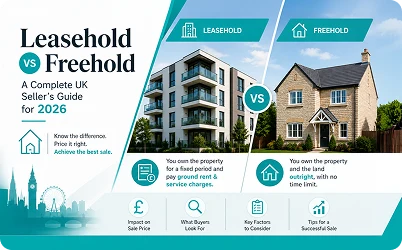
When you list your home for sale, the tenure of your property shapes almost everything that follows. It affects how long your conveyancing takes, what documents your solicitor needs, how many buyers can actually mortgage the property, and how smoothly the sale progresses from offer to completion. Freehold and leasehold are the two most common forms of property ownership in England and Wales, and the difference between them is not merely technical. For sellers in 2026, understanding your tenure and its implications gives you a significant advantage. You can prepare the right paperwork in advance, anticipate the questions your buyer will ask, set a realistic asking price, and avoid the delays that catch so many leasehold sellers off guard.
This guide explains exactly what freehold and leasehold mean, how the sale process differs for each, what the Leasehold and Freehold Reform Act 2024 means for sellers today, and how to handle the most common challenges that arise when selling a leasehold property in 2026.
What Freehold Ownership Means
Freehold means you own the property and the land it stands on outright, with no time limit. There is no landlord above you in the ownership chain, no lease counting down, no ground rent, and no service charge payable to a third party. Your ownership is absolute, subject only to planning law, building regulations, and any restrictive covenants registered on the title.
The vast majority of houses in England and Wales are sold freehold. If you own a freehold house, you are responsible for all maintenance and repair of the building, including the roof, external walls, and boundaries, but you control how and when that work is done. You do not need anyone's permission to carry out repairs, and you do not pay anyone for the privilege of owning the land.
Freehold and Estate Charges
One development worth understanding for sellers in 2026 is the growth of privately managed new-build estates. Many freehold houses on modern developments are subject to estate management charges payable to a private management company for the upkeep of shared roads, landscaping, and communal areas that have not been adopted by the local authority.
These charges are disclosed in the title and conveyancing documents and are increasingly common on new-build and recently built freehold properties. If your freehold property has such a charge, your buyer's solicitor will ask about it and you should be prepared to provide details of the management company, the annual charge, and any recent accounts.
Restrictive Covenants on Freehold Properties
A freehold title may carry restrictive covenants registered at HM Land Registry. These are legally binding obligations on the use of the land, such as restrictions on business use, limitations on building additional structures, or obligations to maintain certain features. They run with the land, meaning they bind future owners.
Your solicitor will review the title register and raise any covenants with the buyer's solicitor as part of the conveyancing process. Where a covenant appears to have been breached, indemnity insurance may be needed. Identifying any such issues before listing reduces the risk of them causing delays once a sale is agreed.
What Leasehold Ownership Means
Leasehold means you own the right to occupy the property for the duration of a lease granted by the freeholder. The lease has a fixed term, which was set at a particular length when originally granted and counts down from that date regardless of how many times the property has changed hands.
Almost all flats in England and Wales are sold leasehold. The legal reason is that English property law does not handle shared ownership of a single building well. The leasehold structure provides a framework in which the freeholder owns the land and building shell while leaseholders own individual units within it, with the freeholder or a managing agent responsible for maintaining shared areas and the building fabric.
According to data from HM Land Registry, approximately 4.98 million homes in England are leasehold, representing around 20% of all housing stock. London has the highest concentration, with around 36% of properties held as leasehold. The North West follows at approximately 27%, with other regions ranging between around 8% and 16%.
What a Lease Actually Contains
A lease is a legally binding document between you, as the leaseholder, and the freeholder. It sets out:
The length of the lease from the date it was originally granted
The ground rent payable and any provisions for review or increase
The service charge arrangements and what they cover
Your obligations regarding repair, decoration, and use of the property
The freeholder's obligations regarding the building and communal areas
Any restrictions on alterations, subletting, or keeping pets
The conditions under which the freeholder could take action against you for breach
Leases vary considerably. A well-drafted modern lease with a long remaining term and a well-managed building is a perfectly sound basis for a sale. A lease with onerous terms, a short remaining term, or a history of service charge disputes presents material challenges when selling.
Ground Rent: What Changed in 2022 and 2024
Ground rent has been one of the most controversial aspects of leasehold ownership in England and Wales. Some older leases contained provisions for ground rent to double periodically, creating a financial burden for leaseholders and making the property difficult to mortgage or sell.
The Leasehold Reform (Ground Rent) Act 2022 banned ground rent on new regulated residential leases granted after 30 June 2022, capping it at a peppercorn, which means effectively zero. The Leasehold and Freehold Reform Act 2024 strengthened protections further. Any statutory lease extension carried out under the 1993 Act now also results in a peppercorn ground rent.
If your lease was granted before 30 June 2022, your ground rent may still be payable under the original terms. If your lease contains a doubling ground rent clause, this is a known concern for buyers and their mortgage lenders and is worth discussing with your solicitor before you list.
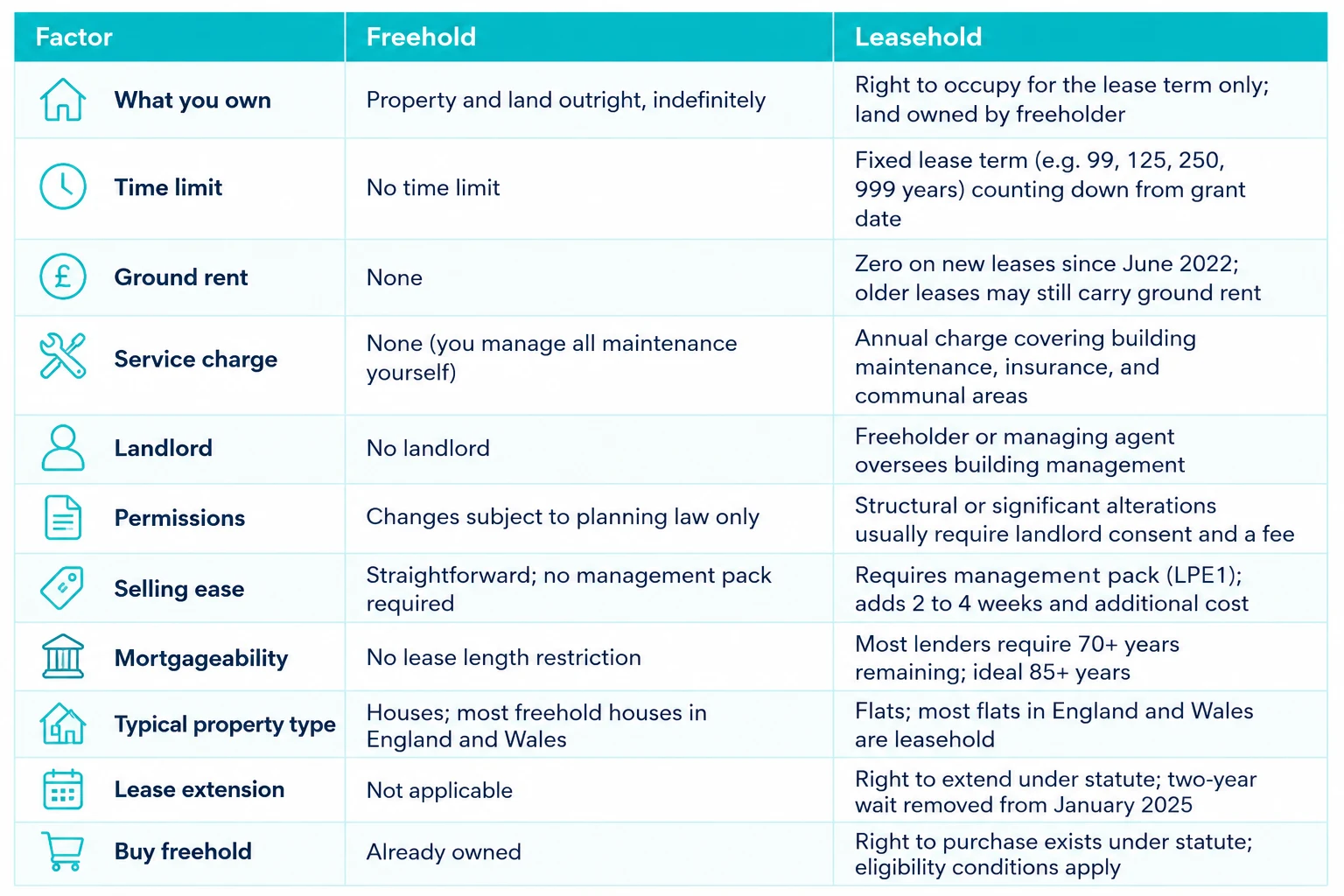
Freehold vs Leasehold: Side-by-Side Comparison
The table below compares the two most common forms of property ownership across the key factors that matter most for sellers and buyers in England and Wales in 2026.
Share of Freehold and Commonhold Explained
Beyond standard freehold and leasehold, two other ownership structures are relevant for sellers in 2026.
Share of Freehold
Share of freehold describes a situation where the leaseholders of flats in a building have collectively purchased the freehold and own it jointly, usually through a company they control. Each flat owner holds both a leasehold interest in their individual unit and a share of the company that owns the freehold of the building.
This structure gives flat owners collective control over the building, removes the external landlord, and allows them to extend their own leases to lengthy terms at low cost. For buyers, a flat with share of freehold is generally considered more desirable than a standard leasehold flat because the ownership structure removes many of the risks associated with an external freeholder.
When selling a flat with share of freehold, your solicitor will need to deal with both the leasehold conveyancing for the flat and the transfer of your share in the freehold company. This adds a small amount of additional complexity but is well understood by experienced conveyancers.
Commonhold
Commonhold is a third form of ownership that was introduced in England and Wales in 2002 but has been very rarely used in practice. Under commonhold, the owners of individual units in a building own their units freehold, with shared areas owned and managed collectively by a commonhold association that all unit owners belong to.
The government published a Commonhold White Paper in March 2025 and has stated its intention to make commonhold the default tenure for new flats in England and Wales over time. As of 2026, the vast majority of flats remain leasehold and commonhold is still rarely encountered in practice. If you own a commonhold property, your solicitor will advise on the specific conveyancing requirements.
The Leasehold and Freehold Reform Act 2024: What Sellers Need to Know
The Leasehold and Freehold Reform Act 2024 is the most significant reform of leasehold law in a generation. It was passed before the 2024 general election and has been implemented in stages, with provisions coming into force throughout 2025. Understanding the changes that are now in effect is important for any seller of a leasehold property in 2026.
Removal of the Two-Year Qualifying Period
Before 31 January 2025, leaseholders had to own their property for at least two years before they could formally exercise the right to extend their lease or purchase their freehold. This restriction has been removed. Leaseholders can now exercise these rights immediately upon acquiring the property.
For sellers, this matters because buyers of leasehold properties no longer face a waiting period before they can take action on a short or ageing lease. This may make your property more attractive to buyers who might previously have been deterred by a lease that needed extending.
Removal of Marriage Value in Lease Extension Calculations
The concept of marriage value previously added significant cost to lease extensions where the remaining term had fallen below eighty years. The Leasehold and Freehold Reform Act 2024 removed marriage value from the statutory calculation for lease extensions. This means that extending a lease with fewer than eighty years remaining is now substantially cheaper than it was before 2024.
For sellers with a lease in the seventy to eighty year range, this change is meaningful. The cost a buyer faces in extending the lease after purchase is lower than it would have been prior to the reforms, which may support your asking price and widen your pool of viable buyers.
Enhanced Right to Manage
The Right to Manage allows leaseholders in a building to take over management of the building from the freeholder without needing to purchase the freehold. From March 2025, the qualifying criteria were expanded. More mixed-use buildings now qualify, and the previous requirement that leaseholders hold a participation threshold has been relaxed in some respects.
If the building your flat is in has a Right to Manage company in place, this is worth disclosing clearly to buyers as it demonstrates that leaseholders have a degree of control over building management, which many buyers regard positively.
Service Charge Transparency
The 2024 Act introduced new requirements for freeholders and managing agents to publish service charge accounts in a standardised format. While the secondary legislation setting out the full detail is still being implemented, the direction of travel is towards greater transparency and leaseholder accountability over service charge spending.
As a seller, being able to provide several years of service charge accounts in a clear and organised format demonstrates good faith to buyers and their solicitors and reduces the risk of enquiries becoming protracted.
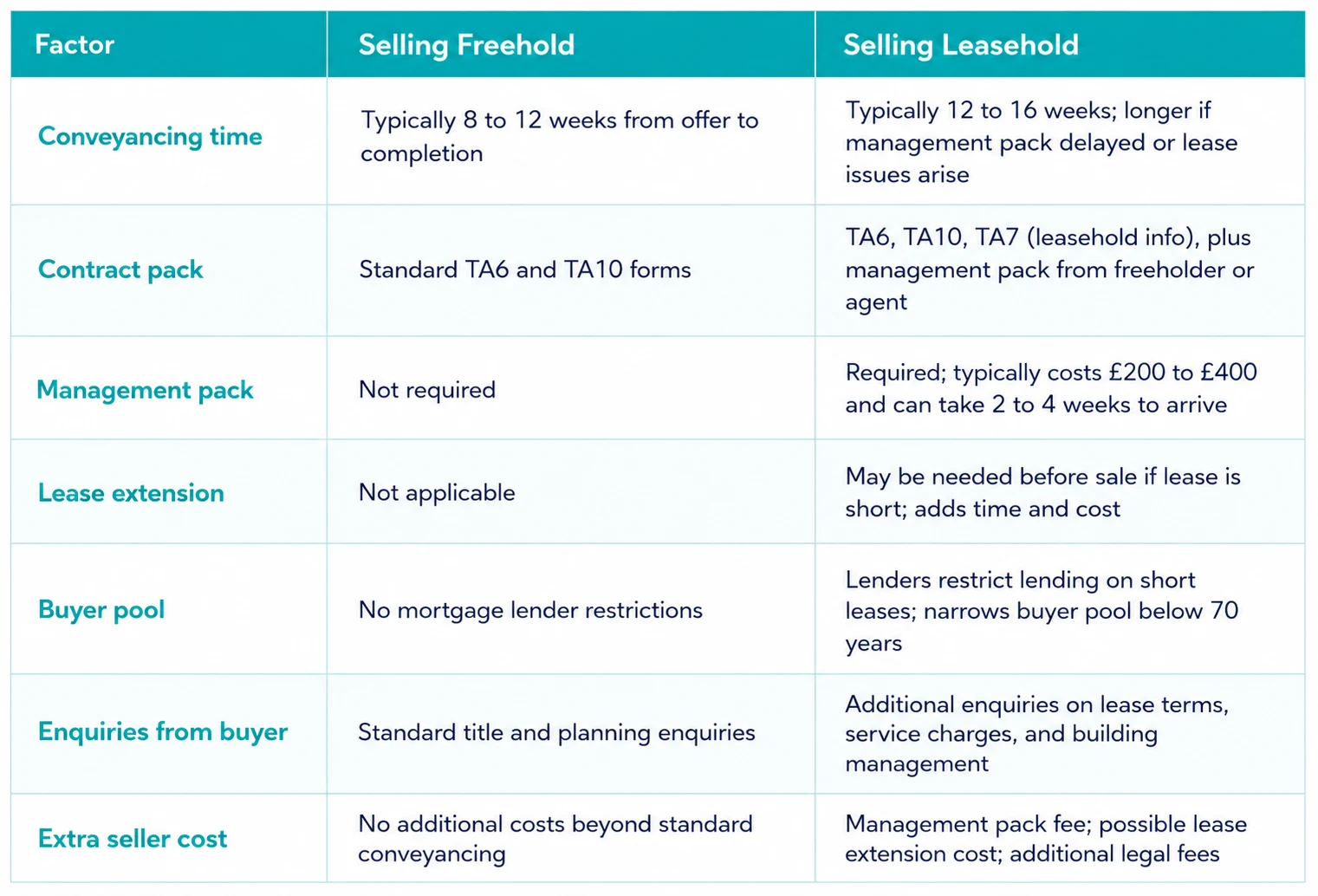
How Selling a Freehold Property Differs from Selling Leasehold
The sale process follows the same broad structure for both tenures, but the practical demands on a leasehold seller are meaningfully greater. The table below summarises the key differences, followed by a detailed explanation of each.
Selling a Freehold Property
Selling a freehold property is the more straightforward of the two processes. Your solicitor prepares a contract pack consisting of the standard property information forms and your title documents. Provided the title is clean, there are no missing planning permissions or building regulations certificates, and the buyer's searches return without issues, the transaction progresses through conveyancing in a relatively predictable way.
The main challenges for freehold sellers typically arise around planning and building regulations compliance for any building works carried out during ownership, boundary clarity, and restrictive covenants. Gathering relevant certificates and documents before listing reduces the risk of any of these causing delays.
Selling a Leasehold Property
Selling a leasehold property involves everything that a freehold sale requires, plus a significant amount of additional work that is specific to the leasehold structure. Understanding this in advance allows you to plan and avoid the delays that commonly slow leasehold transactions.
The Management Information Pack
The most time-sensitive additional requirement for leasehold sellers is the management information pack, also known as the LPE1 pack. This is a set of documents provided by the freeholder or managing agent that gives the buyer's solicitor the information they need to advise on the leasehold structure.
A management pack typically includes:
Current service charge accounts and at least two to three years of historical accounts
Details of the buildings insurance policy and the premium
Information about any planned major works and any reserve fund or sinking fund balance
Details of the ground rent and any review provisions
Confirmation of whether there are any current disputes or legal proceedings involving the building or managing company
Confirmation of any recent or current enforcement or compliance notices
Management packs can take between two and four weeks to arrive from a managing agent or freeholder, and some larger management companies take longer. This is one of the most common causes of delay in leasehold conveyancing. Request the pack as soon as you decide to sell, before a buyer has even been found if possible, so it is ready when needed.
The Lease Length
Lease length is the single most important factor affecting the saleability of a leasehold property and the breadth of the buyer pool. Most mortgage lenders require a minimum of around seventy years remaining on the lease at the time of the mortgage application, though many require more. Some lenders apply an internal rule requiring the lease to have at least eighty-five years remaining after the end of the mortgage term.
The practical thresholds to be aware of as a seller are:
More than ninety years remaining: no issues for buyers or lenders
Eighty to ninety years remaining: worth monitoring; buyers may want to extend soon after purchase but no immediate obstacle
Below eighty years remaining: previously triggered significant additional lease extension costs due to marriage value, but this is no longer the case under the 2024 reforms; still a concern for some lenders
Below seventy years remaining: many mortgage lenders will not lend; buyer pool narrows significantly to cash buyers and specialist lenders
Below sixty years remaining: very difficult to sell without extending the lease first
If your lease is approaching any of these thresholds, speak to your solicitor before listing. Extending the lease before sale, while it involves cost and time, may significantly increase your buyer pool and your achievable price.
Service Charges and Major Works
Buyers and their solicitors will scrutinise the service charge history carefully. A history of well-managed, predictable service charges with a reasonable reserve fund is reassuring. A history of large, unexplained increases, significant arrears in the building, or a major works project currently underway or recently completed raises concerns that will generate detailed enquiries.
If there is a major works programme either planned or recently completed, the buyer's solicitor will want to understand whether any Section 20 consultation was carried out correctly and whether any outstanding contributions might fall to the new owner. Being able to provide clear documentation on this reduces the risk of it becoming a prolonged negotiation point.
Ground Rent Provisions
If your lease was granted before 30 June 2022 and carries a reviewable ground rent, your buyer's solicitor will raise this in their enquiries. Ground rents that double periodically have been known to affect mortgageability and are treated as a red flag by many lenders. If your lease contains a doubling ground rent clause, discuss this with your solicitor at the outset of your sale so you understand how it is likely to be received and whether any action should be taken.
Whether to Extend Your Lease Before Selling
One of the most common questions leasehold sellers face is whether to extend the lease before putting the property on the market. There is no universal answer, but the following framework will help you assess your situation.
When Extending Before Selling Makes Sense
Extending your lease before listing is generally worth considering in the following circumstances:
Your lease has fewer than eighty years remaining, where some lenders apply stricter criteria
Your lease has fewer than seventy years remaining, which significantly restricts the pool of mortgage buyers
You want to market your property to the widest possible buyer pool
You are in an area or price bracket where buyers using mortgages make up the majority of demand
You have sufficient equity in the property to cover the extension cost without a problem
When Selling with a Short Lease May Still Work
In some circumstances, selling with a shorter lease is a practical choice rather than a mistake. Cash buyers, property investors, and buyers who understand leasehold well may offer reasonable prices on a property with a lease that needs extending, factoring the extension cost into their offer. If your property is in a strong demand area and priced accurately to reflect the lease position, a sale can still proceed.
What matters is transparency. Your asking price, your listing description, and your responses to enquiries should all reflect the lease length accurately. Trying to obscure a short lease will only cause problems later when the buyer's solicitor identifies it.
How Statutory Lease Extension Works
Under the Leasehold Reform, Housing and Urban Development Act 1993, qualifying leaseholders have a statutory right to extend their lease by ninety years, added to the remaining term, at a peppercorn ground rent. The process involves serving a formal notice on the freeholder and following a prescribed legal procedure. Since January 2025, the two-year ownership requirement no longer applies.
The cost of a statutory lease extension varies depending on the property value, the remaining lease term, and the ground rent. Since the removal of marriage value under the 2024 reforms, extensions on shorter leases are considerably more affordable than they were previously. Your solicitor or a specialist leasehold valuer can provide a formal estimate before you decide whether to proceed.
Buying the Freehold Before You Sell
An alternative to lease extension for sellers of leasehold properties is to buy the freehold before selling. This is only available in certain circumstances and is typically relevant to houses rather than flats, though collective enfranchisement allows flat owners to purchase the freehold of their building jointly.
Individual Freehold Purchase for Houses
If you own a leasehold house, you may have the right to buy the freehold under the Leasehold Reform Act 1967, as amended. Owning the freehold converts your property to a straightforward freehold title, removing all the complications associated with leasehold ownership. The cost depends on the terms of your lease and the value of the property, and is calculated using a statutory formula.
Collective Enfranchisement for Flats
Leaseholders of flats can join together to purchase the freehold of their building collectively under the Leasehold Reform, Housing and Urban Development Act 1993. The 2024 Act made collective enfranchisement easier and cheaper. While this is a process typically initiated to benefit all leaseholders in the building rather than as a solo seller strategy, if your building is already in the process of enfranchisement it is worth understanding the implications for your sale.
Selling during an active collective enfranchisement process can complicate matters. Your solicitor should be made aware of this immediately so the conveyancing can account for it correctly.
What Buyers and Their Solicitors Will Check When Buying Leasehold
Understanding what a buyer's solicitor will scrutinise when purchasing a leasehold property helps you prepare in advance and reduces the risk of enquiries becoming protracted.
The Lease Itself
The buyer's solicitor will read the lease carefully, checking the remaining term, the ground rent provisions, the service charge structure, the repair and decoration obligations, the restrictions on alterations and use, and any forfeiture provisions. Well-drafted modern leases with long terms and clear terms generate few additional enquiries. Older or unusual leases generate more.
Service Charge History
The buyer's solicitor will request at least two to three years of service charge accounts. They will check whether the charges have been reasonable, whether major works have been carried out, and whether the reserve fund is adequately funded. Any history of disputes, tribunal proceedings, or enforcement action against the managing agent or freeholder will raise questions.
Building Safety
For flats in buildings above eleven metres or four storeys in height, building safety requirements introduced by the Building Safety Act 2022 are relevant. Buyers and their lenders will want to understand the building's cladding status, whether a building safety certificate has been issued, and whether any remediation works are planned or underway. If your building has been through the EWS1 (External Wall System) assessment process, having the certificate available will help.
Building safety is a significant and evolving area. If your flat is in a building that may be affected, speak to your solicitor before listing so you understand the current position and what documentation is available.
The Freeholder and Managing Agent
The reputation and responsiveness of the freeholder and managing agent matters to buyers. A well-managed building where accounts are published clearly, maintenance is carried out promptly, and the managing agent communicates effectively is a positive selling point. A building with a history of management disputes, unresolved maintenance issues, or an unresponsive freeholder generates more buyer concern and solicitor enquiries.
Practical Checklist for Leasehold Sellers in 2026
Use the checklist below to prepare for selling a leasehold property before you list.
Gather Your Documents
Locate your original lease document
Check the remaining lease term and note any ground rent review provisions
Gather at least three years of service charge demands and accounts
Locate the buildings insurance certificate for the current year
Identify the name and contact details of your freeholder and managing agent
Note the current annual service charge and ground rent amounts
Check whether there are any known planned major works in the building
Assess Your Lease Position
If fewer than eighty years remain, obtain a leasehold valuation to understand extension costs
If fewer than seventy years remain, speak to your solicitor about whether to extend before listing
Check whether your ground rent contains any doubling or review clauses
Check whether you have share of freehold and what documentation governs the company
Order the Management Pack Early
Contact your managing agent or freeholder as soon as you decide to sell
Ask for the LPE1 management information pack and confirm the turnaround time
Be aware that this pack will cost a fee, typically between two hundred and four hundred pounds
If the pack has already been produced recently, check whether it is still current and acceptable to your buyer's solicitor
Instruct Your Solicitor
Choose a solicitor with specific leasehold conveyancing experience
Instruct them before you accept an offer so they can begin preparing
Provide the lease and any relevant documents to your solicitor at the outset
Discuss any known issues, such as ground rent provisions or planned major works, before listing
Selling Your Leasehold or Freehold Home with YooSell
Whether you are selling a freehold house or a leasehold flat, YooSell gives you full control of your sale from listing to completion, without paying traditional estate agent commission.
Why Sellers in Leicestershire and the Midlands Choose YooSell
YooSell is a self-service home-selling platform built for homeowners who want to sell directly to verified buyers. You set your price, manage viewings through the built-in booking diary, communicate directly with buyers through the platform, and access integrated legal and professional services when you need them. There is no percentage commission taken at any point.
See how the full process works on the How It Works page or compare plans on the Pricing page.
Integrated Conveyancing for Leasehold and Freehold Sales
Leasehold conveyancing requires a solicitor with specific experience. Through YooSell, you can access trusted conveyancing professionals directly from your seller dashboard without needing to source them independently. This is particularly valuable for leasehold sellers who benefit from working with a solicitor who knows what documentation is needed and can chase managing agents and freeholders efficiently.
Verified Buyers Only
Every buyer on YooSell completes identity and financial verification before they can make an offer. For leasehold sellers, this matters because it reduces the risk of a buyer withdrawing after the offer has been accepted when their lender raises concerns about the lease. Buyers on the platform have already confirmed their financial position, which means the offers you receive are from people who can genuinely proceed.
List on Rightmove Through YooSell
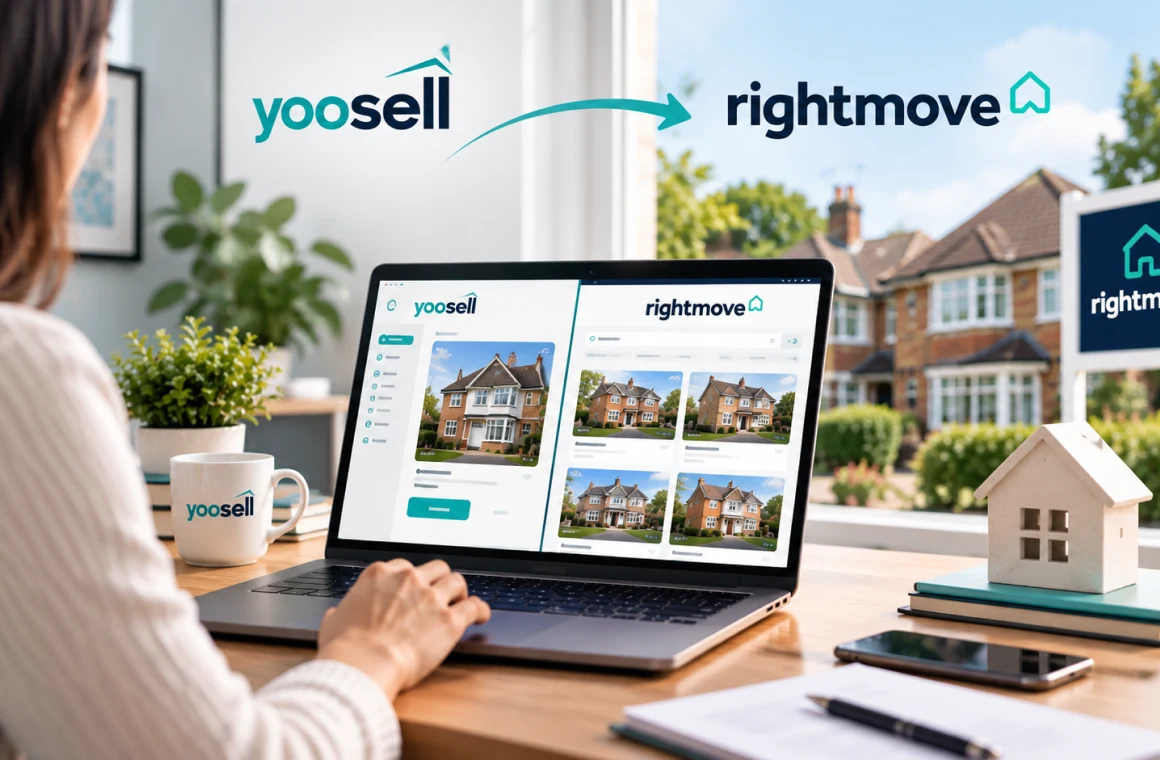
You can list your property directly on Rightmove through YooSell, giving it maximum exposure on the UK's largest property portal. More visibility means more offers, and more offers means a stronger negotiating position. Visit the YooSell Rightmove page for full details on how it works.
Free Tools to Plan Your Move
Use the Valuation Calculator to set a realistic asking price for your property. The Cost Saving Calculator shows how much you save selling without agent commission. The Stamp Duty Calculator covers all buyer types at the April 2025 rates, and the Mortgage Calculator helps you plan your onward purchase.
Frequently Asked Questions
Read Our Blog
Tips, insights and expert advice to help you sell smarter.

Slough House Prices & Property Market Analysis 2026
Slough house prices averaged £334,000 in May 2026 according to ONS data, down modestly from £348,000 a year earlier. The market has softened in the short term, with flat prices falling 7.8% and transaction volumes down significantly. Average monthly rents, however, have risen to £1,572, strengthening the case for buying over renting. The Elizabeth Line puts Slough to Paddington in around 15 minutes, keeping buyer demand structurally strong. For buyers with a medium-term horizon, Slough remains one of the better-value commuter markets in the South East.

Nottingham House Prices 2026: What Buyers Should Know
Nottingham house prices in 2026 are holding steady, with the ONS recording an average of £192,000 in the city area as of June 2026. First-time buyers are paying around £177,000 on average, making Nottingham one of the more accessible cities in the East Midlands. Prices have risen 18.2% over the past five years, despite a brief flat period in 2025 and early 2026. Average monthly rents have reached £1,011, strengthening the financial case for buying over renting. West Bridgford commands the highest prices while areas like Sherwood and Bulwell offer strong value for budget-conscious buyers.
Why YooSell Is the Best Platform in the UK to List Property on Rightmove
You can list your property on Rightmove without an estate agent by using a Rightmove-registered listing platform such as YooSell. Private individuals cannot list directly on Rightmove, but portal-approved services can. YooSell includes Rightmove listing on all three plans from £29 per month, with the first month free, zero commission at completion, and ID-verified buyers as standard. Rightmove receives approximately 52.9 million monthly visits and accounts for around 70% of all time UK buyers spend on property portals, making it the most important portal for any UK seller in 2026.
Start Selling Your Home Today!
Take control of your sale with YooSell. Get started today and explore how we can help you sell smarter, faster, and with less hassle.