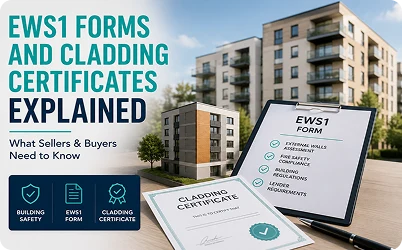
EWS1 Forms and Cladding Certificates Explained
The EWS1 form is not a fire safety certificate and not a law, but it can determine whether a flat sale completes or stalls entirely. This definitive guide explains the full EWS1 rating system from A1 to B2, when your building actually needs one, what it costs and how long it takes, how the Building Safety Act 2022 protects qualifying leaseholders, what to do when a buyer's lender will not lend, and a practical step-by-step process for sellers navigating the cladding landscape in 2026.

Oliver H.
Oliver covers Midlands property trends and practical selling tips for homeowners. He focuses on clear, jargon-free advice that helps private sellers stay in control.
Introduction: Why EWS1 Matters to Every Flat Seller in 2026
If you own a leasehold flat in a multi-storey block in the UK, the External Wall System form, commonly called an EWS1, may be the single document most likely to determine whether your sale completes or collapses. It is not a fire safety certificate. It is not a legal requirement. But it is a lender requirement, and without the right outcome on one, buyers using a mortgage may not be able to purchase your property at all.
The cladding crisis that followed the Grenfell Tower fire in 2017 fundamentally changed the flat sales market in the UK. Tens of thousands of flat owners have been unable to sell, remortgage, or move because their building has combustible cladding or external wall materials that lenders will not accept. Seven years on, significant progress has been made through the Building Safety Act 2022, government remediation schemes, and developer commitments. But EWS1 remains a live and complex issue for many sellers in 2026.
This guide explains exactly what the EWS1 form is, what the rating system means, when your building is likely to need one, what it costs to obtain, how the Building Safety Act 2022 and current remediation schemes affect you as a seller, what to do if your buyer's lender will not lend without one, and the step-by-step process for navigating a sale on a cladding-affected or EWS1-required building.
If you are preparing to sell a flat in Leicestershire or the Midlands, start by using the free Valuation Calculator on YooSell to understand your property's current market position before listing.
What the EWS1 Form Actually Is
The External Wall System form, designated EWS1, is a standardised document introduced in December 2019 by the Royal Institution of Chartered Surveyors, the Building Societies Association, and UK Finance. It records the outcome of a professional assessment of the external wall construction of a residential building, specifically as it relates to fire risk and the suitability of the building for mortgage lending.
What It Is Not
Understanding what the EWS1 is not is as important as understanding what it is.
An EWS1 form is not a fire safety certificate. It does not confirm that a building is safe to live in. It does not replace a professional life safety fire risk assessment, which is a separate statutory requirement for multi-occupied residential buildings. The EWS1 exists solely to tell mortgage valuers and lenders whether a building's external wall system presents an obstacle to lending. RICS confirmed this explicitly in the updated standard published in May 2026: the EWS1 is for valuation and lending purposes only.
An EWS1 form is not a legal requirement. No law states that a building must have one. Its use is driven entirely by mortgage lender requirements. Cash buyers are not legally obliged to require one, though their solicitors may advise them to obtain one anyway given the wider building safety considerations involved.
The Relationship Between the EWS1 and the FRAEW
The EWS1 form is a one-page summary document. Behind it sits a far more detailed technical assessment called a Fire Risk Appraisal of External Walls, known as a FRAEW, carried out under the PAS 9980 standard. The FRAEW is the substantive engineering analysis of the building's external wall construction, its materials, insulation, cavity barriers, fixings, and overall fire risk. The EWS1 records the conclusion of that analysis for lenders and valuers.
You cannot have a meaningful EWS1 without the underlying FRAEW. The FRAEW does the analysis. The EWS1 communicates the result. When sellers, solicitors, and lenders refer to an EWS1, they are in practice referring to the whole assessment process, including the FRAEW that sits behind the form.
Who Commissions the Assessment
The EWS1 assessment is commissioned by the building owner, which in most cases means the freeholder or the managing agent acting on their behalf. Individual flat owners cannot commission an EWS1 independently because the assessment covers the whole building, not individual units. This is a fundamental and frequently misunderstood point: if your building does not have an EWS1 and one is needed, the responsibility and cost sit with the freeholder or managing company, not with you as an individual leaseholder.
The EWS1 Rating System Explained
The EWS1 form records one of two category outcomes: Category A or Category B. Each category has sub-ratings. Understanding what each means is essential for flat sellers.
Category A Outcomes
Category A outcomes apply to buildings where the external wall system does not include materials assessed as presenting a significant fire risk. Within this category there are sub-ratings.
A1: No Relevant Combustible Materials
An A1 rating means the assessor has found no cladding or external wall attachments that would present a relevant fire risk. The external wall is assessed as safe. There is no combustible cladding, no relevant insulation, and no combustible balcony material that triggers concern. Mortgage lenders will lend on buildings with an A1 rating without any additional conditions related to the external wall.
A2: Limited Combustible Material, Assessed as Low Risk
An A2 rating means some attachments or external wall components are present, such as balcony decking, decorative panels, or elements of the cladding system, but they have been assessed as presenting a low fire risk that does not require remediation. Mortgage lenders will generally lend on A2-rated buildings. An A2 is a broadly positive outcome even though combustible material is present.
A3: Recognised as an Historic Reference
In the original version of the EWS1 form, A3 was used to indicate that a building needed a more detailed appraisal. The current form structure uses A1 and A2 as the primary positive outcomes. If you encounter A3 on an older form, speak to your solicitor or the freeholder's assessor about whether a current assessment is needed, particularly given the EWS1's five-year validity window.
Category B Outcomes
Category B outcomes apply to buildings where the assessor has identified combustible materials in the external wall construction that require further consideration.
B1: Combustible Materials Present, No Remediation Required
A B1 rating means combustible materials have been identified in the external wall system, but the assessor has concluded that, taking everything into account including interim safety measures, the risk is managed to an acceptable level and immediate remediation is not required. A B1 outcome is a broadly navigable position in the mortgage market. Most mainstream lenders will lend on B1-rated buildings, though some have additional requirements. A B1 is significantly better than a B2 for a seller trying to proceed with a sale.
B2: Combustible Materials Present, Remediation Required
A B2 rating means the assessor has determined that remediation of the external wall system is required before the building can be assessed as presenting an acceptable fire risk. This is the most serious outcome. Mortgage lenders will typically not lend on flats in B2-rated buildings until remediation is complete and a new EWS1 is obtained with an A1, A2, or B1 outcome. A B2 effectively freezes the mortgageability of every flat in the block for as long as the building remains unremediated.
How to Read an EWS1 Form You Already Have
If your building already has an EWS1 form, the rating will be clearly stated on the form alongside the date of assessment and the signature of the qualified professional who carried it out. The form also records the type of assessment carried out, the specific materials identified, and whether any interim measures are in place. Pass the form to your solicitor as soon as you decide to sell. They will confirm whether it is still within its five-year validity window and whether your buyer's lender is likely to accept it.
When Does Your Building Need an EWS1?
Not every block of flats needs an EWS1. One of the significant problems in the years after 2019 was widespread over-requesting of EWS1 forms, with lenders demanding them for buildings where the fire risk was clearly negligible. RICS has worked progressively to narrow the criteria and ensure that the form is only requested where there is a genuine rationale for doing so.
The Height-Based Framework in 2026
The current position, reflecting government guidance, RICS standards, and mainstream lender practice, is broadly based on building height and the presence of specific risk factors.
Buildings Over 18 Metres
Buildings over 18 metres in height, which broadly corresponds to seven storeys or more, are the highest-risk category and the most likely to require an EWS1. An EWS1 should generally be expected if the building has any of the following: combustible cladding on the external walls, rendered and insulated external walls, balconies with combustible balustrades or decking that are stacked vertically, or curtain wall glazing with combustible spandrel panels. For tall buildings in this category, lenders and valuers will almost always request an EWS1 where any of these features are present.
Buildings Between 11 and 18 Metres
Buildings in this middle height range, broadly four to six storeys, require an EWS1 only where specific risk factors are present. Under the RICS guidance that applied through 2025 and into 2026, the relevant factors include the presence of aluminium composite material cladding, high pressure laminate panels, metal composite materials, or significant quantities of other combustible external wall materials. Not every building in this height range needs one, and lenders have been asked to apply the criteria proportionately.
Buildings Under 11 Metres
Following government guidance issued in January 2022, buildings under 11 metres generally do not require an EWS1 for mortgage purposes. Most mainstream lenders have accepted this guidance and removed the requirement for low-rise blocks. However, individual lender policies still vary, and it is always worth confirming your lender's position rather than assuming.
The New RICS Standard from 1 November 2026
On 12 May 2026, RICS published the second edition of its professional standard for secured lending valuations of multi-storey residential buildings with cladding. This standard takes effect from 1 November 2026 and introduces clearer, storey-based criteria for when a valuer should request an EWS1.
The updated standard sets different thresholds for buildings over six storeys, buildings of five or six storeys, and buildings of four storeys or fewer. It also formally confirms that in some circumstances a suitable executive summary from a FRAEW carried out under PAS 9980 may be relied upon by valuers instead of a separate EWS1 form, provided the summary gives a clear outcome on whether remedial works are required and is signed by a suitably qualified professional.
This is a significant development. It signals that the EWS1 form as a standalone document may gradually be replaced by FRAEW-based evidence as the assessment methodology matures. RICS has stated publicly that it anticipates that over time there will be no need for a separate EWS1 form. For sellers in 2026, this means that if your building has a recent FRAEW conducted under PAS 9980, that documentation may satisfy lender requirements even without a standalone EWS1 form, depending on individual lender policy.
What to Do if You Are Unsure Whether Your Building Needs One
If you are unsure whether your building needs an EWS1, contact your freeholder or managing agent. They should be able to confirm whether an assessment has been commissioned or completed and what the outcome was. If they cannot confirm this, your solicitor can raise it with the freeholder as part of the conveyancing enquiries. If the buyer's mortgage lender requires one and none exists, the freeholder is responsible for commissioning it. You cannot compel the freeholder to act quickly, but you can request confirmation of the position and progress in writing.
What an EWS1 Assessment Costs and How Long It Takes
The cost and timeline of an EWS1 assessment are relevant to sellers because they affect the timeline of any sale where a form is needed but not yet in place.
Who Pays for the Assessment
The EWS1 assessment covers the whole building. It is the freeholder's or managing agent's responsibility to commission it, and the cost is typically recovered from all leaseholders in the building through the service charge. You as an individual flat seller do not pay for the assessment directly as a selling cost. However, if the building has not been assessed and the buyer's lender requires one, the freeholder's timeline for commissioning and completing the assessment will directly affect when your sale can proceed.
Typical Costs
An EWS1 assessment for a typical residential block in 2026 costs between six thousand and twenty thousand pounds, depending on the complexity of the building, the number of storeys, the type of cladding or external wall materials present, and the extent of intrusive investigation required. The FRAEW that underpins the EWS1 may require physical sampling of the external wall construction to confirm what materials are present beneath the surface cladding. This adds both cost and time.
For a straightforward building with clearly identifiable external wall materials and no complex construction, the lower end of this range applies. For a complex building with multiple cladding systems, unusual construction methods, or a history of partial remediation, costs can reach the higher end or beyond.
Typical Timelines
The timeline from commissioning an EWS1 assessment to receiving the completed form depends on the assessor's availability, the complexity of the building, and whether intrusive investigation is needed.
A physical inspection of a single medium-rise block typically takes between two and three days on site. The FRAEW report and resulting EWS1 form are usually issued within two to three weeks following the inspection. However, commissioning the assessment in the first place, going through the freeholder or managing agent's procurement process, can add several more weeks. In practical terms, sellers whose buildings do not have an EWS1 in place should expect the process to take a minimum of four to eight weeks from the decision to commission, and potentially longer if the building has complex issues requiring specialist input.
How Long an EWS1 Remains Valid
An EWS1 form is valid for five years from the date it is signed by the qualified professional who carried out the assessment. If your building's EWS1 was issued before the PAS 9980 methodology became the accepted standard, some lenders may prefer a more recent assessment carried out under PAS 9980. If the external wall has been modified since the original assessment, such as by partial remediation, installation of a waking watch system, or structural changes to the cladding, a new assessment will be needed regardless of the five-year window.
The Building Safety Act 2022 and What It Means for Flat Sellers
The Building Safety Act 2022 is the most significant piece of legislation affecting cladding-affected flat owners in England since the Grenfell fire. For sellers in particular, it is essential to understand both the protections it provides and its limitations.
Core Leaseholder Protections Under the Act
The Building Safety Act 2022 introduced a framework of protections that prevents qualifying leaseholders from being charged for certain categories of remediation costs. Understanding whether you are a qualifying leaseholder, and what costs you are protected from, affects how you should present your property to potential buyers.
Who Is a Qualifying Leaseholder
To be a qualifying leaseholder under the Act you must hold a long lease in a building that is at least eleven metres in height or has at least five storeys. You must have owned the property on 14 February 2022. If you own more than three residential properties in England at the time of the relevant defect, you do not qualify for the full protections, though this has been the subject of significant parliamentary debate.
What Costs Qualifying Leaseholders Are Protected From
Qualifying leaseholders cannot be charged through the service charge for the cost of removing or replacing unsafe cladding on the outer wall of the building. This protection applies regardless of what the lease itself says about service charge recovery. Legal and professional services costs directly related to fire safety liability are also protected.
Non-cladding remediation costs, such as fire door replacements, compartmentalisation work, and sprinkler systems, can still be charged to leaseholders but only up to a capped amount that depends on the value of the property and whether the landlord or a developer can be made to pay first.
The Developer Remediation Contracts
The government secured developer remediation contracts from the major residential developers, under which they agreed to fund the remediation of buildings they constructed or refurbished that are now identified as having fire safety defects. As of 2026, the vast majority of major developers have signed these contracts. If your building was constructed or substantially refurbished by one of these developers, the building may be entitled to funded remediation without cost to leaseholders.
The presence of a developer remediation contract or a government-funded scheme covering your building is information that your freeholder should be able to confirm. From a mortgage lending perspective, lenders can consider applications on flats in buildings where there is evidence of a commitment to self-remediation by the developer, even where an EWS1 does not yet exist or has a B rating.
The Cladding Safety Scheme and Building Safety Fund
The Cladding Safety Scheme and the preceding Building Safety Fund are government grant programmes administered by Homes England that fund the remediation of cladding on eligible buildings. The Cladding Safety Scheme covers buildings between eleven and eighteen metres. The Building Safety Fund covers buildings above eighteen metres.
In August 2026, the government announced new funding for the remediation of unsafe cladding on eligible residential buildings under eleven metres, delivered through an expansion of the Cladding Safety Scheme with applications opening from 17 August 2026. This is a significant development for lower-rise buildings that were previously excluded from government funding.
If your building is in one of these schemes or is in the process of applying, confirmation of that status can itself allow some lenders to proceed with mortgage applications even where a satisfactory EWS1 is not yet in place.
The Leaseholder Deed of Certificate
As a qualifying leaseholder, you can apply for a Leaseholder Deed of Certificate under the Building Safety Act 2022. This document formally records your qualifying leaseholder status and protections. Some lenders now accept a Deed of Certificate as sufficient evidence to proceed with mortgage lending on buildings where the EWS1 position is not yet resolved. Obtain one from your solicitor or through your building's freeholder if you believe you qualify.
The Remediation Acceleration Plan
The government's Remediation Acceleration Plan, published in late 2024 and updated in 2025, set target remediation deadlines for affected buildings. Under the plan, buildings over eighteen metres in government-funded schemes must have remediation completed by the end of 2029. Buildings between eleven and eighteen metres must be remediated by the end of 2031. These deadlines provide a framework for when affected buildings should move through the remediation process, though enforcement and progress vary considerably.
What Happens If Your Buyer's Lender Will Not Lend
If a buyer's mortgage lender requires an EWS1 and either none exists or the existing one shows a B2 outcome, the sale may stall. This is one of the most challenging situations a flat seller can face, but there are practical steps and alternative routes worth understanding.
Step One: Confirm the Exact Lender Requirement
Different lenders have different EWS1 policies. Some will lend on B1 with no conditions. Others require A1 or A2 only. Some accept a FRAEW under PAS 9980 as an alternative to a standalone EWS1 form. Before assuming the sale is blocked, get the precise requirement from the buyer's lender in writing. A mortgage broker with experience of cladding-affected buildings is invaluable at this stage.
Step Two: Check Whether Alternative Evidence Is Available
As of 2026, lenders may consider mortgage applications on the basis of alternative evidence rather than an EWS1 alone. This can include:
A signed developer remediation contract confirming the developer will fund the works
Confirmation of placement in a recognised government scheme such as the Cladding Safety Scheme or Building Safety Fund
A Leaseholder Deed of Certificate under the Building Safety Act 2022
A FRAEW executive summary under PAS 9980, for lenders that accept this alternative
Your solicitor and the freeholder's managing agent are the key contacts for establishing which of these applies to your building.
Step Three: Consider Cash Buyers or Specialist Lenders
Some specialist mortgage lenders have developed products specifically for cladding-affected buildings and will lend where mainstream lenders will not, typically with different risk criteria and sometimes higher rates. A mortgage broker who specialises in this area can identify which lenders may be willing to proceed.
Cash buyers do not have a mortgage lender requirement for an EWS1. A buyer with sufficient cash to complete without a mortgage removes the lender obstacle entirely. The trade-off is that the buyer pool is significantly narrower, and a cash buyer on a cladding-affected property will typically negotiate a lower price to reflect the building safety uncertainty. Understanding your property's market value in the context of the EWS1 position requires honest assessment. The YooSell Cost Saving Calculator can help you understand your financial position after all selling costs are factored in.
Step Four: Apply Pressure Through the Freeholder
If the freeholder has not yet commissioned an EWS1 assessment for a building that needs one, you can apply pressure through the right to manage company if one exists, through the First-tier Tribunal, or by formal written demand for the freeholder to confirm the building's EWS1 status and timeline. This is a slow route and unlikely to resolve a current sale, but it is a legitimate long-term step.
Step Five: Price Transparently
If the building has an unresolved EWS1 position and no immediate prospect of resolution, pricing the property transparently to reflect that position is better than overpricing and repeatedly losing buyers at the mortgage valuation stage. Your asking price should reflect the current, genuine saleability of the property, not its hypothetical value if the building were fully remediated.
A Step-by-Step Process for Flat Sellers Affected by EWS1 Requirements
This section brings together all of the above into a practical sequence for sellers navigating the EWS1 landscape.
Step One: Establish Your Building's Current EWS1 Status
Before you list your property, contact your freeholder or managing agent and ask specifically whether your building has a current, valid EWS1 form or FRAEW assessment, what the outcome or rating is, and when it was issued. Ask for a copy of the form. If the building has a valid A1, A2, or B1 rating, your sale is unlikely to be significantly affected. If it has a B2 rating or no assessment at all, you need to understand the position fully before listing.
Step Two: Check Whether Your Building Is in a Remediation Scheme
Ask your freeholder or managing agent whether the building is covered by a developer remediation contract, whether it is registered with or awaiting funding from the Cladding Safety Scheme or Building Safety Fund, and whether a FRAEW under PAS 9980 has been commissioned or completed. Confirm the answers in writing.
Step Three: Obtain a Leaseholder Deed of Certificate if Applicable
If you believe you are a qualifying leaseholder under the Building Safety Act 2022, obtain a Leaseholder Deed of Certificate. This formally records your protections and may be relevant to lender decisions on your property.
Step Four: Instruct Your Solicitor Early
Instruct a solicitor with experience of cladding-affected leasehold conveyancing before you list your property. This is not the time for a generic high-volume conveyancing firm. The legal complexities of cladding-affected sales, the interplay between the Building Safety Act, remediation schemes, and mortgage lender requirements, demand a solicitor who understands this specific landscape. Review the YooSell pricing plans to find the plan that includes integrated conveyancing access from your seller dashboard once an offer is accepted.
Step Five: Be Transparent in Your Listing
Disclose the EWS1 position clearly in the information you provide to buyers. Hiding it or omitting it invites problems at the mortgage valuation stage when the issue surfaces anyway, often causing buyers to withdraw after several weeks of wasted legal costs on both sides. Transparency about the building's cladding status, the remediation scheme coverage if applicable, and the current EWS1 outcome is both legally required through your TA6 disclosure obligations and practically the most efficient route to a sale.
If you are listing through YooSell, your listing can clearly set out the building safety position so buyers are informed before they enquire rather than discovering it during the mortgage process. Being transparent from the outset attracts buyers who are prepared for the situation and reduces the risk of late-stage withdrawals.
Step Six: Prepare the Supporting Documentation Pack
Gather and pass to your solicitor as early as possible:
The current EWS1 form or FRAEW executive summary if available
Confirmation of any remediation scheme coverage in writing
The Leaseholder Deed of Certificate if obtained
Developer remediation contract confirmation if your building is covered
The management information pack including the latest service charge accounts, which will reflect any additional costs related to building safety work
The buildings insurance certificate, which may carry additional excess provisions related to cladding
Step Seven: Respond Promptly to Buyer and Lender Enquiries
Once your property is under offer, building safety enquiries will be among the first things raised by the buyer's solicitor. Being ready with complete and accurate documentation allows these to be resolved quickly rather than causing weeks of back-and-forth. The YooSell property guides cover the full conveyancing process for leasehold sellers in detail.
How the November 2026 RICS Standard Changes Things
The second edition of the RICS cladding valuation standard, effective from 1 November 2026, is the most significant change to the EWS1 landscape since the government guidance of January 2022 removed the requirement for buildings under eleven metres.
Clearer Storey-Based Criteria
The new standard introduces clearer criteria based on the number of storeys rather than a single height threshold. It sets different triggers for buildings over six storeys, buildings of five or six storeys, and buildings of four storeys or fewer. This should reduce the incidence of EWS1 being requested for lower-rise buildings where the risk profile does not justify it.
FRAEW as a Sufficient Alternative
The 2026 standard confirms that a suitable executive summary from a FRAEW conducted under PAS 9980 may in some circumstances be used by valuers instead of a separate EWS1 form. This reflects the direction of travel towards PAS 9980 as the primary assessment framework and away from the EWS1 as a standalone document.
What This Means for Sellers in Practice
For sellers with a sale completing after 1 November 2026, the updated standard applies to how mortgage valuers will approach their assessment. If your building has a FRAEW under PAS 9980 but not a standalone EWS1, it is worth checking with your solicitor and the buyer's lender whether the FRAEW alone will be accepted. From November 2026, this is more likely to be the case for some buildings than it was before.
Selling Your Leasehold Flat with YooSell
YooSell is a self-service home-selling platform for sellers in Leicestershire and the Midlands that gives you full control of your sale from listing to completion, without paying traditional estate agent commission.
Why Sellers Choose YooSell
YooSell lets you list, manage, and complete your sale directly. You set your asking price, manage viewings through a built-in booking diary, communicate with verified buyers through the platform, and access trusted conveyancing professionals directly from your seller dashboard. There is no percentage commission taken at completion.
See how the full process works on the How It Works page.
Verified Buyers for Cladding-Affected Properties
Every buyer on YooSell completes identity and financial verification before making an offer. For sellers of cladding-affected flats, this means buyers who enquire have already confirmed their financial position, which helps surface early whether the buyer will be using a mortgage and therefore whether an EWS1 will be a lender requirement for their specific purchase.
List on Rightmove Through YooSell
You can list your flat directly on Rightmove through YooSell by choosing the Enhanced or Premium plan, giving your home maximum visibility on the UK's largest property portal. Visit the YooSell Rightmove page for full details on how it works.
Free Tools to Support Your Sale
Stamp Duty Calculator: understand the buyer's SDLT liability at the April 2025 rates
Mortgage Calculator: help buyers work out their monthly repayment position
Find a Home: browse verified listings across Leicestershire and the Midlands
Frequently Asked Questions
Read Our Blog
Tips, insights and expert advice to help you sell smarter.
Slough House Prices & Property Market Analysis 2026
Slough house prices averaged £334,000 in May 2026 according to ONS data, down modestly from £348,000 a year earlier. The market has softened in the short term, with flat prices falling 7.8% and transaction volumes down significantly. Average monthly rents, however, have risen to £1,572, strengthening the case for buying over renting. The Elizabeth Line puts Slough to Paddington in around 15 minutes, keeping buyer demand structurally strong. For buyers with a medium-term horizon, Slough remains one of the better-value commuter markets in the South East.

Nottingham House Prices 2026: What Buyers Should Know
Nottingham house prices in 2026 are holding steady, with the ONS recording an average of £192,000 in the city area as of June 2026. First-time buyers are paying around £177,000 on average, making Nottingham one of the more accessible cities in the East Midlands. Prices have risen 18.2% over the past five years, despite a brief flat period in 2025 and early 2026. Average monthly rents have reached £1,011, strengthening the financial case for buying over renting. West Bridgford commands the highest prices while areas like Sherwood and Bulwell offer strong value for budget-conscious buyers.
Why YooSell Is the Best Platform in the UK to List Property on Rightmove
You can list your property on Rightmove without an estate agent by using a Rightmove-registered listing platform such as YooSell. Private individuals cannot list directly on Rightmove, but portal-approved services can. YooSell includes Rightmove listing on all three plans from £29 per month, with the first month free, zero commission at completion, and ID-verified buyers as standard. Rightmove receives approximately 52.9 million monthly visits and accounts for around 70% of all time UK buyers spend on property portals, making it the most important portal for any UK seller in 2026.
Start Selling Your Home Today!
Take control of your sale with YooSell. Get started today and explore how we can help you sell smarter, faster, and with less hassle.