
EPC Ratings Explained: How Your Energy Performance Certificate Affects Your UK Sale
Your Energy Performance Certificate is more than a legal formality. In 2026, buyers, lenders, and surveyors pay close attention to EPC ratings when assessing a property. This guide explains what the A to G scale means, how your rating is calculated under the updated RdSAP 10 methodology, what improvements deliver the best uplift before a sale, and what changes to the EPC system are coming in the years ahead.

Sarah M.
Sarah focuses on pricing strategy, presentation, and getting listings ready for market. She helps sellers present homes clearly without overcomplicating the process.
Introduction: Why Your EPC Rating Matters More Than Ever in 2026
An Energy Performance Certificate is no longer just a legal formality that sits at the bottom of your conveyancing pack. In 2026, buyers, mortgage lenders, and surveyors pay close attention to EPC ratings when assessing a property. A good rating can support your asking price. A poor one can narrow your buyer pool, trigger questions from lenders, and give buyers grounds to negotiate harder.
Understanding your EPC, knowing what it measures, how it is calculated, and what you can do to improve it before listing your home gives you a meaningful advantage as a seller. This guide covers everything you need to know about Energy Performance Certificates in the context of selling your home in England and Wales in 2026, including the latest changes to the assessment methodology introduced in June 2025 and the government's upcoming plans for the EPC system.
If you are preparing to sell your home, use the free Valuation Calculator on YooSell to understand your property's current market value before listing.
What Is an Energy Performance Certificate
An Energy Performance Certificate is a document that records how energy-efficient a property is. It provides an energy rating on a scale from A to G, where A is the most efficient and G is the least. The certificate also includes an estimated figure for the property's annual energy costs and a list of recommended improvements that would raise the rating.
EPCs were introduced in England and Wales in 2008 under the Energy Performance of Buildings Regulations. Since then, they have been a legal requirement whenever a residential property is sold, let, or newly constructed. An EPC must be available to prospective buyers before a property is marketed. This means it must be in place before your listing goes live, not after an offer has been accepted.
Each EPC is valid for ten years from the date it is lodged on the national register. If your property already has a valid EPC from a previous sale or tenancy within the last decade, that certificate can be used again. If it has expired, a new assessment must be commissioned before you can market the property.
What an EPC Actually Measures
An EPC does not measure how much energy a property actually uses. It measures how energy-efficient the building itself is, based on its physical characteristics and installed systems, assuming a standard pattern of occupation.
The key factors that feed into an EPC assessment include:
The age, construction type, and thickness of the walls and whether they are insulated
The depth and type of insulation in the loft or roof space
The type, age, and efficiency of the heating system and boiler or heat pump
The type of fuel used for heating and hot water
The type of glazing throughout the property, whether single, double, or triple
The presence of any renewable energy systems such as solar photovoltaic panels
The lighting installed throughout the property
Floor insulation, draught-proofing, and other heat retention measures
An accredited Domestic Energy Assessor visits the property, records all relevant details through a systematic inspection, and inputs them into approved software to generate the certificate. The assessor does not need to carry out physical tests or invasive checks. The assessment is based on visible evidence and information provided by the seller.
The Updated Assessment Methodology from June 2025
On 15 June 2025, the methodology used to calculate EPC ratings in England and Wales was updated. The new standard, known as RdSAP 10, introduced more detailed and accurate modelling of several key elements. Under RdSAP 10, assessors are required to individually measure all windows in a property rather than applying standard assumptions. The new methodology also includes more granular options for wall types and insulation, provides more accurate modelling for heat pumps and other low-carbon heating technologies, and introduces new recommendations for photovoltaic battery storage and diverters where solar panels are already present.
The practical implication for sellers is that a property assessed under RdSAP 10 may receive a slightly different rating than it would have under the previous methodology, even if no physical changes have been made. If your EPC was produced before June 2025 and you are commissioning a new one, the updated methodology will apply.
The EPC Rating Bands Explained
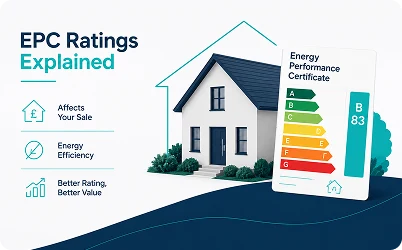
EPC ratings run from A to G on a numerical scale of 1 to 100. Each band covers a range of scores. The section below explains each band, what it typically indicates, and the practical implications for sellers.
Band A: Score 92 to 100
The most energy-efficient band. Properties in band A are typically new builds built to Passivhaus or equivalent standards. They have very low estimated running costs and represent the best environmental performance. Band A properties carry strong buyer appeal and can command a premium in markets where energy costs are a key purchasing consideration.
Band B: Score 81 to 91
Very energy-efficient. Band B properties are typically modern new-builds or older homes that have been comprehensively retrofitted with insulation, efficient heating, and glazing upgrades. Running costs are competitive and buyer appeal is strong. Most new-build properties built to current building regulations achieve band B or above.
Band C: Score 69 to 80
Good energy efficiency. Band C is an important threshold because it is the minimum standard that privately rented properties in England and Wales must reach by 1 October 2030. Properties built from the 2000s onwards, or older properties that have been meaningfully upgraded, typically fall here. Band C properties are widely mortgageable and present no energy-related barriers to sale.
Band D: Score 55 to 68
Average efficiency. Band D is where most homes in England and Wales currently sit. It is the national average EPC rating for the housing stock. Mid-twentieth-century properties with some improvements, such as cavity wall insulation or double glazing, but without comprehensive retrofit, typically fall in this band. A band D rating presents no significant barrier to sale and is familiar to buyers and lenders alike.
Band E: Score 39 to 54
Below average efficiency. Band E is the current legal minimum for privately rented properties in England and Wales. Properties rated E are often pre-1950s homes that have received limited improvement over time. Buyers purchasing a band E property may factor in the cost of future improvements. Investor buyers using buy-to-let mortgages will also be aware of the 2030 compliance deadline.
Band F: Score 21 to 38
Poor energy efficiency. Band F properties are typically older homes with limited or no insulation, single-glazed windows, and older heating systems. A band F rating can affect mortgage offers in some cases and will prompt buyers to factor the cost of improvements into their assessment of the property's value. The buyer pool narrows compared to higher bands.
Band G: Score 1 to 20
The least energy-efficient band. Band G properties are very old or largely unimproved buildings with significant heat loss and high estimated running costs. Properties rated G are the hardest to mortgage and significantly narrow the pool of viable buyers. Selling a band G property without improvements is possible but typically requires pricing that reflects the cost of bringing the property to a more efficient standard.
The Legal Requirements for Sellers
The legal obligations around EPCs for sellers in England and Wales are clear and consistent. Understanding them in advance means you do not fall foul of requirements that are frequently misunderstood.
You Must Have a Valid EPC Before Marketing
A valid EPC must be commissioned and lodged on the national EPC register before you market your property for sale. This means the certificate must be in place before your listing is published online, placed on a portal, or promoted in any other way. Waiting until an offer has been accepted is too late.
If your property was sold or rented within the last ten years and a valid EPC was produced at that time, you can check whether it is still valid using the government's free EPC register. If it remains valid, you do not need to commission a new one unless you want to reflect improvements made since the last assessment.
The Fixed Penalty for Not Having an EPC
Sellers who market a property without a valid EPC are subject to a fixed penalty fine of two hundred pounds. While this is a relatively modest penalty in the context of a property sale, the more significant risk is that a missing EPC can delay conveyancing when the buyer's solicitor raises it, or create a barrier if a listing is challenged on a portal. Getting the EPC in place before listing removes this risk entirely.
Exemptions from the EPC Requirement
A small number of property types are exempt from the EPC requirement. These include:
Listed buildings, but only where compliance with minimum energy efficiency requirements would unacceptably alter the character or appearance of the building. This exemption is not automatic for all listed properties and each case must be assessed on its merits
Standalone buildings with a total useful floor area of less than fifty square metres
Properties that are due to be demolished and have planning permission and all relevant consents in place
A common misconception is that all listed buildings are automatically exempt from the EPC requirement. This is not the case. Many listed residential properties do require an EPC. If you own a listed property and are unsure whether the exemption applies, speak to your solicitor or a qualified energy assessor before assuming you do not need one.
How to Commission a New EPC
EPCs must be produced by a qualified Domestic Energy Assessor who is accredited by a government-approved accreditation scheme. You can find accredited assessors through the official government website. Most assessors offer a straightforward booking process, and the assessment typically takes between thirty and ninety minutes depending on the size and complexity of the property.
The cost of an EPC assessment typically ranges from around sixty-five to one hundred and twenty pounds based on current market rates, though quotes vary between providers. It is worth comparing a small number of quotes before booking.
How Your EPC Rating Affects Your Home Sale
The practical impact of your EPC rating on your sale depends on which band your property falls in, the type of buyer you are likely to attract, and the price point of the property.
Buyer Behaviour and Energy Running Costs
Energy costs have been a prominent concern for UK households since 2022 and remain so in 2026. Buyers are increasingly aware of how a property's energy efficiency affects their monthly outgoings and are factoring running costs into their overall assessment of a property's value. A property in band C or above, where heating costs are relatively low, is likely to be seen as more attractive than an equivalent property in band E or F where bills are considerably higher.
This shift in buyer behaviour means that your EPC rating is no longer simply a compliance document. It is a data point that buyers use when deciding whether to make an offer and at what level to pitch it.
Mortgage Lender Requirements
Most residential mortgage lenders do not impose a minimum EPC requirement for standard owner-occupied purchases. However, some lenders have started to price their products differently based on EPC band, offering preferential rates for properties in higher bands as part of green mortgage initiatives.
The most significant mortgage-related EPC concern in 2026 is for buy-to-let properties rather than owner-occupied homes. Lenders providing buy-to-let mortgages are increasingly unwilling to finance properties that cannot demonstrably reach band C by 2030. For a seller marketing a property that is attractive to investor buyers, an EPC below band D can meaningfully affect the buyer pool.
The Impact on Price Negotiations
A low EPC rating can give buyers grounds to negotiate on price by pointing to the cost of improvements required to bring the property to a more efficient standard. If your property is in band E or below, it is reasonable to expect that buyers will factor in the cost of insulation, glazing, or heating upgrades when formulating their offer.
Being proactive about this removes the uncertainty. If you know your property's EPC rating and have a clear understanding of what improvements would be needed to raise it, you can price your property accurately from the outset rather than finding yourself negotiating against a buyer's estimate of improvement costs late in the process.
EPC Ratings and Property Listings
When a property is listed for sale on a portal, the EPC rating is displayed alongside the listing. Buyers can filter searches by EPC band on some platforms. A property in band A, B, or C is therefore more visible to buyers who are actively filtering for energy-efficient homes. While this is not the most common search filter used in the general market, it is increasingly relevant among buyers who are conscious of running costs and environmental impact.
What Your EPC Certificate Contains
Understanding the full content of an EPC helps you present your property effectively and anticipate the questions buyers may ask.
The Energy Efficiency Rating
This is the headline figure, expressed as a letter from A to G and a numerical score from 1 to 100. It reflects the estimated cost of running the property under standard occupancy conditions. The certificate shows both the current rating and the potential rating that could be achieved if all the recommended improvements on the certificate were implemented.
The Environmental Impact Rating
Alongside the energy efficiency rating, the EPC also includes an environmental impact rating, which reflects the property's estimated carbon dioxide emissions rather than its running cost. This rating uses the same A to G scale. A property can sometimes have a slightly different environmental impact rating from its energy efficiency rating, depending on the fuel type used for heating.
Estimated Energy Costs
The EPC includes an estimate of the annual cost to heat and light the property under standard occupancy. Since the June 2025 RdSAP 10 update, these figures have been updated to reflect current energy market rates more accurately. These estimated costs give buyers a sense of what the property will cost to run, though actual bills will vary depending on occupancy patterns and individual usage.
The Recommendation Report
Every EPC includes a recommendation report setting out the improvements that would raise the property's rating, listed in order of cost-effectiveness. Each recommendation shows the estimated cost of the improvement and the estimated annual saving it would produce.
The recommendations are not obligations for the seller. They are suggestions for improvements and buyers cannot require you to carry them out as a condition of sale. However, they do provide a reference point for buyers when assessing what the property might cost to improve after purchase.
How to Improve Your EPC Rating Before Selling
Whether to invest in EPC improvements before selling depends on the cost of the work, the likely impact on your rating and asking price, and the timeline of your sale.
Starting with the Recommendations on Your Certificate
The most logical starting point is the recommendation report on your existing EPC. It tells you precisely what improvements would raise your rating and gives an estimated cost and saving for each. Prioritise the high-impact, low-cost measures first, as these deliver the best return relative to investment.
High-Impact, Low-Cost Improvements
For sellers who want to make targeted improvements before listing without significant capital expenditure, the following measures consistently offer the best return relative to cost:
Loft insulation to a depth of at least 270mm of mineral wool. If your loft has less than this, topping it up is inexpensive, quick to install, and can deliver a meaningful improvement on your EPC score
Draught-proofing around doors, windows, and floorboards is low-cost and has a small but tangible impact on both the rating and actual running costs
A hot water cylinder jacket on an uninsulated tank is one of the cheapest improvements available and is straightforward to fit
Switching to LED lighting throughout the property is inexpensive and contributes to the rating, particularly in older properties where lighting energy use is higher
Mid-Range Improvements Worth Considering
For properties where the headline measures above have already been addressed, the following mid-range improvements offer a meaningful EPC uplift without the disruption and cost of major works:
Cavity wall insulation where the construction of the property allows it. This is one of the most cost-effective improvements for properties with unfilled cavity walls, typically those built between the 1920s and 1990s
Upgrading to a modern A-rated condensing boiler from an older G-rated system reduces both the running cost estimate on the EPC and the actual heating bills for the buyer
Double glazing to replace remaining single-glazed windows contributes to the rating and improves comfort
When Major Works May Be Worth Considering
Larger investments such as solid wall insulation, a heat pump, or solar photovoltaic panels involve meaningful upfront cost and a longer installation programme. Whether these are justified before a sale depends on:
How far below the target band your property currently sits and whether the investment would move it into a meaningfully more marketable band
Whether the likely increase in asking price or reduction in price negotiation is greater than the cost of the work
Whether the improvement also increases the property's general appeal beyond the EPC rating alone
Whether the timeline required for the work fits within your intended sale schedule
For many sellers in band D or C who are not facing any significant buyer or lender concerns, major EPC improvement works before a sale are unlikely to be the most efficient use of capital. For sellers in band E, F, or G, the calculation is different and improving before listing is worth serious consideration.
Getting a New EPC After Improvements
You are not legally required to obtain a new EPC after making improvements if your existing certificate is still valid within its ten-year term. However, if you have made improvements that materially raise your rating, commissioning a new EPC allows the listing to reflect the improved score, which may support your asking price and reassure buyers. This is worth doing when the improvement is significant enough to move the rating into a higher band.
Changes to the EPC System: What Is Coming
The EPC system in England and Wales is going through its most significant reform since its introduction. Understanding what is changing and when helps sellers and buyers plan ahead.
The New Multi-Metric EPC Expected in 2027
The government has confirmed that the current single energy efficiency rating will be replaced by a new style of EPC with multiple metrics. Rather than one A to G rating, the new certificate will assess a property on several dimensions including its cost to run, the performance of its building fabric, its smart readiness, and the type of heating system installed. The new EPC format is expected to be introduced in late 2027, subject to the government finalising the scoring methodology for each metric.
For sellers in 2026, the current A to G single rating system remains in place. EPCs produced now will continue to be valid for ten years from their date of issue, though it is worth being aware that the system will change during the validity period of any certificate commissioned today.
Minimum EPC Standards for Rental Properties from 2030
The current minimum EPC standard for privately rented residential properties in England and Wales is band E. Properties rated F or G cannot legally be let. The government has confirmed that this minimum standard will be raised to band C by 1 October 2030, with a spending cap of ten thousand pounds per property for landlords required to make improvements to reach that standard.
For sellers who own buy-to-let properties or properties that may appeal to investor buyers, this deadline is a relevant factor. A property currently in band D that would require meaningful investment to reach band C may be valued differently by investor buyers who are factoring in the cost and timeline of compliance.
The Position for Owner-Occupied Properties
There are currently no mandatory minimum EPC requirements for owner-occupied residential properties being sold. The government has indicated it is considering mechanisms to require owner-occupied homes to reach band C by 2035, but as of 2026 no firm proposals have been set out for the owner-occupied market. Sellers of owner-occupied homes are not legally required to improve their EPC rating before selling.
EPC Considerations for Listed Buildings and Older Properties
Listed buildings, older properties, and properties with non-standard construction require particular care when it comes to EPC requirements and the improvement options available.
Listed Buildings
The EPC exemption for listed buildings is not automatic. It applies only where complying with minimum energy efficiency requirements would unacceptably alter the character or appearance of the building. Many listed residential properties do still require an EPC. If you own a listed property that is being sold, obtain specialist advice before assuming you do not need one. An accredited Domestic Energy Assessor with experience of historic buildings will be able to advise on what the assessment involves and what options exist.
Older Properties with Solid Walls
Properties built before the 1930s typically have solid brick or stone walls rather than cavity walls. These properties cannot benefit from cavity wall insulation and instead require solid wall insulation, either externally applied or internally fitted. This is a more expensive and disruptive improvement than cavity fill, which affects the calculation of whether major works are worthwhile before a sale.
For solid-wall properties in band E or below, the recommendation report on the EPC will typically include solid wall insulation as a measure. Being transparent with buyers about the property's construction type and what improvement costs look like is better practice than allowing it to become a late-stage negotiation point.
Properties with Renewable Energy Systems
If your property has solar photovoltaic panels, a heat pump, or other renewable energy systems installed, these will be reflected in the EPC assessment and typically produce a higher rating than the building fabric alone would suggest. Make sure the assessor is aware of all installed systems so they are captured in the assessment. Under RdSAP 10, the methodology for modelling heat pumps and solar installations was improved, meaning a new assessment may reflect the contribution of these systems more accurately than an older certificate.
How to Check Your Current EPC
You can check whether a valid EPC already exists for your property at no charge through the government's official EPC register. The register is publicly accessible and allows anyone to search for an EPC by postcode or address. The search returns the current rating, the potential rating, the date the certificate was issued, and its expiry date.
If a valid EPC exists for your property, you can download it directly from the register. You do not need to commission a new one simply because time has passed since it was issued, as long as it is still within its ten-year validity period.
If You Have Made Improvements Since the Last Assessment
If your existing EPC was produced before significant improvements were made, such as before a new boiler was installed, insulation was added, or solar panels were fitted, the certificate will not reflect those improvements. You can choose to continue using the existing certificate if it is still valid, but a new assessment would show a more accurate and potentially higher rating, which may support your asking price and how your listing is presented to buyers.
Selling Your Home with YooSell
If you are ready to sell your home in Leicestershire or the Midlands, YooSell gives you full control of your listing, viewings, and sale without paying traditional estate agent commission.
Why Sellers Choose YooSell
YooSell is a self-service home-selling platform that lets you list, manage, and complete your sale directly. You set your asking price, manage viewings through an integrated booking diary, communicate with verified buyers through the platform, and access trusted professional services when you need them. There is no percentage commission taken at completion, only a simple fixed monthly fee.
See how the full process works on the How It Works page or explore plan options on the Pricing page.
Free Tools to Plan Your Sale
Use the Valuation Calculator to set a realistic asking price before you list. The Cost Saving Calculator shows how much you keep by selling without a traditional agent's commission. The Stamp Duty Calculator works out the buyer's SDLT liability at the current April 2025 rates, and the Mortgage Calculator helps you plan your onward purchase.
Verified Buyers for a More Certain Sale
Every buyer on YooSell completes identity and financial verification before they can make an offer. This means you are only dealing with buyers whose finances have been confirmed, which reduces the risk of a sale falling through at a late stage.
List on Rightmove Through YooSell
You can list your property directly on Rightmove through YooSell, giving your home maximum exposure on the UK's largest property portal and helping you reach the widest possible pool of serious buyers. Visit the YooSell Rightmove page for full details on how it works.
Frequently Asked Questions
Read Our Blog
Tips, insights and expert advice to help you sell smarter.

Slough House Prices & Property Market Analysis 2026
Slough house prices averaged £334,000 in May 2026 according to ONS data, down modestly from £348,000 a year earlier. The market has softened in the short term, with flat prices falling 7.8% and transaction volumes down significantly. Average monthly rents, however, have risen to £1,572, strengthening the case for buying over renting. The Elizabeth Line puts Slough to Paddington in around 15 minutes, keeping buyer demand structurally strong. For buyers with a medium-term horizon, Slough remains one of the better-value commuter markets in the South East.

Nottingham House Prices 2026: What Buyers Should Know
Nottingham house prices in 2026 are holding steady, with the ONS recording an average of £192,000 in the city area as of June 2026. First-time buyers are paying around £177,000 on average, making Nottingham one of the more accessible cities in the East Midlands. Prices have risen 18.2% over the past five years, despite a brief flat period in 2025 and early 2026. Average monthly rents have reached £1,011, strengthening the financial case for buying over renting. West Bridgford commands the highest prices while areas like Sherwood and Bulwell offer strong value for budget-conscious buyers.

Why YooSell Is the Best Platform in the UK to List Property on Rightmove
You can list your property on Rightmove without an estate agent by using a Rightmove-registered listing platform such as YooSell. Private individuals cannot list directly on Rightmove, but portal-approved services can. YooSell includes Rightmove listing on all three plans from £29 per month, with the first month free, zero commission at completion, and ID-verified buyers as standard. Rightmove receives approximately 52.9 million monthly visits and accounts for around 70% of all time UK buyers spend on property portals, making it the most important portal for any UK seller in 2026.
Start Selling Your Home Today!
Take control of your sale with YooSell. Get started today and explore how we can help you sell smarter, faster, and with less hassle.