
Selling an Inherited Property in the UK: A Step-by-Step Guide
Selling an inherited property involves legal, tax, and practical steps that go well beyond a standard sale. This complete guide explains every stage of the process in England and Wales, from obtaining probate and understanding inheritance tax and capital gains tax through to preparation, marketing, conveyancing, and post-sale tax reporting in 2026.

Sarah M.
Sarah focuses on pricing strategy, presentation, and getting listings ready for market. She helps sellers present homes clearly without overcomplicating the process.
Introduction: What You Need to Know Before You Sell
Inheriting a property is one of the most significant financial events most people experience. For many, it also coincides with bereavement, making it a time of considerable emotional and practical pressure. The decisions you make in the months following an inheritance can have a meaningful impact on both the outcome of the sale and your tax position, so understanding the process clearly from the outset matters.
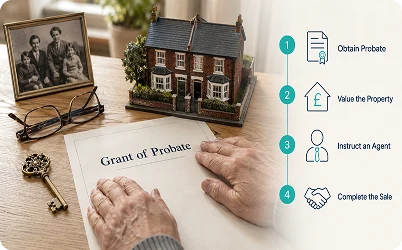
Selling an inherited property in the UK is not simply a case of listing the home and accepting an offer. Before you can legally complete a sale, you must obtain the legal authority to deal with the estate, understand your inheritance tax and capital gains tax position, and navigate a conveyancing process that has specific differences from a standard sale. None of these steps is insurmountably complex, but they do need to be taken in the right order and with the right professional support.
This guide explains every stage of the process from what inherited property means in law through to completion and post-sale tax reporting. It applies to property in England and Wales.
If you are preparing to sell an inherited property in Leicestershire or the Midlands, use the free Valuation Calculator on YooSell to get a current market value estimate before you make any decisions about pricing or timing.
What Is Inherited Property
Inherited property is residential or commercial property that passes to one or more individuals following the death of the owner. The transfer of ownership can occur in several ways depending on whether the deceased left a valid will and how the property was held.
Property Left by Will
When a person dies leaving a valid will, the property they owned passes according to the terms of that document. The will names one or more executors who are responsible for administering the estate, settling debts and tax liabilities, and distributing assets to the named beneficiaries. Inherited property in this context is property that the deceased has specifically left to one or more people by name, or that forms part of the residual estate distributed after specific gifts have been made.
Property Passing Under Intestacy Rules
When a person dies without leaving a valid will, they are said to have died intestate. In England and Wales, the rules of intestacy determine who inherits from an intestate estate. These rules follow a defined order of priority, beginning with a surviving spouse or civil partner, followed by children and then more distant relatives. If the deceased had no surviving relatives within the scope of the intestacy rules, the estate passes to the Crown.
A person who inherits property under the intestacy rules does not hold it under a will. They receive it because the law determines they are entitled to it. The practical implications for a sale are broadly the same as for property inherited under a will, though the administration process differs in some respects.
Jointly Owned Property
Property that was jointly owned by the deceased and one or more other people may or may not form part of the estate depending on how the ownership was structured.
Joint Tenancy
Where property was held as joint tenants, the surviving owner or owners automatically inherit the deceased's share under the right of survivorship. The property does not pass through the will or the intestacy rules. It passes directly to the surviving joint tenant. No grant of probate is required to deal with the property in this case, though the Land Registry record will need to be updated to reflect the sole or new joint ownership.
Tenancy in Common
Where property was held as tenants in common, each owner holds a defined share of the property. The deceased's share does not pass automatically to the surviving owner. It forms part of the estate and passes according to the will or the intestacy rules. A grant of probate or letters of administration will be needed before the deceased's share can be dealt with.
Understanding Probate: The Legal Authority to Sell
The most important preliminary step when selling an inherited property is obtaining the legal authority to deal with the estate. Without this, you cannot legally complete a sale.
What Is Probate
Probate is the legal process through which a deceased person's estate is administered. Where the deceased left a valid will, the named executor applies to the Probate Registry for a grant of probate. This is an official document confirming the executor's authority to deal with the assets of the estate, including any property.
Where there is no will, a close relative typically a spouse, civil partner, or adult child applies for letters of administration. The letters of administration serve the same legal function as a grant of probate but apply to an intestate estate.
When You Need Probate to Sell a Property
Probate is almost always required before you can complete the sale of a property that was solely owned by the deceased. If the property was held as joint tenants and is passing by survivorship, probate may not be needed specifically for the property, though it may still be required for other assets in the estate.
The key legal rule is that you cannot exchange contracts or complete a sale of an inherited property until the grant of probate or letters of administration have been issued. The legal title to the property remains with the deceased's estate until probate is granted, and without proof of authority to act, the buyer's solicitor cannot safely proceed.
Can You Market a Property Before Probate Is Granted
Yes. You can list the property for sale, arrange viewings, and accept an offer before probate is granted. This is common practice and allows you to use the time during which probate is being processed to find a buyer. However, you must be transparent with any prospective buyer that the sale cannot complete until probate is issued. Most buyers and their solicitors understand and accept this.
Marketing before probate gives you a head start and can reduce the overall time from death to completion. If you accept an offer and probate is granted shortly afterwards, the transaction can proceed into conveyancing immediately rather than needing to find a buyer from scratch once probate is in hand.
How Long Does Probate Take
Straightforward estates where there is a clear will, no disputes, and a modest inheritance tax liability typically take between three and six months from the date of application to the grant of probate. More complex estates involving inheritance tax calculations, asset valuations, or disputes among beneficiaries can take considerably longer. As of 2026, the Probate Registry's processing times remain a significant variable, with some applications taking longer due to administrative backlog.
The Probate Fee
The standard probate application fee for estates worth more than five thousand pounds is three hundred pounds as of 2026. This is paid to the Probate Registry when the application is submitted.
The Date-of-Death Valuation
A professional valuation of the property at the date of death is required for two distinct purposes: to calculate any inheritance tax liability on the estate, and to establish the base cost for capital gains tax purposes if the property is later sold.
Why the Probate Valuation Matters
The probate value is the market value of the property on the date the owner died. This figure is used in the inheritance tax return submitted to HMRC. It is also the starting point for any capital gains tax calculation if the property is sold after it has been inherited. Getting the valuation right matters because:
Too High a Valuation
A valuation that is higher than the property was actually worth at the date of death increases any inheritance tax liability on the estate. However, it also increases the CGT base cost, which can reduce any taxable gain if the property is later sold for more.
Too Low a Valuation
A valuation that is lower than the true market value at death reduces the inheritance tax calculation, but HMRC's Valuation Office Agency has the right to challenge probate valuations it considers inaccurate. A low probate valuation also reduces the CGT base cost, potentially increasing the taxable gain on a future sale.
How to Obtain a Date-of-Death Valuation
A date-of-death valuation should be obtained from a qualified RICS-accredited surveyor or a local estate agent with documented knowledge of the specific market at the relevant date. The valuation must be a formal written assessment of what the property would have achieved on the open market on the date of death, taking into account its condition, tenure, and location at that time.
Inheritance Tax: What Sellers Need to Know
Inheritance tax is charged on the total value of the deceased's estate above the applicable tax-free thresholds. It is paid by the estate, not by the individual beneficiaries, and it must be settled before the grant of probate is issued in most circumstances.
The Inheritance Tax Thresholds
Every estate has a nil-rate band of three hundred and twenty-five thousand pounds within which no inheritance tax is charged. Above this threshold, inheritance tax is charged at forty percent.
The Residence Nil-Rate Band
An additional allowance, the residence nil-rate band, applies where the deceased owned a residential property that they lived in at some point and that is being passed to direct descendants. The residence nil-rate band is currently one hundred and seventy-five thousand pounds per person. This means a person leaving their home to children or grandchildren effectively has a combined threshold of five hundred thousand pounds before inheritance tax becomes payable.
Where a spouse or civil partner died before the person whose estate is being administered, any unused nil-rate band or residence nil-rate band from the first death can be transferred to the surviving partner's estate, potentially doubling the thresholds available.
Estates Worth More Than Two Million Pounds
The residence nil-rate band is reduced by one pound for every two pounds the estate exceeds two million pounds. For estates worth two million four hundred thousand pounds or more in the 2025/26 tax year, the residence nil-rate band is lost entirely.
When Inheritance Tax Is Due
Inheritance tax must be paid to HMRC within six months of the date of death. After this deadline, interest is charged at the prevailing HMRC rate, which as of early 2026 is between seven and a half and nine percent. Probate is only issued after at least some inheritance tax has been paid where it is due, which creates a practical challenge for estates where the main asset is property and there is limited liquid cash.
Paying Inheritance Tax Before the Property Sells
If the estate has insufficient liquid assets to pay the inheritance tax bill before probate is granted, several options are available. The personal representatives can apply to pay the inheritance tax on a property in instalments over ten years rather than as a lump sum. Banks and specialist lenders also offer probate loans designed specifically for this situation. In exceptional circumstances where genuine financial hardship can be demonstrated, HMRC may agree to grant probate on credit.
Spousal Exemption
Assets passing between spouses or civil partners are exempt from inheritance tax entirely, regardless of value. A spouse or civil partner who inherits the deceased's property therefore has no inheritance tax liability on that transfer. Inheritance tax may become relevant when the surviving spouse or civil partner later dies and the estate passes to children or others.
Agricultural and Business Property Relief
From April 2026, the previous one hundred percent relief available on qualifying agricultural land and family businesses is capped at the first one million pounds of combined qualifying assets. Above this threshold, relief is reduced to fifty percent. For most residential estates, this change has no direct impact, as it affects primarily larger farms and trading businesses rather than standard residential properties.
Capital Gains Tax on an Inherited Property Sale
Capital gains tax is a separate tax from inheritance tax and operates on a different basis. Understanding the distinction between the two taxes and how CGT is calculated on an inherited property is essential before you decide how and when to sell.
No CGT on Inheriting a Property
There is no capital gains tax charge at the point of inheriting a property. When a person dies, all of the unrealised gains that accumulated during their lifetime on their assets are permanently extinguished. The beneficiary starts with a fresh base cost equal to the market value of the property at the date of death. This tax-free uplift to market value on death is one of the most valuable features of the UK CGT system.
When CGT Becomes Payable
CGT becomes payable only if you sell the inherited property for more than its probate value. The taxable gain is the difference between the sale proceeds and the probate value, minus any allowable deductions.
Allowable Deductions from the Gain
The following costs can be deducted from the gain to reduce your CGT liability:
Solicitor fees and estate agent costs incurred on the sale
The cost of any capital improvements you made to the property after inheriting it, such as an extension or a new kitchen of improved specification. Routine repairs and redecoration do not count as capital improvements and cannot be deducted
The cost of the probate valuation itself, where it was incurred in connection with establishing the CGT base cost
The CGT Rates for Residential Property in 2026/27
Inherited property sold at a gain is taxed as a residential property gain. The rates for the 2026/27 tax year are:
Basic Rate Taxpayers
Gains falling within the basic rate income tax band are taxed at eighteen percent.
Higher and Additional Rate Taxpayers
Gains falling above the basic rate band are taxed at twenty-four percent.
The Annual Exempt Amount
Each individual has an annual capital gains tax exempt amount of three thousand pounds for the 2026/27 tax year. Gains below this threshold are free of CGT. Only the gain exceeding three thousand pounds is taxable.
Where a property is inherited jointly by more than one person, each beneficiary is assessed on their own share of the gain and each has their own three thousand pound annual exemption. This can make it advantageous in some cases to transfer a property to all named beneficiaries before sale rather than selling during the administration period, though this requires careful planning and professional advice.
The 60-Day CGT Reporting Rule
When you sell a UK residential property and capital gains tax is owed, you must report the disposal and pay the tax within sixty days of the completion date. This is done through HMRC's online property reporting service. This deadline is strict. Failure to report and pay within sixty days results in automatic penalties and interest charges.
If you complete a self-assessment tax return, the gain must also be reported there in addition to the sixty-day return.
Private Residence Relief
If you move into an inherited property and use it as your main residence before selling, you may be able to claim Private Residence Relief, which reduces or eliminates the CGT liability for the period you lived there.
The Nine-Month Final Period Exemption
Under legislation codified in the Taxation of Chargeable Gains Act 1992, the final nine months of any period of ownership are automatically treated as a period of main residence for CGT purposes, regardless of whether the owner was actually living there. This exemption applies to inherited properties and can reduce the taxable gain proportionally for beneficiaries who sell within a reasonable period of inheriting.
For example, if you inherit a property and sell it twenty-one months after the date of death without ever moving in, nine of those twenty-one months are treated as main residence. This means nine twenty-firsts of the total gain would be exempt from CGT, with the remaining twelve twenty-firsts being chargeable.
CGT During the Administration Period
If the property is sold by the personal representatives during the administration of the estate, before it is transferred to the beneficiaries, the estate pays CGT rather than the individual beneficiaries. The estate has its own annual exempt amount of three thousand pounds and pays CGT at twenty-four percent on any gain, as there is no basic rate band available to estates.
Practical Steps to Selling an Inherited Property
Once the legal and tax framework is understood, the practical process of selling an inherited property follows a broadly similar path to any other property sale, with some important additional steps specific to the inherited context.
Step One: Locate and Review the Will
The starting point is locating the will and understanding its terms. The will names the executors and sets out how the estate, including any property, is to be distributed. If the original will cannot be found, it may be held by the deceased's solicitor, their bank, or the National Will Register.
If there is no will, identify who is entitled to administer the estate under the intestacy rules. In most cases this will be the closest surviving relative, beginning with a spouse or civil partner.
Step Two: Appoint a Probate Solicitor
While it is possible to apply for probate without professional help, the complexity of most estates and the interaction between inheritance tax, CGT, and the property sale process makes professional guidance strongly advisable. A probate solicitor handles the application to the Probate Registry, prepares the inheritance tax return, liaises with HMRC, and manages the distribution of the estate.
Probate solicitor fees vary depending on the complexity of the estate and the value of the assets involved. A straightforward probate typically costs between one thousand and six thousand five hundred pounds plus VAT. More complex estates with multiple assets, disputes, or significant inheritance tax positions cost more.
Step Three: Obtain the Date-of-Death Valuation
Commission a formal date-of-death valuation from a RICS-accredited surveyor or a qualified local estate agent. This is required for the inheritance tax return and forms the CGT base cost for any future sale. Do this as early as possible as it is needed before the inheritance tax return can be submitted.
Step Four: Secure the Property
Once you have legal authority over the estate or are waiting for probate to be granted, take practical steps to secure the inherited property. This includes:
Notifying the buildings and contents insurer of the change in occupancy. Many standard home insurance policies have exclusions for unoccupied properties and you may need specialist unoccupied property insurance
Ensuring the property is secure, including checking all door and window locks
Arranging for the garden and exterior to be maintained if the property will be empty for some time
Forwarding mail or redirecting it to the executor's address
Ensuring utility bills are being managed and that no services are disconnected that might cause damage such as heating in winter
Step Five: Clear the Property
Before listing an inherited property for sale, the contents typically need to be dealt with. This can be one of the more practically and emotionally demanding aspects of the process.
Distributing Personal Possessions
Personal possessions may be specifically mentioned in the will or distributed among family members by agreement. Items of significant value should be professionally valued before distribution, as they may affect the inheritance tax calculation.
Clearing Furniture and Effects
Items not distributed personally will need to be removed before the property can be effectively presented for sale. Options include house clearance companies, charitable donation, auction, or online sale. Professional house clearance services will typically assess and clear a property's contents for a fixed fee or in exchange for any items of resale value.
Step Six: Prepare the Property for Sale
An inherited property will often have been maintained to the standards and tastes of the previous occupant rather than the current market. A targeted programme of preparation before listing can make a meaningful difference to the price achieved and the speed of sale.
Assessment of Condition
Walk through the property and assess its condition objectively. Identify any obvious maintenance issues such as damaged gutters, worn roof sections, damp patches, or outdated kitchens and bathrooms. Consider which of these to address before sale and which to reflect in the asking price rather than the condition of the property.
Decoration and Presentation
Fresh neutral decoration can significantly improve buyer perception of an inherited property, particularly where the existing decor is very dated or personalised. This does not require a comprehensive renovation. A clean, freshly painted property in good repair is more appealing to buyers than a heavily personalised space with accumulated wear.
Energy Performance Certificate
A valid EPC is a legal requirement before the property can be marketed for sale. Check whether the property has a valid certificate on the government's EPC register. If the certificate has expired or does not exist, commission a new one from an accredited Domestic Energy Assessor before listing.
Step Seven: Set the Asking Price
Pricing an inherited property requires the same market research as any other sale. Use recent HM Land Registry sold price data to identify comparable properties in the same area and assess what buyers have actually paid, not just what sellers are asking. Factor in the condition of the property, any improvements needed, and the current state of demand in the local market.
Use the free Valuation Calculator on YooSell to get a data-driven estimate of the property's current market value as part of your pricing research.
One consideration specific to inherited properties is timing. From a CGT perspective, selling quickly while the sale price is close to the probate value minimises any taxable gain. The longer the property is held, the greater the potential for the value to increase above the probate base cost.
Step Eight: Instruct a Conveyancing Solicitor
The conveyancing solicitor who manages the legal transfer of ownership is separate from the probate solicitor, though in some cases the same firm handles both. Your conveyancing solicitor will need a copy of the grant of probate and the official title documents before the sale can proceed.
Through YooSell, you can access trusted conveyancers directly from your seller dashboard once your listing is live and an offer has been accepted.
Step Nine: List the Property and Manage Viewings
List the property on the appropriate portal or platform once your EPC is in place and the property is ready to present. If you are selling privately, YooSell's Enhanced and Premium plans include a direct Rightmove listing, giving the property maximum visibility on the UK's largest property portal. Visit the YooSell Rightmove page for full details on how it works.
Manage viewings as you would for any property sale. Be prepared to answer buyers' questions about the property's history and condition honestly. If you are aware of any issues from the deceased's occupancy, these must be disclosed on the TA6 Property Information Form.
Step Ten: Accept an Offer and Progress to Completion
Once an offer is accepted, the conveyancing process begins. The key difference from a standard sale is that the executors, not the beneficiaries, sign the contract and the TR1 transfer deed on behalf of the estate. The grant of probate must be available to the buyer's solicitor before exchange of contracts can take place.
Multiple Beneficiaries and Disagreements
Where an inherited property has more than one beneficiary, all must agree to the sale, the buyer, and the agreed price before the executor can proceed. A single beneficiary who objects can block the sale.
When Beneficiaries Cannot Agree
If beneficiaries cannot reach agreement about whether to sell the property or the terms of the sale, any executor or co-owner can apply to the court under the Trusts of Land and Appointment of Trustees Act 1996 for an order compelling a sale. Courts will generally order a sale where the majority of beneficiaries or the executors consider it necessary to wind up the estate and distribute the proceeds, unless there are compelling reasons not to.
This is a last resort and involves legal costs that are borne by the estate. It is always preferable to reach agreement through open communication and, where necessary, the assistance of a mediator before resorting to court.
Distributing the Sale Proceeds
Once the property has been sold, any inheritance tax, CGT, conveyancing costs, and other estate expenses are settled from the proceeds. The remaining net amount is distributed to the beneficiaries according to the terms of the will or the intestacy rules. Your probate solicitor prepares the estate accounts showing exactly how the proceeds have been applied.
Selling a Tenanted Inherited Property
Where the inherited property has sitting tenants, additional considerations apply before a sale with vacant possession can be achieved.
The Renters' Rights Act 2025
Since 1 May 2026, the Renters' Rights Act 2025 governs all private residential tenancies in England. Every private tenancy converted to an assured periodic tenancy when the Act commenced. Section 21 no-fault evictions no longer exist.
Ground 1A: Selling with Vacant Possession
The route to recovering vacant possession when you intend to sell an inherited tenanted property is Ground 1A, a mandatory ground introduced by the Renters' Rights Act 2025. The conditions are strict:
Notice Requirements
You must serve at least four months' written notice on the correct prescribed form. The notice cannot expire within the first twelve months of the tenancy, and for tenancies that converted to assured periodic tenancies on 1 May 2026, the twelve-month period runs from the original tenancy start date, not from commencement of the Act.
Genuine Intention to Sell
You must genuinely intend to sell the property and be able to evidence that intention, for example through a solicitor instruction or an estate agency listing. Courts will not grant possession under Ground 1A where there is evidence that the stated intention to sell is not genuine.
Re-letting Restriction
Once you have served a Ground 1A notice, you cannot re-let or re-market the property as a rental for a period running twelve months from the notice expiry date, even if the sale subsequently falls through. Breach of this restriction is a criminal offence.
Selling with a Tenant in Place
An alternative to seeking vacant possession is to sell the property with the tenant in situ. Some investors and landlords actively seek tenanted properties. The buyer takes over the tenancy on its existing terms and the sale can proceed without the tenant needing to vacate. The sale price is typically lower than vacant possession value, reflecting the discount that buyer demand for tenanted properties requires.
Selling an Inherited Property Where There Is a Mortgage
Where the deceased had an outstanding mortgage on the property, the mortgage does not automatically transfer to the beneficiaries. The mortgage is a liability of the estate.
Notifying the Lender
The lender should be notified of the borrower's death promptly. Most lenders will allow a period of several months for the estate to be administered and the property sold without immediately calling in the debt, provided payments continue to be made where possible or the estate is being actively administered.
Selling to Redeem the Mortgage
In many cases, the primary reason for selling an inherited property is to redeem the outstanding mortgage and distribute the net equity to the beneficiaries. Your probate solicitor and conveyancing solicitor will coordinate the redemption of the mortgage from the sale proceeds on completion day, in the same way as any other mortgage redemption.
Selling Your Inherited Home with YooSell
If you are selling an inherited property in Leicestershire or the Midlands, YooSell offers a self-service selling platform that gives you full control of the sale without paying traditional estate agent commission.
Why Sellers Choose YooSell
YooSell lets you list, manage, and complete your sale directly. You set your asking price, manage viewings through a built-in booking diary, communicate with verified buyers through the platform, and access trusted conveyancing professionals directly from your dashboard once an offer is accepted. There is no commission taken at completion, only a simple fixed monthly listing fee.
See how the full process works on the How It Works page or explore plan options on the Pricing page.
Verified Buyers Only
Every buyer on YooSell completes identity and financial verification before they can make an offer. This means you only receive offers from buyers who are confirmed as financially qualified, which reduces the risk of a sale falling through after the offer has been accepted.
List on Rightmove Through YooSell
You can list the inherited property directly on Rightmove through YooSell by choosing the Enhanced or Premium plan. Visit the YooSell Rightmove page for full details.
Free Tools to Help You Plan
Valuation Calculator: get a current market value estimate before you price your listing
Cost Saving Calculator: see exactly how much you save compared to a traditional estate agent's commission
Stamp Duty Calculator: understand the buyer's SDLT liability at the April 2025 rates
Mortgage Calculator: plan any onward purchase
Frequently Asked Questions
Read Our Blog
Tips, insights and expert advice to help you sell smarter.

Slough House Prices & Property Market Analysis 2026
Slough house prices averaged £334,000 in May 2026 according to ONS data, down modestly from £348,000 a year earlier. The market has softened in the short term, with flat prices falling 7.8% and transaction volumes down significantly. Average monthly rents, however, have risen to £1,572, strengthening the case for buying over renting. The Elizabeth Line puts Slough to Paddington in around 15 minutes, keeping buyer demand structurally strong. For buyers with a medium-term horizon, Slough remains one of the better-value commuter markets in the South East.

Nottingham House Prices 2026: What Buyers Should Know
Nottingham house prices in 2026 are holding steady, with the ONS recording an average of £192,000 in the city area as of June 2026. First-time buyers are paying around £177,000 on average, making Nottingham one of the more accessible cities in the East Midlands. Prices have risen 18.2% over the past five years, despite a brief flat period in 2025 and early 2026. Average monthly rents have reached £1,011, strengthening the financial case for buying over renting. West Bridgford commands the highest prices while areas like Sherwood and Bulwell offer strong value for budget-conscious buyers.

Why YooSell Is the Best Platform in the UK to List Property on Rightmove
You can list your property on Rightmove without an estate agent by using a Rightmove-registered listing platform such as YooSell. Private individuals cannot list directly on Rightmove, but portal-approved services can. YooSell includes Rightmove listing on all three plans from £29 per month, with the first month free, zero commission at completion, and ID-verified buyers as standard. Rightmove receives approximately 52.9 million monthly visits and accounts for around 70% of all time UK buyers spend on property portals, making it the most important portal for any UK seller in 2026.
Start Selling Your Home Today!
Take control of your sale with YooSell. Get started today and explore how we can help you sell smarter, faster, and with less hassle.