|Reading time: 12 minutes
What Is Gazumping? How UK Sellers and Buyers Can Avoid Losing a Sale in 2026

Olivia G.
Olivia writes buyer-focused guides on viewings, offers, and due diligence. Her articles aim to make private-sale decisions feel more confident and transparent.
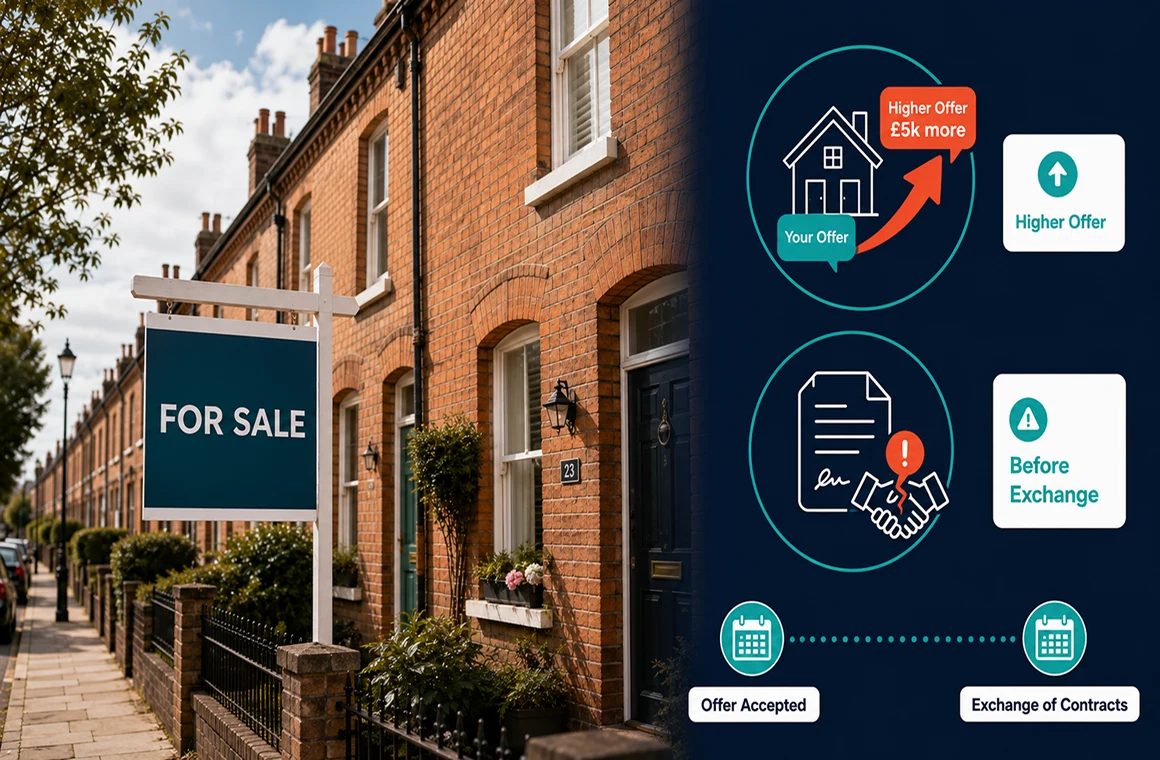
Gazumping is when a seller accepts a higher offer from a new buyer after already agreeing a sale with the original buyer, before contracts have been exchanged. It is entirely legal in England and Wales because no property sale becomes legally binding until the moment of exchange. The original buyer loses the property and, in most cases, loses every penny they spent on surveys, solicitor fees, and mortgage arrangement costs in the process.
It happens more than most people realise. According to a nationally representative survey by Market Financial Solutions covering 524 UK property buyers, 31% of people in England and Wales who bought a property said they had been gazumped at least once. A further 26% admitted to gazumping another buyer themselves. And here is the part that rarely gets mentioned: while gazumping is almost always framed as a buyer problem, it creates serious risks for sellers too. A gazumped buyer can withdraw their goodwill, torpedo the chain, or trigger a domino collapse that leaves the seller back at square one, months down the line and thousands of pounds poorer.
This guide covers both sides of the gazumping question in 2026: what it is, why it happens, what it costs, and exactly what buyers and sellers can do to avoid it.
What Is Gazumping and How Does It Work in Practice?
Gazumping is when a seller, having verbally accepted one buyer's offer, subsequently accepts a higher offer from a different buyer before exchange of contracts. The term is used almost exclusively in England, Wales, and Northern Ireland, where property sales are not legally binding until contracts are exchanged in writing.
Gazumping is possible in England and Wales because of the "subject to contract" principle that governs all UK property transactions. When a seller accepts an offer, the agreement is verbal and conditional. It carries moral weight but zero legal enforceability. Either party can walk away at any point before exchange without owing the other side anything, regardless of what has been verbally agreed or how much money has already been spent.
The timeline where gazumping occurs is the conveyancing phase: the weeks or months between offer acceptance and exchange of contracts. According to Pauzible's 2026 analysis, the average time from conveyancer instruction to completion in the UK is around 160 days. That is a long window. The longer the gap, the greater the opportunity for a new buyer to emerge with a higher offer.
Estate agents are also legally required to pass on all offers received to the seller, even after one has been accepted. This is a professional obligation under the Estate Agents Act 1979. That means a motivated bidder can legitimately approach the selling agent weeks into your conveyancing process and put a higher number on the table, with no legal barrier to the seller accepting it.
Gazumping vs Gazundering: What Is the Difference?
These two terms are often confused, and both are worth knowing.
Gazumping is a seller-side act. The seller accepts a higher offer and drops the original buyer. The buyer loses the property and any money spent getting to that point.
Gazundering is a buyer-side act. The buyer reduces their offer at the last minute, usually just before exchange, knowing the seller is unlikely to restart the whole process from scratch. The seller faces the choice of accepting the lower price or relisting and losing months of progress.
Both practices are legal in England and Wales. According to Estate Agent Power's 2025 data, gazumping affects 31% of buyers and gazundering affects 15% of sellers. In a slow market with elevated buyer leverage, gazundering is more common. In a competitive market with limited supply, gazumping is more common.
Is Gazumping Legal in the UK?
Yes. Gazumping is entirely legal in England, Wales, and Northern Ireland. A seller who accepts a higher offer before exchange of contracts breaks no law, forfeits no deposit, and owes the original buyer nothing beyond a difficult conversation.
This surprises many people. According to industry surveys cited by Pauzible's 2026 property guide, 78% of UK homebuyers believe gazumping should be made illegal. Despite repeated calls for reform and multiple government consultations, no legislation banning the practice has been passed. The system has remained fundamentally unchanged for decades.
Scotland is the meaningful exception. In Scotland, once a seller's solicitor formally accepts a buyer's offer through "concluded missives," the agreement becomes legally binding at a much earlier stage. A verbal acceptance in Scotland can create binding obligations. As a result, gazumping in Scotland is extremely rare, and the Scottish system is frequently cited as the model England and Wales should adopt.
As of 2026, no legislative changes to England and Wales's gazumping framework are confirmed. According to Ownio's February 2026 property guide, various proposals have been put forward over the years, including mandatory reservation agreements and binding pre-contract commitments. None have been implemented. Until that changes, buyers and sellers must work within the current system.
Why Does Gazumping Happen? The Real Causes
Understanding why gazumping happens helps both sellers and buyers address it at root rather than simply reacting after the fact.
The causes fall into four main categories:
Long conveyancing timelines. The average UK property sale takes around 160 days from instruction to completion. The longer the pre-exchange period, the more opportunity a new buyer has to approach the agent. Reducing the timeline is the single most effective way to reduce gazumping risk for everyone.
Rising markets and price competition. Gazumping is more common when house prices are rising and buyer demand is strong. In competitive local markets, particularly in the Midlands where supply has tightened in 2026, this dynamic can emerge quickly after an offer is accepted.
Seller financial pressure or anxiety. Some sellers gazump not out of greed but out of fear. If a conveyancing process drags on and a higher offer arrives, a seller under financial pressure may feel they cannot afford to say no. A smooth, well-progressed process protects buyers far more effectively than any moral appeal.
Estate agent obligations. Agents must pass on all offers to the seller, regardless of whether a sale is already agreed. An agent who deliberately withholds a higher offer risks losing their licence under the Estate Agents Act 1979. This structural fact means the pressure on sellers to consider competing bids will always be present while a sale is open.
What Does Gazumping Cost the Buyer?
Being gazumped is not just emotionally devastating. It has real, immediate financial consequences.
When a buyer is gazumped before exchange, they typically lose:
Solicitor and conveyancing fees for work completed to date: usually £500 to £1,500.
Survey costs: a homebuyer survey typically costs £400 to £1,500 depending on property type and survey level.
Mortgage arrangement and valuation fees: lenders often charge upfront arrangement fees and valuation costs that are non-refundable once committed.
Time: property searches reset and the market may have moved on.
According to Clifton Private Finance's analysis, industry surveys suggest more than a third of homebuyers have experienced gazumping, with the average gazumped buyer losing over £2,000 in wasted fees. On higher-value properties with specialist surveys or significant legal work, that figure can reach £4,000 to £5,000.
Home buyer protection insurance is available for premiums of approximately £50 to £100. These policies typically reimburse survey, search, and legal fees if a sale falls through through no fault of the buyer. It is not a solution to gazumping, but it provides a financial safety net if it happens. Premiums are worth paying from the moment an offer is accepted.
How Can Buyers Avoid Being Gazumped? 7 Practical Steps
You cannot guarantee you won't be gazumped under the current system in England and Wales. But you can meaningfully reduce the risk through speed, preparation, and deliberate relationship management.
Move as fast as possible to exchange. Instruct your solicitor before you make your offer. Have your mortgage Agreement in Principle in place before you view. Respond to solicitor queries the same day, every day. The longer the pre-exchange period, the wider the gazumping window.
Ask the seller to take the property off the market. Once your offer is accepted, ask the selling agent or seller directly to mark the property as sold and remove it from Rightmove and Zoopla. This doesn't prevent gazumping legally, but it closes the pipeline of new competing offers.
Build a personal relationship with the seller. A buyer who has communicated genuinely and demonstrated commitment is psychologically harder to drop for a faceless higher bidder. This matters more than most buyers expect.
Request a lock-out or exclusivity agreement. A lock-out agreement is a legally binding contract where the seller commits to not accepting other offers for a fixed period, typically four to eight weeks. If the seller breaches it, the buyer can claim damages for wasted costs. Uncommon in standard sales but enforceable and worth requesting on higher-value properties.
Instruct your solicitor to complete property information forms immediately. The sooner the seller's TA6 and TA10 forms are complete and enquiries are raised, the faster the conveyancing moves. Delays in this paperwork are one of the most common causes of extended pre-exchange periods.
Take out home buyer protection insurance. For £50 to £100, these policies cover survey, solicitor, and search costs if the sale falls through before exchange. It does not prevent gazumping but removes the financial sting if it happens.
Use a platform where buyers are ID-verified. When buying through a platform where buyers are pre-verified for identity and proof of funds, you present as a more committed, lower-risk buyer to sellers. YooSell's verified buyer system confirms buyer identity through biometric checks and proof of funds before any offer is made, giving sellers greater confidence to stay committed to the agreed sale.
How Can Sellers Avoid the Gazumping Trap?
Almost no guide covers this angle, and it matters enormously. Many sellers who accept a higher offer and drop their original buyer regret it quickly.
Here is why gazumping is often a bad decision for sellers:
Chain collapse risk. If your original buyer is part of a chain, dropping them can collapse multiple transactions below you simultaneously. A higher offer from a new buyer who then falls through puts you back to zero, months later, in a less motivated market.
Delay costs. Every week spent renegotiating with a new buyer costs you mortgage interest, maintenance, insurance, and time. The financial premium of a higher offer can be significantly eroded within weeks.
Buyer goodwill withdrawal. A gazumped buyer who moves on can damage your property's reputation on portals, particularly if the property relists after a failed sale with a visible "previously SSTC" history.
The right way to handle a competing offer as a seller, if one arrives after you've agreed a sale, is to consider all the variables before acting. How close are you to exchange? Is the new buyer in as strong a position financially and logistically as your current one? Can you give your current buyer the opportunity to match or improve their offer? A transparent conversation is more likely to preserve the relationship and the sale than a sudden switch.
The most gazumping-resistant selling method is one where you control the buyer selection process directly from the start. When you sell through YooSell, every buyer is ID-verified and proof-of-funds confirmed before they can submit an offer. You receive offers directly, communicate through the platform, and make your decision without the intermediary pressure that traditional agents sometimes apply to accept newer, higher bids that serve the agent's commission timeline more than your own interests.
Use YooSell's free Valuation Calculator to price your property accurately before listing. An accurately priced property attracts serious, committed buyers from day one and reduces the extended pre-exchange periods where gazumping risk is highest.
Gazumping in the Midlands: Context for 2026
The East Midlands and wider Midlands market in 2026 is more competitive than the national average for affordable properties. Manchester, Leicester, and Birmingham all rank among the fastest-growing buyer markets in the UK, creating genuine gazumping conditions for well-priced properties in strong locations.
For sellers in Leicestershire and surrounding areas, the right approach in a competitive market is to select a buyer based on quality, not just price. A chain-free buyer with mortgage pre-approval, or a cash buyer, who is verified and ready to exchange quickly is more valuable than a slightly higher offer from a buyer in a complex chain who needs two months to arrange finance.
Browse current listings on YooSell to see how buyers and sellers in the Midlands are transacting right now, and read YooSell's Area Guides for neighbourhood-level market context across the East Midlands.
What to Do If You Have Already Been Gazumped
If you have been gazumped, these are the immediate practical steps.
First, instruct your solicitor to stop all work immediately to avoid accumulating further fees. Second, request itemised invoices for all work completed to date from your solicitor and surveyor. Third, check whether you took out home buyer protection insurance at the start of the process. If you did, initiate your claim promptly.
Beyond the immediate steps, consider whether the property is genuinely worth pursuing at the new price. In some cases, a gazumped buyer can make a stronger counter-offer that the seller accepts over the new bidder. This is not common, but it does happen.
If you have decided to move on, use the experience to approach your next offer more strategically. Instruct your solicitor before viewing. Have your mortgage Agreement in Principle confirmed before making any offer. Request that the seller takes the property off the market the moment your offer is accepted.
Read YooSell's full property guides for practical support on every stage of the buying and selling process.
Conclusion
Gazumping is one of the most frustrating realities of the UK property market in 2026, and the outlook for legislative change in England and Wales remains uncertain. The practice is legal, it is common, and for many buyers it is financially painful, with the average gazumped buyer losing over £2,000 in wasted fees. For sellers, the risks of gazumping a committed buyer are equally real, even if less visible from the outside.
The single most important thing both sides can take from this guide is that speed to exchange is the most powerful protection available. The longer the gap between offer acceptance and exchange of contracts, the greater the window for competing offers, for cold feet, and for the whole process to unravel. Buyers who move fast, prepare thoroughly, and build genuine relationships with sellers consistently come out better. Sellers who choose quality, committed buyers and progress decisively toward exchange consistently achieve cleaner, faster completions.
The selling method matters too. When you sell through YooSell, all buyers are ID-verified and proof-of-funds confirmed before making offers. You control the communication, the offer evaluation, and the timeline directly, without the intermediary pressure that traditional agents sometimes introduce. You list on Rightmove and reach the same buyer pool as any agent-listed property, for a fixed monthly fee from £49.50 with zero commission at completion.
Here is your clear next step. Use YooSell's free Valuation Calculator to price your property accurately before listing. Then register on YooSell to list with verified, commitment-ready buyers and direct communication. The faster you move from listing to exchange, the less gazumping risk matters.
The system has a flaw. Your preparation is the fix.
Frequently Asked Questions
Start Selling Your Home Today!
Take control of your sale with YooSell. Get started today and explore how we can help you sell smarter, faster, and with less hassle.