Reading
Thinking of moving to Reading in 2026? This original area guide covers the best neighbourhoods from Caversham to Earley, verified property market data, the Elizabeth line to Canary Wharf, Microsoft and Oracle campuses, Reading Festival, Reading Abbey, schools including two grammar schools, and how to sell your Berkshire home commission-free with YooSell.

Oliver H.
Oliver covers Midlands property trends and practical selling tips for homeowners. He focuses on clear, jargon-free advice that helps private sellers stay in control.
Reading is the county town of Berkshire and one of the most strategically positioned towns in England. Sitting at the confluence of the River Thames and River Kennet, approximately 40 miles west of London, it combines outstanding transport connectivity with a powerful technology and knowledge economy, a lively cultural scene anchored by the legendary Reading Festival, and a property market that sits below the wider Berkshire county average while remaining above the national average. The arrival of the Elizabeth line, running directly into the heart of London via Paddington, Bond Street, Canary Wharf, and on to Liverpool Street, has transformed Reading's position in the national property market, making it one of the most practical large towns in England for London workers who want space, a genuine civic community, and fast daily access to the capital.
Whether you are a technology professional at one of Reading's global campuses, a family relocating from London, or a homeowner considering selling your Reading property without paying estate agent commission, this guide gives you an accurate and original picture of the town in 2026.
Browse verified property listings in and around Reading on the YooSell Find a Home platform, with no agent fees and direct access to verified seller listings across the RG1 to RG31 postcode areas.
About Reading?
Reading is a town and borough in Berkshire, England, and the county town of Berkshire. It is Berkshire's largest town. The total population of Reading's built-up area was 203,795 at the 2021 census, with the 2024 ONS mid-year estimate for the Borough of Reading local authority placing the population at 182,907. Reading serves as the western terminus of the Elizabeth line and sits at the junction of the Great Western Main Line and the M4 motorway, making it one of the most important transport nodes in the South East outside London itself.
Reading grew around a crossing of the River Kennet, approximately one mile upstream from its confluence with the River Thames. Its history stretches back to the 8th century. By 1525, Reading was the largest town in Berkshire and the tenth wealthiest town in England for taxable wealth. Reading Abbey, founded by King Henry I in 1121, was one of the most powerful Benedictine monasteries in medieval England and the burial place of Henry I. The abbey ruins, restored and opened to the public as a major heritage site, remain one of the most significant medieval remains in the South East.
Reading became the county borough of Berkshire in 1888 and the sole county town in 1867, taking over from Abingdon. Today it is administered by Reading Borough Council and sits within the parliamentary constituencies of Reading Central and Reading West and Mid-Berkshire.
The town has a significantly younger population profile than the national average, with a median age of 35 years, reflecting its large student population at the University of Reading and its attraction of young professionals working in the technology sector. The population grew 11.9% between 2011 and 2021, one of the stronger growth rates among large English towns, driven by the tech economy and consistent London-overspill demand.
Reading's Economy and the Technology Sector
Reading is one of the most significant technology and knowledge economy centres in England and is often referred to as the commercial capital of the Thames Valley. Its gross value added output is approximately £20 billion, making it an economically self-sustaining hub rather than merely a commuter town.
Major technology companies with significant campuses and headquarters in Reading include Microsoft, whose UK headquarters is at Thames Valley Park, and Oracle, which also has a major campus at Thames Valley Park. Other technology companies with a significant presence in the town include Huawei Technologies, Cisco, Ericsson, CGI Inc., Agilent Technologies, and Pegasystems. Thames Valley Business Park is home to the Microsoft and Oracle campuses, as well as other major employers. Green Park Business Park, on the southern edge of the town, is home to global pharmaceutical giant Bayer Life Sciences, which relocated its UK operations to Reading in 2016.
The town's technology heritage stretches back to the early presence of International Computers Limited and Digital Equipment Corporation, which established Reading as one of England's first significant technology employment centres in the latter decades of the 20th century. Other major employers in the town include the insurance company Prudential, PepsiCo, Wrigley, and Hibu, formerly the Yell Group. During morning peak hours, approximately 30,000 workers arrive inward into Reading from surrounding areas, confirming the town's status as a net importer of labour and a genuine employment centre in its own right.
For property buyers seeking proximity to technology employment without London prices, Reading represents one of the most compelling locations in England. Use the free YooSell Valuation Calculator to understand current market values before listing or making an offer on a Reading property.
Reading Property Market 2026
Reading occupies a distinctive position in the South East property market: it sits below the Berkshire county average while remaining above the UK national average, combining genuine value relative to the wider region with the premium that reflects London proximity, technology employment, and exceptional rail connectivity.
Property Market Overview
According to ONS UK House Price Index data, the average house price in Reading was £350,000 in July 2026, down slightly by 1.2% from July 2025. For homes bought with a mortgage, the average house price was £353,000 in July 2026. The average price paid by first-time buyers was £308,000 in July 2026, slightly lower than the revised £312,000 in July 2025. Home movers paid an average of £432,000 in July 2026.
Private rents in Reading rose to an average of £1,574 per month in August 2026, an annual increase of 1.4% from £1,552 in August 2025, according to ONS Price Index of Private Rents data. This modest rental growth was significantly below the national average rental increase over the same period, suggesting Reading's rental market has plateaued at a high base following years of strong growth.
Construction Capital's analysis of HM Land Registry price-paid data places the Reading median sold price at £340,000, based on 1,652 residential sales over the past 12 months, representing a year-on-year change of minus 2.9%. Reading ranks eighth by price out of eight principal Berkshire towns, making it the most affordable town in the county. The median price of £340,000 places Reading £60,000 below the Berkshire county median of £400,000 but £55,000 above the UK national median of £285,000.
Reading median prices have moved from £350,000 in Q1 2025 to £339,000 in Q2 2026, a change of minus 3.1% over five quarters. The South East regional average was £376,819 in April 2026, placing Reading below its regional average and confirming that the town offers relative value within the South East context.
Property Types in Reading
Reading's housing stock reflects its history as a Victorian industrial and commercial town alongside significant 20th and 21st-century residential development. Detached homes command a median of approximately £595,000 to £612,500 depending on the dataset. Flat properties are the most accessible at approximately £222,500 to £227,500. The spread of over £370,000 between the most and least expensive types reflects the diversity of Reading's housing stock, from Victorian terraces in Caversham and West Reading through to modern apartments at Reading Bridge and family semis in Earley and Tilehurst.
Recent verified HM Land Registry transactions illustrate this range. A semi-detached property in RG2 7NB sold for £430,000 in February 2026, a terraced property in RG4 7RD sold for £440,000 in February 2026, a flat in RG1 6NB sold for £225,000 in February 2026, and a flat in RG2 0DJ sold for £140,000 in the same month. A semi-detached in RG31 6LH achieved £675,000 in February 2026, illustrating the premium commanded by the more desirable western suburban areas.
Use the YooSell Mortgage Calculator to understand your monthly repayments and the YooSell Stamp Duty Calculator to calculate your full tax liability before completing on a Reading property.
How Much Could You Save Selling Without an Agent?
Traditional estate agents in Reading typically charge between 1% and 3% commission on the final sale price. On a Reading home sold at the median of £340,000, a 1.42% commission rate takes approximately £4,828 from your proceeds. With YooSell, you pay a fixed monthly fee from just £49.50 and keep 100% of your agreed sale price. You can also list your property on Rightmove through YooSell directly, giving your home full visibility on the UK's biggest property portal without paying estate agent commission. Use the YooSell Cost Saving Calculator to see exactly what you could keep.
Best Areas and Neighbourhoods in Reading
Reading covers a wide range of distinct residential communities, each with its own character, price point, and practical amenities. Understanding the differences helps buyers focus their search on the right area for their priorities and budget.
Caversham
Caversham is consistently named Reading's most desirable residential area, sitting on the north bank of the River Thames across Caversham Bridge from the town centre. Administratively it lies within South Oxfordshire but is functionally a suburb of Reading. Caversham offers Victorian and Edwardian detached and semi-detached homes on wide, leafy streets, excellent primary schools, proximity to the river and Caversham Park, and a high street with independent cafes, restaurants, and shops. Caversham Heights, on the ridge above the main Caversham village, offers panoramic views across Reading and the Thames Valley and is among the most sought-after addresses in the whole area. Prices in Caversham and Caversham Heights command a premium over the Reading average, reflecting consistent and strong demand.
Search for available properties in Caversham on the YooSell Find a Home platform.
Tilehurst
Tilehurst, to the west of Reading on the ridge above the Thames Valley, is a large and well-established residential suburb popular with families. It offers a mix of Victorian, inter-war, and post-war semi-detached and detached homes at varying prices and is served by its own railway station on the Great Western Main Line. Tilehurst has good primary and secondary schools, local shops along the Oxford Road corridor, and access to the Thames Path and Prospect Park.
Earley and Lower Earley
Earley and Lower Earley, to the south-east of Reading, are among the most popular suburban areas for families and professionals. Earley has a mix of 1930s semi-detached housing on the older streets and substantial post-war developments on Lower Earley, which was one of the largest private residential developments in Europe when it was built from the 1970s onwards. The area has multiple well-regarded schools, the Maiden Erlegh School which is one of the most oversubscribed secondary schools in the Reading area, and excellent bus connections into the town centre and Reading railway station.
Woodley
Woodley, to the east of Earley, is a large suburban town that forms part of the wider Reading urban area. It has its own town centre shopping facilities, multiple schools, sports clubs, and leisure facilities, and is popular with families seeking more space at prices that tend to be slightly lower than the equivalent in Earley or Tilehurst.
West Reading and Newtown
West Reading and the Newtown area immediately west of the town centre have become increasingly popular with young professionals and those who want urban character at lower prices. The area has a vibrant food, drink, and independent retail scene, particularly along Oxford Road, and is within walking distance of Reading railway station and the town centre.
Whitley
Whitley, to the south of the town centre, is one of Reading's more affordable residential areas, with a high proportion of social housing alongside private terraced and semi-detached streets. The area is close to Reading Football Club's Select Car Leasing Stadium and benefits from bus connections to the town centre.
Sonning and the Riverside Villages
Sonning and the riverside villages to the north-east of Reading, including Woodley, Sonning Common, and Emmer Green, attract buyers seeking a village or semi-rural setting with practical access to Reading's employment centres and railway station. Sonning itself is a particularly attractive Thames-side village with a historic church, the Mill at Sonning theatre, and a tight-knit community character that commands a significant premium over the Reading average.
Schools in Reading
Reading has a range of primary and secondary schools serving its different residential communities, with secondary provision that includes some of the most oversubscribed schools in Berkshire. School quality varies considerably across different parts of the town, and families are strongly advised to research individual Ofsted reports and performance data before making residential decisions based on school catchment.
Primary Schools in Reading
Reading has a large number of primary schools across its residential areas. Caversham, Tilehurst, and Earley are generally regarded as having the strongest cluster of primary schools in the wider Reading area. Parents should confirm current Ofsted ratings and catchment boundaries directly with Reading Borough Council ahead of each year's admissions process, as these can change between academic years and the new Ofsted report card system introduced from September 2024 no longer issues a single overall effectiveness judgement for most state-funded school inspections.
Secondary Schools in Reading
Maiden Erlegh School
Maiden Erlegh School, serving Earley and the south-eastern suburbs of Reading, is consistently one of the most oversubscribed secondary schools in Berkshire. Its combination of Good Ofsted judgements, strong academic outcomes, and active extra-curricular programme makes proximity to its catchment area a primary consideration for families choosing where to live in Reading.
Reading School
Reading School, on Erleigh Road in the town centre, is a selective grammar school for boys providing education from age 11 through to sixth form. It is one of the highest-performing state secondary schools in England and consistently ranks among the top non-fee-paying schools nationally. Entry is by competitive examination and the school is highly oversubscribed, with applications drawn from a wide area across Berkshire and beyond.
Abbey School and Kendrick School
The Abbey School is a leading independent day school for girls aged 3 to 18, and Kendrick School is a selective grammar school for girls on Kendrick Road providing outstanding academic outcomes. Together with Reading School for boys, these three schools give Reading an unusual concentration of high-performing secondary educational options. Kendrick School entry is by selective examination.
The University of Reading
The University of Reading is a major research university with its main Whiteknights campus set within 130 acres of parkland and lake approximately 2 miles south of the town centre. The university has approximately 22,000 students and is ranked among the UK's leading research universities, with particular strengths in meteorology and climate science, agriculture and food science, law, and pharmacy. The university is a major employer in the town and contributes significantly to Reading's younger demographic profile and its property rental market. The nearby Thames Valley Science Park, adjacent to the Whiteknights campus, is a purpose-built science and technology business park designed to commercialise research from the university and attract high-growth technology businesses to the area.
Special Educational Needs Provision
Reading Borough Council provides SEND home-to-school transport support for eligible children across the borough. Families with children who have additional needs should contact Reading Borough Council's SEND team directly to discuss eligibility and available specialist provision.
Transport and Commuting from Reading
Transport is one of Reading's defining strengths as a place to live. The town's position at the intersection of the Great Western Main Line and the M4 motorway, combined with its role as the western terminus of the Elizabeth line, gives it a level of connectivity that is exceptional for any English town at this distance from London.
Reading Railway Station and London Paddington
Reading railway station is one of the busiest railway stations in England outside London. It is served by Great Western Railway on the Great Western Main Line, which provides non-stop fast trains to London Paddington in approximately 23 to 26 minutes, making Reading one of the fastest-connected towns to central London in the entire South East outside the immediate Home Counties. Frequent GWR services run throughout the day, with a high frequency of fast and stopping services.
Reading is also served by South Western Railway trains to London Waterloo via the Berks and Hants line and the North Downs route, providing a further London terminal option for residents who need access to Waterloo, Vauxhall, or the Surrey and Hampshire rail network.
The Elizabeth Line
Reading serves as the western terminus of the Elizabeth line, which runs through central London to Abbey Wood in the south-east. The Elizabeth line provides a direct through-service from Reading to Paddington in approximately 54 minutes on stopping services, continuing through to Bond Street, Tottenham Court Road, Farringdon, Liverpool Street, Canary Wharf, Custom House, and Abbey Wood without requiring passengers to change trains. This direct connection to Canary Wharf in approximately 80 minutes and to the City of London in approximately 70 minutes significantly extended Reading's commuter appeal when the central section of the Elizabeth line opened in 2022. TfL contactless payment is accepted on both GWR fast services and the Elizabeth line between Reading and London Paddington, allowing passengers to use a single contactless bank card across both services.
Road and Motorway Access
The M4 motorway passes through Reading, with Junctions 11 and 12 serving the town. This gives Reading direct motorway access to London to the east, Bristol and South Wales to the west, and, via the M25, to the M1, M3, and M11. The M4 has been one of the primary arteries of England's technology economy, linking the Thames Valley technology corridor from Reading and Slough through to London. The A4, which broadly follows the M4's route, passes through Reading town centre and provides an alternative road route into London.
Buses and Local Transport
Reading Buses operates an extensive local bus network covering all parts of the town and connecting to the surrounding villages and towns. The network is one of the highest-performing local bus companies in England outside London for punctuality and customer satisfaction. Reading is also served by National Express coach services to London Victoria and other destinations.
Heathrow Airport
Heathrow Airport is accessible from Reading via the Elizabeth line, with passengers able to board at Reading station and travel directly to Heathrow Terminal 2 and 3 and Terminal 5 without changing trains. The journey takes approximately 50 to 60 minutes depending on the terminal, providing Reading residents with one of the most convenient airport connections of any town at this distance from Heathrow.
Living in Reading: Heritage, Culture and Community
Reading Abbey Ruins
Reading Abbey, founded by King Henry I in 1121 as a Benedictine monastery and the burial place of Henry I himself, is one of the most historically significant medieval sites in southern England. At its founding, it was one of the most powerful and wealthy monasteries in England. The abbey was dissolved by Henry VIII in 1539 during the Dissolution of the Monasteries, and its last abbot Hugh of Faringdon was executed at the site. The ruins of the abbey, along with the adjacent Inner Forbury Gardens, have been restored and opened to the public as a major heritage destination. The restoration project, completed in recent years, has made the Reading Abbey Ruins one of the most significant open-air medieval heritage sites accessible anywhere in the South East.
The Oracle Shopping Centre
The Oracle shopping centre, which opened in 1999 at the confluence of the River Kennet and the Oracle riverside, is Reading's flagship retail destination. The centre is anchored by major department stores and fashion retailers alongside a riverside restaurant and cinema quarter that makes it a leisure destination as well as a shopping centre. The riverside boardwalk along the Kennet is one of Reading's most popular outdoor social spaces, lined with restaurants and cafes operating outdoor seating throughout the warmer months. The Oracle and the adjacent Broad Street Mall between them provide Reading with a retail offer that draws shoppers from across Berkshire, parts of South Oxfordshire, and beyond.
Reading Festival
Reading Festival is one of the oldest and most iconic music festivals in England, held annually at the end of August on the Richfield Avenue site on the banks of the River Thames. The festival was first held in its current form in 1971 and has grown into one of the UK's most significant live music events, attracting headliners of global stature across rock, indie, electronic, and hip-hop. For Reading residents, the annual festival is a source of community identity and a major driver of the town's national cultural profile. The festival takes place simultaneously with Leeds Festival each year, with the same headliners appearing at both events.
Forbury Gardens
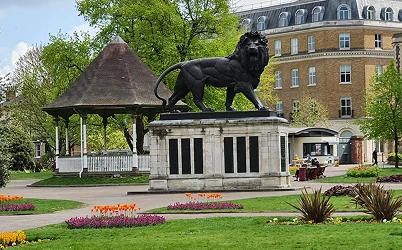
Forbury Gardens, at the heart of Reading town centre adjacent to the abbey ruins, is a Victorian public park of considerable beauty. The park contains formal flower beds, the famous Maiwand Lion monument, a Grade II listed bandstand, and shaded tree-lined paths. It sits within a short walk of Reading station and the Oracle and provides a genuinely pleasant green space at the centre of the commercial town. The park is popular with office workers at lunchtime and families throughout the weekend.
Prospect Park
Prospect Park, on the western edge of Reading, is the town's largest public park, covering 87 acres and including formal gardens, a restored walled kitchen garden managed as a heritage project, a café in the restored mansion house, children's play areas, tennis courts, a bandstand, and open grassland. The park is one of the best-equipped and most actively used public parks in the South East and is freely accessible throughout the year.
Readipop and the Arts Scene
Reading has a strong independent arts and music culture built around the town's music heritage and its significant student population. The Readipop charity promotes community music-making across the town, while the Hexagon Theatre serves as the main entertainment venue for larger touring productions, stand-up comedy, and concerts. The Reading Fringe Festival is an annual celebration of independent arts and performance.
The River Thames and Kennet
The River Thames forms the northern boundary of Reading at Caversham and provides riverside walking along the Thames Path National Trail connecting Reading to Pangbourne, Sonning, Henley-on-Thames, and beyond. The River Kennet, running through the town centre and past the Oracle, provides a further waterway corridor of considerable charm, with canal boats navigating from the Kennet and Avon Canal westward from the town.
Safety in Reading
Crime rates in Reading vary significantly between different parts of the town. The town centre and some inner residential areas have higher recorded crime rates reflecting the activity levels of a major town centre, while the residential suburbs of Earley, Tilehurst, Caversham, and Woodley generally have lower rates more typical of suburban South East England. Buyers are encouraged to review crime statistics by specific postcode using Thames Valley Police's crime data before making residential decisions.
Healthcare in Reading
Royal Berkshire Hospital on London Road is Reading's main acute hospital, operated by Royal Berkshire NHS Foundation Trust. It provides a full range of acute and specialist hospital services and is one of the largest employers in the town. Multiple GP practices and health centres serve Reading's residential population, providing accessible primary care across the borough.
Selling Your Home in Reading with YooSell
If you are thinking about selling your Reading property, YooSell offers a genuinely better alternative to the traditional high street estate agency model. YooSell is a self-service home-selling platform built for homeowners across England, giving you complete control of your sale at a fraction of the cost of a conventional agent.
Why Reading Homeowners Choose YooSell
With YooSell, you pay no commission at any stage of the sale process. You pay a simple fixed monthly fee from £49.50 and keep 100% of your agreed sale price. There is no percentage cut at completion, no hidden extras, and no agent taking a share of the equity you have built in your home.
You can list your property on Rightmove through YooSell directly, putting your Reading home in front of millions of active buyers on the UK's biggest property portal without instructing a traditional estate agent. You set your own asking price, manage your own viewings on your own schedule, and respond to offers entirely on your own terms. Every buyer on the platform is ID-verified and financially qualified before making an offer, so you only deal with serious, genuine purchasers. When you accept an offer, access trusted conveyancers and legal partners directly through your YooSell dashboard, keeping the process streamlined from acceptance through to completion.
Free Tools for Reading Buyers and Sellers
Before listing or making an offer, use the free tools available through YooSell:
Valuation Calculator to estimate your Reading property's current market value
Cost Saving Calculator to see exactly how much you save versus a traditional agent on your sale
Mortgage Calculator to plan your next purchase and understand your monthly repayments
Stamp Duty Calculator to calculate your full tax liability before you exchange contracts
YooSell Pricing Plans to choose the listing tier that fits your sale
Frequently Asked Questions
Find Homes Available In Reading
Browse verified homes listed directly by sellers in Reading. Compare listings, arrange viewings and make offers in one place.
Find Homes Available In ReadingStart Selling Your Home Today!
Take control of your sale with YooSell. Get started today and explore how we can help you sell smarter, faster, and with less hassle.