Nottingham
Thinking of moving to Nottingham in 2026? This original city area guide covers the best neighbourhoods, verified property market data, schools, the tram network, Robin Hood heritage, universities, and how to sell your East Midlands home on Rightmove commission-free with YooSell.

Sarah M.
Sarah focuses on pricing strategy, presentation, and getting listings ready for market. She helps sellers present homes clearly without overcomplicating the process.
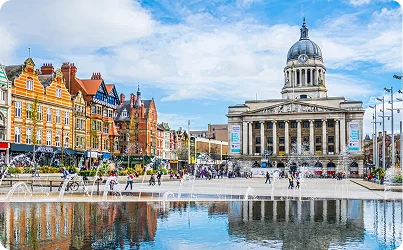
Nottingham is one of England's most distinctive and consistently underrated cities. The East Midlands' largest economy, a UNESCO City of Literature, the legendary home of Robin Hood, and the host of two leading universities, Nottingham has a cultural depth, a transport infrastructure, and a property market that genuinely rewards buyers and residents who choose it over the more expensive and overcrowded cities to the south. Its population reached an estimated 331,077 in 2024 and the city covers a compact but densely woven urban landscape that connects historic lace warehouses, Victorian parks, university campuses, and leafy family suburbs within one of the UK's most integrated public transport networks. Whether you are a first-time buyer seeking your first home in the city, a family looking for the right school catchment, a professional commuting to London or across the Midlands, or a homeowner considering selling without paying estate agent commission, this guide gives you an accurate and original picture of Nottingham in 2026.
Browse verified property listings across Nottingham and the wider East Midlands on the YooSell Find a Home platform, with no agent fees and no third-party delays between buyer and seller.
What Is Nottingham?
Nottingham is a city and unitary authority area in the East Midlands of England. It is the county town of Nottinghamshire and operates as a separate administrative authority from Nottinghamshire County Council. The city sits approximately 42 miles south-east of Sheffield and 54 miles north-east of Birmingham, and its wider urban area has a population of approximately 768,638, making it the largest urban area in the East Midlands and the second-largest in the Midlands.
The city was granted its city charter in 1897 as part of Queen Victoria's Diamond Jubilee celebrations. Nottingham was designated a UNESCO City of Literature in 2015, recognising a strong contemporary literary community, a thriving publishing industry, and a vibrant creative writing culture. It is also named a UNESCO Creative City, with a metropolitan economy that is the seventh-largest in the United Kingdom with an estimated GDP of $50.9 billion, placing it among the most economically significant cities in England outside London.
Nottingham has a substantially younger population profile than the national average. Nottingham has 15.8% of its population aged 19 to 22, compared to just 4.7% nationally, reflecting the large university population across the two campuses. The proportion of the population aged 66 and over is just 11% in Nottingham, compared to 17.6% nationally, giving the city an energy and dynamism that is rarely found in comparable East Midlands towns. In 2025, there were 12,075 active VAT and PAYE registered businesses operating in Nottingham, according to the ONS Inter Departmental Business Register, with healthcare and social work, wholesale and retail, and professional services among the dominant employment sectors.
Nottingham is the 18th most deprived district in the country out of 296 districts in England using the Rank of Average Rank measure from the Indices of Deprivation 2025. Deprivation is concentrated in specific inner city wards while the suburban areas to the west, south, and east of the city are considerably more affluent. Understanding this geography is essential for buyers and residents choosing where to live within the city.
Nottingham Property Market 2026
The Nottingham property market offers genuine value for buyers coming from London, the South East, or from more expensive Midlands cities. The city's two universities, healthcare sector, and growing tech and digital economy provide consistent demand from both owner-occupiers and buy-to-let investors, making it one of the most active residential property markets in the East Midlands.
Property Market Overview
According to ONS UK House Price Index data, the average house price in Nottingham city was £192,000 in March 2026, broadly in line with March 2025. This compares to an East Midlands average of £284,000 and a Great Britain average of £329,000 in the same period, illustrating the significant value advantage Nottingham offers relative to both the region and the national market.
The median sold price across the Nottingham postcode area was £224,250 based on 6,284 HM Land Registry transactions in the last 12 months. The per-postcode range runs from approximately £152,500 in the NG1 city centre to £275,000 in the NG2 West Bridgford area, showing the broad spectrum of values available across the city's different neighbourhoods and suburbs.
The average price paid by first-time buyers in Nottingham was £177,000 in March 2026, broadly in line with March 2025. Home movers paid an average of £229,000. For buyers purchasing with a mortgage, the average house price was £195,000 in March 2026, similar to the year before. These figures reflect a market that has plateaued rather than fallen sharply, which suggests stable underlying demand is supporting values even as transaction volumes remain below the peak levels seen in 2021 and 2022.
Property Types in Nottingham
Nottingham's housing stock of 147,850 residential properties covers a wide range of building types and eras. The city has a significant stock of Victorian terraced homes in the inner suburbs, mid-20th century semi-detached estates in the outer suburbs, Georgian and Victorian townhouses in the more affluent areas such as The Park and Mapperley, and a growing supply of modern city centre apartment conversions in the Lace Market, Hockley, and around the Broadmarsh regeneration zone.
Terraced houses in Nottingham averaged £174,742 according to HM Land Registry data, making them the most accessible entry-level property type. Semi-detached homes averaged £218,320, while detached properties averaged £344,478. Flats and apartments are particularly prevalent in the city centre and student areas, and represent a significant share of the city's investment property market given the 70,000-plus student population across both universities.
The Rental Market
Private rents in Nottingham averaged £1,007 per month in April 2026, an increase of 3.8% from £970 in April 2025, according to ONS Price Index of Private Rents data. This was in line with the East Midlands regional rise of 3.8% over the same period. The city's large and consistent student population, combined with demand from young professionals and healthcare workers, maintains rental demand across most inner-city and suburban postcodes throughout the year. The University of Nottingham and Nottingham Trent University together accommodate over 70,000 students, generating one of the most reliable sources of rental demand in any regional UK city.
How Much Could You Save Selling Without an Agent?
Traditional estate agents typically charge between 1% and 3% commission on the final sale price. On a Nottingham property, that commission can represent a significant sum deducted from your proceeds at completion, particularly for home movers selling at the £229,000 average. With YooSell, you pay a fixed monthly fee from just £49.50 and keep 100% of your agreed sale price. You can also list your property on Rightmove through YooSell directly, giving your Nottingham home full visibility on the UK's biggest property portal without paying estate agent commission. Use the free YooSell Cost Saving Calculator to calculate exactly what you could keep based on your own property value.
Best Areas and Neighbourhoods in Nottingham
Nottingham is a city of genuinely distinct neighbourhoods, each with its own character, price point, and appeal. Understanding the differences between them is essential for making a confident property decision.
West Bridgford
West Bridgford is consistently named the most desirable address in the Greater Nottingham area and is frequently cited as one of the best places to live in Nottinghamshire by lifestyle and property guides. Technically within the borough of Rushcliffe in Nottinghamshire rather than within the Nottingham City Council boundary, it sits immediately south of the city across the River Trent and is functionally part of Greater Nottingham. West Bridgford is known for its excellent schools, vibrant Central Avenue high street with independent cafes, restaurants, and shops, good parks including West Bridgford Park, and a strong family community. Wollaton and West Bridgford are among the safest areas in Greater Nottingham, with a crime rate of around 5 offences per 1,000 people per month, well below the city average. The area is popular with families, professionals, and those relocating from London who want a high-quality suburban setting with strong transport links back to the city and beyond.
Wollaton
Wollaton is a highly regarded residential suburb on the western edge of Nottingham, best known for the magnificent Wollaton Hall and Deer Park, a stunning Elizabethan mansion set within a 500-acre deer park that is freely accessible to all. The area offers larger detached homes popular with established families, several Good and Outstanding Ofsted-rated schools, and a strong community built around local shops, pubs, and the park. Wollaton is served by the Nottingham Express Transit tram network, providing easy access to the city centre, Queen's Medical Centre, and the University of Nottingham campus. It is regarded as one of the safest areas in the city.
The Park Estate
The Park is the most affluent neighbourhood within the Nottingham City Council boundary and one of the most architecturally significant residential areas in the East Midlands. The estate was developed in the 19th century on land belonging to the Duke of Newcastle and is characterised by wide, tree-lined streets, ornate Victorian villas, and mansion houses. Much of the estate is a conservation area and many properties are listed. The Park Estate manages its own grounds, sports facilities, and a seasonal market for residents. Properties in The Park are priced at a premium that reflects the combination of architecture, community management, and location within walking distance of both Nottingham Castle and the city centre.
Mapperley
Mapperley is a popular residential area in the north-east of Nottingham offering a balance of affordable housing, a lively independent high street, and a genuine community character. Mapperley Top, the highest point in the city, gives the area distinctive views across Nottingham. The neighbourhood has good primary and secondary schools, a range of local shops and restaurants, and is well served by Nottingham City Transport bus routes connecting it to the city centre in approximately 15 minutes. It is popular with families and young professionals who want a good quality of life without paying the premium of West Bridgford or Wollaton.
Beeston
Beeston sits in the borough of Broxtowe, immediately south-west of Nottingham, and is one of the most practically well-equipped towns in the Greater Nottingham area. It is served by both the tram network and the Nottingham to Beeston rail line, providing fast access to the city centre, Queen's Medical Centre, and both university campuses. Beeston has a lively town centre with a wide range of shops, supermarkets including Waitrose, and a strong independent food and drink offer. It is particularly popular with first-time buyers and young professionals for its competitive prices relative to its amenities, and with students and staff at the University of Nottingham given the campus's position on the Beeston boundary.
The Lace Market and Hockley
The Lace Market and Hockley sit at the heart of Nottingham city centre and form what is often called the Creative Quarter. The Lace Market's Victorian lace warehouses have been converted into apartments, galleries, restaurants, and creative businesses, giving the area a distinctive urban character unlike anywhere else in the East Midlands. Hockley, adjacent to the Lace Market, is known for its independent shops, record stores, art galleries, and a vibrant café and bar scene. These areas attract young professionals, artists, and those who want to live at the centre of city life. Properties here are predominantly flats and apartments, reflecting the density of the urban core.
Sherwood
Sherwood, in the north of the city, is a neighbourhood with a growing reputation for independent retail, community events, and a relaxed residential character. Its high street has a well-regarded mix of independent shops, pubs, and cafes that give it a village-within-the-city atmosphere. Sherwood attracts buyers and renters who want proximity to the city centre with a stronger community feel than the inner suburbs provide, and it sits within good bus range of both the city centre and Arnold to the north.
Arnold and Carlton
Arnold and Carlton are the main suburban towns on the north-east edge of the Nottingham conurbation, sitting within the borough of Gedling in Nottinghamshire County. Both offer good value semi-detached and terraced housing, strong schools, a range of supermarkets and retail parks, and regular bus services into Nottingham city centre. They attract families and first-time buyers who need more space and affordability than the inner city provides, while remaining within a practical commute of Nottingham.
Clifton and the Southern Suburbs
Clifton is a large residential estate to the south of the city, well served by the Nottingham Express Transit tram to Clifton South. It provides affordable family housing with good tram access to the city centre, Queen's Medical Centre, and the city's employment zones. The wider southern suburban corridor, including areas such as Ruddington in Rushcliffe, offers a range of settings from established suburban estates to village-feel communities for buyers who want to live south of the river.
Search for available properties across all Nottingham neighbourhoods on the YooSell Find a Home platform.
Schools in Nottingham
Schools are a primary consideration for families choosing where to live in Nottingham. The city's overall school performance sits at a level broadly comparable to the national average, though there is significant variation between individual schools and between the inner city and suburban areas.
Primary Schools in Nottingham
According to Nottingham Insight key facts data, 92% of primary schools in Nottingham are rated Good or Outstanding by Ofsted, compared to a national average of 93%. This places Nottingham's primary sector very close to the national benchmark, with the majority of schools providing a solid education for younger children. The strongest performing primary schools tend to be concentrated in the more affluent outer suburbs including Wollaton, West Bridgford, Mapperley, and Beeston, where competition for places is high and Ofsted Outstanding ratings are common. Families targeting specific primary school catchments should check the current Ofsted rating and catchment boundaries directly with the school and Nottingham City Council or the relevant borough admissions team before making a property purchase.
Secondary Schools in Nottingham
Secondary school performance in Nottingham is more variable. According to Nottingham Insight data, 82% of secondary schools in Nottingham are rated Good or Outstanding by Ofsted, compared to a national average of 86%. This means Nottingham sits slightly below the national average at secondary level, and the gap between the best and least-performing schools in the city is significant. Families prioritising secondary school quality are strongly advised to research individual school Ofsted reports, current admissions criteria, and performance data before committing to a specific neighbourhood or property purchase.
Schools in the Wollaton and West Bridgford Areas
The western and southern suburbs of Nottingham and the bordering Rushcliffe district contain some of the highest-performing secondary schools in Greater Nottingham. Families moving to Wollaton, Beeston, West Bridgford, and the surrounding areas benefit from proximity to schools with consistently strong Ofsted records. Fernwood School in Wollaton is regularly cited as one of the best secondary schools in the wider Nottingham area.
Special Educational Needs Provision
Nottingham City Council operates SEND provision across the city and provides home-to-school transport support for eligible children with Education, Health and Care Plans. Families with children who have SEND requirements should contact the SEND team at Nottingham City Council to discuss available provision, specialist schools, and transport eligibility in their specific area of the city.
Universities in Nottingham
The University of Nottingham
The University of Nottingham is a Russell Group research university with its main campus in Beeston on the south-western edge of the city. The campus is served directly by the Nottingham Express Transit tram, connecting it to the city centre and Nottingham railway station in approximately 20 minutes. The university is consistently ranked among the UK's top universities and sits in the world's top 100 in multiple global rankings. It has over 35,000 students and particular strengths in pharmacy, medicine, engineering, biosciences, and business. The university's Queen's Medical Centre, Europe's largest teaching hospital, sits adjacent to the campus and is one of the largest employers in the East Midlands.
Nottingham Trent University
Nottingham Trent University has its main campus in the city centre on Shakespeare Street and a second campus at Clifton on the southern edge of the city. It is one of England's largest universities with over 38,000 students and a strong national reputation for graduate employment outcomes, business, law, fashion, art and design, and sport science. NTU's city centre campus is within walking distance of the Lace Market, Old Market Square, and Nottingham railway station, making it deeply embedded in the daily life of the city centre.
Transport and Commuting from Nottingham
Nottingham has one of the most integrated and highly regarded public transport systems in England. In April 2026, Transport Secretary Heidi Alexander visited the city specifically to highlight Nottingham's transport network as a national model for the government's Better Connected strategy, describing it as "best-in-class when it comes to integration" and noting the integrated ticketing, real-time information, and tram, bus, and rail connectivity as what she wants rolled out across the country.
The Nottingham Express Transit Tram Network
The Nottingham Express Transit tram system is a 20-mile, 32-kilometre light rail network that is one of the most successful urban tram systems in England. The network opened in March 2004 and carried 15.7 million passenger journeys in the year ending March 2025, equivalent to approximately 43,000 daily journeys. The system operates two lines.
Line 1: Toton Lane to Hucknall
Line 1 runs from the Toton Lane park-and-ride site in the south-west, through Beeston, the University of Nottingham campus, Queen's Medical Centre, and the city centre, continuing north through the Forest Recreation Ground, Basford, Highbury Vale, and the Robin Hood Line corridor to Hucknall. The total journey time from Toton Lane to Hucknall is 62 minutes, passing through 33 to 34 stops including all the key destinations of the western and northern suburbs.
Line 2: Clifton South to Phoenix Park
Line 2 runs from Clifton South in the south, through the Meadows, the city centre, and north-west to Phoenix Park. The total journey time is 47 minutes across 27 to 28 stops. Both lines pass through the city centre, where services operate at 3 to 5 minutes frequency during peak hours, expanding to 7 to 10 minutes on outer sections.
The tram serves Nottingham's major employment sites directly, including Queen's Medical Centre, the ng2 business park, both university campuses, and Nottingham Science Park. It also connects to large event venues including the Theatre Royal and Concert Hall, Nottingham Arena, and Nottingham Tennis Centre. The Nottingham Contactless ticketing system allows passengers to pay using a single contactless bank card across both NET trams and Nottingham City Transport buses, with a daily cap of £6.70.
Rail Connections
Nottingham railway station is the second-busiest railway station in the Midlands for passenger entries and exits. It is served by East Midlands Railway, CrossCountry, and Northern services.
East Midlands Railway operates the main intercity services, including direct trains to London St Pancras. Faster services reach St Pancras in approximately 1 hour 45 minutes, with a frequency that supports regular commuting to the capital for those with flexible working arrangements. Direct trains also serve Leicester, Derby, and Sheffield, with connections at each providing access to the wider national rail network. CrossCountry operates services through Nottingham connecting to Birmingham New Street, the South West, and the North East. Northern services connect Nottingham to Leeds and the northern rail network.
The Robin Hood Line runs from Nottingham northwards through Hucknall, Kirkby-in-Ashfield, Newstead, and Worksop, serving communities in the central coalfield corridor. The tram runs parallel to and connects with the Robin Hood Line in the Hucknall area, providing integrated connectivity between the two networks.
Road and Motorway Access
Nottingham is well connected by road. The A52 and A453 provide the main arterial routes towards the M1 motorway to the west. Junction 25 of the M1 is approximately 6 miles from Nottingham city centre, accessible via the A52 in approximately 15 to 20 minutes. The A60, A614, and A609 provide road connections north and east into Nottinghamshire. The A46 ring road connects the western and southern sides of the city, giving access to Leicester to the south and Newark and Lincoln to the north-east.
Buses
Nottingham City Transport is one of the most awarded bus operators in the UK and forms the backbone of the city's daytime bus network. Routes cover the entire city and are coordinated with the tram network through the Nottingham Contactless system, allowing integrated daily travel on a single payment. Trentbarton operates services connecting Nottingham to surrounding towns and villages in Nottinghamshire and Derbyshire, providing access to communities beyond the tram and NCT bus coverage areas. The East Midlands Combined County Authority's Ride app, first developed in Nottingham and Derby, allows passengers to plan and pay for bus, tram, and bike hire journeys across the city through a single platform.
Cycling
Nottingham has an active cycling infrastructure programme and a strong cycling culture supported by the University of Nottingham, the city council, and local employers. Lime e-bikes and Dott e-scooters are available across the city through the Ride app. The network of dedicated cycle lanes and off-road routes connecting the city centre to suburban areas continues to expand as part of the city's active travel investment programme.
Living in Nottingham: Culture, Heritage and Community
Nottingham Castle and Robin Hood Heritage
Nottingham Castle stands on a dramatic sandstone crag at the heart of the city and has a history stretching back to the Norman Conquest. Extensively restored and reopened in its current form, the castle tells the city's story from its medieval roots to the present day, with interactive exhibitions and access to the caves beneath the rock on which it stands. The castle sits at the centre of Nottingham's Robin Hood heritage, which draws visitors from around the world. The annual Robin Hood Town Tour, led by Ezekial Bone, winner of multiple VisitEngland and European travel awards, explores the city's connection to the legendary outlaw through theatrical, character-led storytelling from historic sites across the centre.
The Lace Market and City of Caves
The Lace Market quarter is one of the most architecturally distinctive areas in the East Midlands. Built during the 18th and 19th centuries when Nottingham was the centre of the global lace industry, its ornate Victorian warehouses and Flemish Gothic buildings have been converted into apartments, galleries, restaurants, and creative businesses. The quarter is now recognised as the Creative Quarter, hosting independent retailers, design studios, and independent food businesses that give it a genuine urban energy.
Beneath the Lace Market and the castle rock, the City of Caves network comprises over 500 sandstone caves carved into the cliff over centuries of habitation. The caves have served as homes, tanneries, air raid shelters, and tunnels across Nottingham's long history and are now a significant visitor attraction, accessible via guided tours from the Broadmarsh area.
Ye Olde Trip to Jerusalem pub, built into the cliff face beneath the castle, claims to date to 1189, making it one of the contenders for the title of England's oldest inn. Whether or not that specific date is accepted, the pub is an unmistakably historic and unusual venue that forms a natural part of any exploration of the city's heritage.
Old Market Square and the City Centre
Old Market Square is the civic heart of Nottingham and one of the largest market squares in England. The square hosts a year-round programme of events including the annual Goose Fair, one of the oldest travelling fairs in the world, which has been held in Nottingham since approximately 1284. The Goose Fair moved to its current location at the Forest Recreation Ground in the early 20th century and takes place every October, drawing tens of thousands of visitors to the city for a week of fairground rides, food, and entertainment.
The city centre offers one of the most varied retail environments in the East Midlands, combining the major department stores and national retailers of the Victoria Centre and Broadmarsh area with the independent boutiques, galleries, and food businesses of the Lace Market, Hockley, and the Creative Quarter. The Broadmarsh development continues to evolve with new leisure and retail uses following major regeneration investment over recent years.
Arts, Sport, and Entertainment
Nottingham has a rich and varied arts and entertainment offer. The Nottingham Playhouse on Wellington Circus is one of England's most prolific producing theatres. The Theatre Royal and the Royal Concert Hall on Theatre Square together form the city's main performance venue complex, hosting opera, ballet, classical music, and popular entertainment throughout the year. The Motorpoint Arena is the city's main indoor arena, attracting national and international touring music acts.
The city holds Purple Flag status, recognising a safe, well-managed, and diverse night-time economy that supports residents and visitors in enjoying Nottingham's bars, restaurants, clubs, and late-night cultural venues responsibly.
Nottingham is home to two professional football clubs, Nottingham Forest and Notts County, who play at the City Ground and Meadow Lane respectively, separated only by the River Trent in a geographical proximity unique in English professional football. Nottingham Forest was European Champion in 1979 and 1980. Trent Bridge cricket ground in West Bridgford is one of England's Test match grounds and hosts international cricket throughout the summer.
Green Spaces and Outdoor Life
Wollaton Park
Wollaton Park is one of the finest urban parks in England, covering 500 acres of deer parkland in the west of the city. At its centre stands Wollaton Hall, an extraordinary Elizabethan mansion completed in 1588, now home to the Nottingham Natural History Museum and the Nottingham Industrial Museum. The park is home to over 90 red deer and 120 fallow deer that roam freely across the grounds, giving it a natural spectacle that is genuinely unusual in an urban setting. The park is freely accessible throughout the year and is one of the most visited green spaces in the East Midlands.
Nottingham Arboretum
The Arboretum is one of Nottingham's oldest public parks, opened in 1852 in the north of the city centre. A Victorian park in the formal tradition, it features a bandstand, ornate gates, and a collection of mature trees that make it a tranquil green refuge within the dense inner city. It is particularly popular with students and young professionals living in Lenton, Radford, and the surrounding inner city areas.
Colwick Country Park
Colwick Country Park on the eastern fringe of the city occupies a large area of former flood plain along the River Trent, providing lakeside walking, cycling, and wildlife watching in a natural setting close to the city centre. The park is also home to Nottingham Racecourse, which hosts flat racing throughout the season.
Attenborough Nature Reserve
Attenborough Nature Reserve, a short tram or bus journey from the city centre near Beeston, is a nationally important wetland managed by the Nottinghamshire Wildlife Trust on the banks of the River Trent. The reserve covers former gravel pits that have been transformed into a network of lakes and wetland habitats, supporting a wide range of bird species and providing one of the best wildlife watching destinations in the East Midlands. It is freely accessible throughout the year and is one of the great green resources within easy reach of Nottingham city.
Healthcare in Nottingham
Nottingham is home to one of England's largest hospital complexes. Queen's Medical Centre, adjacent to the University of Nottingham campus in Beeston, is Europe's largest teaching hospital and one of the UK's leading trauma and specialist treatment centres. It is operated by Nottingham University Hospitals NHS Trust and is accessible directly by tram from the city centre and from across the tram network. Nottingham City Hospital on Hucknall Road, also operated by Nottingham University Hospitals NHS Trust, provides a full range of acute hospital services for the northern parts of the city. Together, the two hospital sites form one of the largest NHS organisations in England and are one of the city's most significant employers.
Multiple GP practices, dental surgeries, pharmacies, and community health services operate across all parts of the city, providing accessible primary care for residents in every neighbourhood.
Selling Your Home in Nottingham with YooSell
If you are thinking about selling your Nottingham property, YooSell offers a fundamentally better alternative to the traditional estate agency model. YooSell is a self-service home-selling platform built for homeowners across the East Midlands and the wider Midlands, giving you complete control of your sale at a fraction of the cost of a conventional agent.
Why Nottingham Homeowners Choose YooSell
With YooSell, you pay no commission at any stage of the sale process. You pay a simple fixed monthly fee from £49.50 and keep 100% of your agreed sale price. There is no percentage cut at completion, no hidden extras, and no agent taking a portion of the equity you have built in your home.
You can list your property on Rightmove through YooSell directly, giving your Nottingham home maximum visibility on the UK's biggest property portal without needing to instruct a traditional estate agent. You set your own asking price, manage your own viewings, and respond to offers entirely on your own terms. Every buyer on the platform is ID-verified and financially qualified before making an offer, so you only deal with serious, genuine purchasers. When you accept an offer, access trusted conveyancers and legal partners directly through your YooSell dashboard, keeping the process streamlined from acceptance through to completion.
Free Tools for Nottingham Buyers and Sellers
Make use of the free planning tools available through YooSell before listing or making an offer:
Valuation Calculator to estimate your Nottingham property's current market value
Cost Saving Calculator to see exactly how much you save versus a traditional agent on your sale
Mortgage Calculator to plan your next purchase and understand your monthly repayments
Stamp Duty Calculator to calculate your full tax liability before you exchange contracts
YooSell Pricing Plans to choose the listing tier that fits your sale
Frequently Asked Questions
Find Homes Available In Nottingham
Browse verified homes listed directly by sellers in Nottingham. Compare listings, arrange viewings and make offers in one place.
Find Homes Available In NottinghamStart Selling Your Home Today!
Take control of your sale with YooSell. Get started today and explore how we can help you sell smarter, faster, and with less hassle.