Northern Ireland
Thinking of buying or selling property in Northern Ireland in 2026? This original national guide covers Belfast, the Causeway Coast, the Mournes, and Fermanagh with verified NISRA and Land Property Services data, nine consecutive quarters of 7% to 9% annual growth explained, and how to sell commission-free on Rightmove with YooSell.

Sarah M.
Sarah focuses on pricing strategy, presentation, and getting listings ready for market. She helps sellers present homes clearly without overcomplicating the process.
Northern Ireland is the UK's fastest-growing property market in 2026 and its most affordable major property destination. With an average house price of £202,487 in Q2 2026, up 9.2% year-on-year according to official NISRA and Land and Property Services statistics, Northern Ireland has delivered the strongest sustained annual price growth of any UK nation over the last three years while still offering buyers prices that are lower than any other part of the UK. It is a region of dramatic natural scenery including the Giant's Causeway, the Mourne Mountains, and the Antrim Coast Road, of thriving cities in Belfast and Derry, of a property transaction system that uses Stamp Duty Land Tax as in England, and of a housing market that has recovered from its post-2007 collapse to deliver consistent and broad-based growth. Whether you are a first-time buyer, a professional relocating to Belfast, or a homeowner considering selling your Northern Ireland property without paying estate agent commission, this guide gives you an accurate and original picture of Northern Ireland in 2026.
Browse verified property listings across Northern Ireland on the YooSell Find a Home platform, with no agent fees and direct access to verified seller listings.
About Northern Ireland?
Northern Ireland is a constituent country of the United Kingdom, occupying the north-eastern portion of the island of Ireland. It is bordered by the Republic of Ireland to the south and west, the North Channel to the north and east separating it from Scotland, and the Irish Sea to the south-east. Northern Ireland has a population of 1,903,100 at the 2021 census, making it the smallest of the four UK nations by population, and a land area of approximately 14,130 square kilometres.
Northern Ireland has a devolved legislature, the Northern Ireland Assembly, established under the Belfast Agreement (also known as the Good Friday Agreement) of 1998. The Assembly, based at Stormont in Belfast, has devolved powers over health, education, justice, planning, and other matters. The Northern Ireland Executive is the power-sharing governmental body, with ministerial posts allocated proportionally between the largest parties. Northern Ireland is divided into eleven local government districts for local authority purposes.
Belfast is Northern Ireland's capital and largest city, with a population of approximately 345,000 in the city proper and approximately 671,000 in the greater Belfast area. Derry, Northern Ireland's second city, is known by its Irish-language name Doire and officially recognised as Derry or Londonderry. Other significant towns include Newry, Armagh, Lisburn, and Omagh.
Northern Ireland has a unique constitutional position within the UK, reflected in the Windsor Framework agreed in 2023, which provides a distinct regulatory framework for Northern Ireland concerning trade with the Republic of Ireland and the European Union. Northern Ireland is the only part of the UK that shares a land border with an EU member state, and this border with the Republic of Ireland is entirely open under the terms of the Belfast Agreement, allowing free movement of people and goods.
Northern Ireland uses Stamp Duty Land Tax as in England, rather than the devolved equivalents used in Scotland (LBTT) and Wales (LTT). Property transactions are registered with Land and Property Services Northern Ireland, which together with NISRA publishes the Northern Ireland House Price Index, the official quarterly measure of residential property prices in Northern Ireland.
Northern Ireland Property Market 2026
Northern Ireland's property market in 2026 is the strongest performing of any UK nation by annual price growth, delivering consistent and broad-based price increases across all eleven local government districts while still offering prices that are the most accessible of any UK nation.
National Property Market Overview
According to NISRA and Land and Property Services, the authoritative official sources for Northern Ireland property statistics, the average house price in Northern Ireland was £202,487 in Q2 2026, the April to June 2026 quarter. This represents an annual increase of 9.2% compared to the same period in 2025, and a quarterly increase of 2.1% from Q1 2026. House prices in Northern Ireland have increased by 119.6% since the housing market reached its lowest point in Q1 2013, following the post-2007 financial crisis collapse that saw Northern Ireland house prices fall more steeply than any other UK region.
In Q1 2026, the average house price was £198,015, up 7.4% year-on-year and up 1.5% from Q4 2025, according to the same NISRA publication. In Q4 2025, the average was £195,936, up 7.5% year-on-year. The consistency of 7% to 9% annual growth across Q3 2025, Q4 2025, Q1 2026, and Q2 2026 confirms a sustained and broad-based growth trend, not a single quarter spike.
The 83% of transactions below £300,000 in Q4 2025 illustrates the accessible nature of the Northern Ireland market, where the vast majority of buyers are operating in price brackets that remain affordable relative to incomes, particularly given Northern Ireland's position at the top of UK affordability metrics.
Use the YooSell Valuation Calculator to estimate the current market value of any Northern Ireland property before listing or making an offer.
Property Prices by Local Government District
In Q1 2026, average prices ranged from £173,893 in Mid and East Antrim to £233,022 in Lisburn and Castlereagh, according to NISRA and Land and Property Services data. In Q4 2025, the most expensive area was also Lisburn and Castlereagh at £231,628, and the most affordable was Mid and East Antrim at £173,261.
Annual price growth in Q1 2026 was highest in Newry, Mourne and Down at 11.7% and lowest in Causeway Coast and Glens at 4.1%. This differential illustrates strong growth across all districts, even the slowest-growing area delivered 4.1% annual appreciation.
In Q2 2026, average house prices ranged from £177,450 in Mid and East Antrim to £240,737 in Lisburn and Castlereagh.
Looking at the Ulster University Quarterly House Price Index for Q1 2026, which uses a separate methodology from the NISRA figures, average prices in Northern Ireland ranged from £194,244 to £259,371 by local government district and from £180,792 to £238,309 by functional housing market area.
Property Prices Compared to the Republic of Ireland
An important context for Northern Ireland's property market is the contrast with the Republic of Ireland to the south. Average house prices in the Republic of Ireland were approximately €357,851 in comparable recent data, equivalent to approximately £310,000, making Northern Ireland properties approximately 35% cheaper than in the Republic while offering the same access to the island of Ireland and an open border.
How Much Could You Save Selling Without an Agent?
Traditional estate agents in Northern Ireland typically charge between 1% and 2% commission on the final sale price. With YooSell, you pay a fixed monthly fee from just £49.50 and keep 100% of your agreed sale price. You can list your property on Rightmove through YooSell directly, giving your Northern Ireland home full visibility on the UK's biggest property portal without paying estate agent commission. Use the YooSell Cost Saving Calculator to see exactly what you could keep.
Best Places to Live in Northern Ireland
Northern Ireland's diverse geography and communities offer a wide range of living environments for buyers of all types.
Belfast
Belfast is Northern Ireland's capital and its most dynamic city, with a population that has grown consistently since the Good Friday Agreement of 1998 transformed Northern Ireland's political stability and opened the door to major inward investment in tourism, film production, higher education, and financial services. The Titanic Quarter, built on the site of the Harland and Wolff shipyard where RMS Titanic was constructed, is one of the most spectacular regenerated waterfront areas in the British Isles. The Titanic Belfast visitor attraction, which opened in 2012 and was rated the world's best tourist attraction by TripAdvisor in 2016, anchors a cultural and leisure quarter alongside the SS Nomadic, the only surviving White Star Line vessel. The Cathedral Quarter, with its concentration of bars, restaurants, galleries, and music venues in and around the Cathedral Church of St Anne, is Belfast's creative and cultural heart.
Property in Belfast averages approximately £186,000 to £192,000 in recent NISRA data for the city, making it significantly more accessible than any comparable UK capital city and one of the most affordable city property markets in the British Isles. Browse Belfast properties on the YooSell Find a Home platform.
Lisburn and Castlereagh
Lisburn and Castlereagh, the local government district to the south and east of Belfast, consistently has the highest average house prices in Northern Ireland, at £240,737 in Q2 2026. The district covers the city of Lisburn, the town of Carryduff, and the suburban communities of south and east Belfast including Finaghy, Dunmurry, and Castlereagh. Its popularity with families reflects strong schools, good access to Belfast city centre, and a wide range of family housing.
The Ards and North Down Peninsula
Ards and North Down, covering the peninsula that juts southward into the Irish Sea from Belfast, consistently has the second highest average prices in Northern Ireland. The town of Bangor, with its marina, Victorian seafront, and direct rail connection to Belfast in approximately 30 minutes, is one of the most popular commuter addresses outside the capital. Holywood, a prosperous village between Belfast and Bangor, is home to many of Belfast's professional families and commands premium values.
Derry and Strabane
Derry, Northern Ireland's second city, sits on the River Foyle close to the border with the Republic of Ireland. The city walls of Derry, one of the finest surviving examples of walled city fortification in Europe and the only complete example of 17th-century town walls remaining in Ireland, surround the historic centre. Derry is a city undergoing significant transformation, with investments in the Waterside area, the Peace Bridge crossing the Foyle, and an expanding higher education sector centred on Ulster University's Magee campus. Average prices in Derry City and Strabane are among the most affordable in Northern Ireland, offering genuine value in a city with improving employment and cultural infrastructure.
Antrim and Newtownabbey
Antrim and Newtownabbey, north of Belfast on the western shore of Lough Neagh, provides a suburban and semi-rural setting with fast road and rail connections to the capital. Templepatrick, Antrim town, and Newtownabbey are popular residential addresses for Belfast commuters seeking more space at lower prices. The area has direct rail connections to Belfast and good motorway access via the M2 and M6.
Causeway Coast and Glens
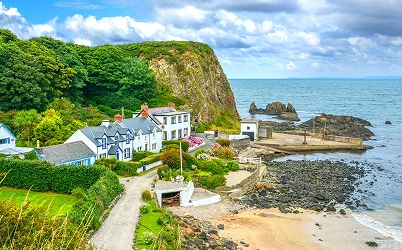
The Causeway Coast and Glens district in the north-east of Northern Ireland covers one of the most dramatic and internationally celebrated landscapes in the British Isles. The Giant's Causeway, a UNESCO World Heritage Site and Northern Ireland's most visited natural attraction, sits on the Antrim coast. The Antrim Coastal Road, known as the Causeway Coastal Route, connects Larne to Ballycastle along a spectacular stretch of coast above the cliffs and glens. The towns of Ballycastle, Cushendall, and Glenariff sit at the foot of the Nine Glens of Antrim, with Portrush and Portstewart providing resort character on the north coast. Royal Portrush Golf Club has hosted The Open Championship multiple times, with the 2025 Open Championship taking place there.
Newry, Mourne and Down
Newry, Mourne and Down had the highest annual price growth of any Northern Ireland district in Q1 2026 at 11.7%. The area covers the Mourne Mountains, the coastal town of Newcastle, and the city of Newry close to the Republic of Ireland border. The Mourne Mountains, described by C.S. Lewis as his mental model for Narnia and the inspiration for the fictional landscape, offer outstanding hill walking, cycling, and countryside recreation. Newcastle at the foot of Slieve Donard is one of Northern Ireland's most popular coastal towns.
Fermanagh and Omagh
Fermanagh, in the south-west of Northern Ireland, is dominated by Lough Erne, a vast system of lakes and islands that is one of the finest inland boating and angling destinations in Europe. Enniskillen, the county town, sits on an island in the river connecting Upper and Lower Lough Erne. The wider Fermanagh and Omagh district offers some of the most rural and affordable property in Northern Ireland.
Education in Northern Ireland
Northern Ireland has its own distinct education system, separate from those of England, Scotland, and Wales. The system retains academic selection at age 11, unlike the rest of the UK, with grammar schools and secondary schools providing separate pathways for pupils based on performance in voluntary grammar school entrance tests. A significant proportion of Northern Ireland's schools are Catholic-maintained, reflecting the historical denominational character of the schooling system, with Catholic maintained, controlled (largely Protestant), integrated, and Irish-medium schools all forming part of the state school network.
Schools in Northern Ireland are inspected by the Education and Training Inspectorate, which publishes inspection reports on individual schools. Families researching schools in Northern Ireland should use the ETI reports and the Department of Education Northern Ireland's performance statistics for the most current information.
Higher education in Northern Ireland is provided principally by Queen's University Belfast, a Russell Group member with particular strengths in medicine, engineering, and law; Ulster University, with campuses in Belfast, Coleraine, Jordanstown, and Magee in Derry; and a range of further education colleges providing vocational and professional qualifications across the country.
Transport in Northern Ireland
Rail Connections
Translink operates Northern Ireland's rail network, branded as Northern Ireland Railways. The main routes connect Belfast Great Victoria Street and Belfast Lanyon Place (formerly Belfast Central) to Derry via Antrim and Ballymena, to Bangor, to Lisburn, to Newry, and to Portadown with a connecting coach service to Dublin. Enterprise services between Belfast and Dublin, operated jointly by Translink and Irish Rail, complete the approximately 2-hour journey between the two capitals multiple times per day and connect Northern Ireland to the Republic of Ireland's national rail network.
The Belfast suburban rail network provides commuter connections from Belfast to Holywood, Bangor, Antrim, and the Larne Line, making rail commuting a practical option for residents in the districts surrounding the capital.
Roads
Northern Ireland's motorway and dual carriageway network radiates from Belfast. The M1 connects Belfast southward to Lisburn, Moira, and the border with the Republic near Newry. The M2 connects northward to Antrim and Ballymena. The M3 crosses the River Lagan on the Lagan Motorway Bridge to the east. The A1 dual carriageway connects Belfast to Newry and the Republic's M1, providing the main road route between Belfast and Dublin.
Air Travel
Belfast is served by two airports. George Best Belfast City Airport, close to the city centre, provides connections to London and other UK cities with short flight times of approximately one hour to London. Belfast International Airport, to the north-west of the city near Antrim, provides a wider range of European and transatlantic connections.
Heritage, Culture and Community
The Giant's Causeway
The Giant's Causeway on the Antrim coast is Northern Ireland's most famous natural landmark and only UNESCO World Heritage Site. The site consists of approximately 40,000 interlocking basalt columns, the result of an ancient volcanic fissure eruption approximately 60 million years ago. The hexagonal columns, some standing up to 12 metres high, descend from the cliff face to the sea in a formation so regular that it inspired the legend of the Irish giant Finn MacCool, who supposedly built the causeway as a stepping stone to Scotland. The National Trust manages the visitor centre and surrounding coastal path.
Titanic Belfast
Titanic Belfast opened in 2012 on the centenary of the Titanic disaster and has since become the most visited tourist attraction in Ireland. The museum, built in the form of four ship hulls, tells the story of Belfast's maritime and industrial heritage and the construction, launch, and sinking of RMS Titanic, which was built in the Harland and Wolff yards on the site where the museum stands. In 2016, Titanic Belfast was named the world's best tourist attraction by TripAdvisor.
The Antrim Coastal Road
The Antrim Coastal Road, known as the Causeway Coastal Route, is widely described as one of the most scenic coastal drives in Europe. The road connects Larne to Ballycastle along the north Antrim coast, passing through the Nine Glens of Antrim, the Carrick-a-Rede rope bridge, Ballintoy Harbour, and the Giant's Causeway. Several of the locations along this route were used as filming locations for the HBO television series Game of Thrones, which was produced largely in Northern Ireland and has generated significant tourism from international visitors.
The Mourne Mountains
The Mourne Mountains in County Down are Northern Ireland's highest mountain range, topped by Slieve Donard at 850 metres. C.S. Lewis, who was born in Belfast and spent his childhood there, described the Mournes as his inspiration for the imaginary world of Narnia. The Silent Valley Reservoir, the Tollymore Forest Park, and the Mourne Wall, a drystone wall that crosses the summits of twelve Mourne peaks, are among the range's most visited features.
Belfast's Cultural Transformation
Belfast has undergone one of the most remarkable urban transformations of any European city in the period since 1998. The city that was synonymous internationally with the Troubles has become a major tourism, film production, and economic hub. The development of the Titanic Quarter, the expansion of the Cathedral Quarter arts and culture scene, the growth of the Ulster Museum and the MAC arts centre, and the hosting of major international events have collectively repositioned Belfast as one of the most dynamic and interesting cities in the British Isles. The city's proximity to outstanding natural scenery in County Down and County Antrim gives it a quality of life combination that is genuinely rare.
Selling Your Home in Northern Ireland with YooSell
If you are considering selling your Northern Ireland property, YooSell offers a genuinely better alternative to the traditional estate agency model. YooSell is a self-service home-selling platform giving you complete control of your sale at a fraction of the cost of a conventional agent.
Why Northern Ireland Homeowners Choose YooSell
With YooSell, you pay no commission at any stage of the sale process. You pay a simple fixed monthly fee from £49.50 and keep 100% of your agreed sale price. You can list your property on Rightmove through YooSell directly, giving your Northern Ireland home maximum visibility on the UK's biggest property portal without instructing a traditional estate agent. Learn more about how YooSell works or view the full pricing plans.
Free Tools for Northern Ireland Buyers and Sellers
Valuation Calculator to estimate your Northern Ireland property's current market value
Cost Saving Calculator to see exactly how much you save versus a traditional agent
Mortgage Calculator to plan your purchase costs and monthly repayments
Stamp Duty Calculator to calculate your Stamp Duty Land Tax liability before you exchange
YooSell Pricing Plans to choose the right listing tier
YooSell Rightmove Listing to list on Rightmove through YooSell
Frequently Asked Questions
Find Homes Available In Northern Ireland
Browse verified homes listed directly by sellers in Northern Ireland. Compare listings, arrange viewings and make offers in one place.
Find Homes Available In Northern IrelandStart Selling Your Home Today!
Take control of your sale with YooSell. Get started today and explore how we can help you sell smarter, faster, and with less hassle.