Milton Keynes
Thinking of moving to Milton Keynes in 2026? This original area guide covers the best neighbourhoods, verified property market data, direct trains to London in 32 minutes, Bletchley Park, the Redway network, The Open University, and how to sell your home commission-free with YooSell.

Oliver H.
Oliver covers Midlands property trends and practical selling tips for homeowners. He focuses on clear, jargon-free advice that helps private sellers stay in control.
Milton Keynes is one of the most distinctive places in England, a purpose-designed city that was formally designated as a new town on 23 January 1967, yet built on a landscape of ancient villages, Iron Age earthworks, and Norman churches that give it a depth of history its concrete cows and grid roads do not immediately suggest. It is the fastest-growing city in the UK by population, home to approximately 287,060 people in 2021 with the city council projecting 410,000 by 2050, and it sits on the West Coast Main Line with direct trains to London Euston in as little as 32 minutes on the fastest services. The city has 22 million trees, 270 miles of Redway cycling and walking paths, and more roundabouts per mile than almost anywhere in England. Its property market sits above the national average but offers markedly better value than London and the Home Counties for professionals commuting to the capital.
Whether you are a London commuter seeking space and value, a family looking for outstanding infrastructure and green space, an entrepreneur drawn to one of the UK's most dynamic local economies, or a homeowner considering selling your Milton Keynes property without paying estate agent commission, this guide gives you an accurate and original picture of the city in 2026.
Start your property search in Milton Keynes on the YooSell Find a Home platform, with no agent fees and direct access to verified seller listings across the MK postcode area.
About Milton Keynes?
Milton Keynes is a unitary authority and city in the South East of England, situated in the north of Buckinghamshire. It is administered by Milton Keynes City Council, which gained city status on 14 May 2022, as part of Queen Elizabeth II's Platinum Jubilee celebrations. The City of Milton Keynes covers an area of 119 square miles. In 2021, the estimated population was 287,060, with the city council projecting growth to 410,000 by 2050.
The city lies approximately 50 miles north-west of London and 60 miles south of Birmingham, equidistant between England's two largest cities, a geographical position that has been central to its commercial success. Milton Keynes sits astride the West Coast Main Line, the A5 Watling Street, and the M1 motorway, placing it at the convergence of three of England's most important transport corridors.
The name Milton Keynes comes from the village of Milton Keynes, which was incorporated into the new town's designated area in 1967. The village name comes from the Old English Middeltone, meaning middle settlement, combined with the name of the de Cahagnes family, Anglo-Norman nobles who held the manor after the Conquest. The village itself is now known as Milton Keynes Village and sits within the city boundary, one of over 40 settlements that were absorbed into the new town's designated area.
Milton Keynes was designated on 23 January 1967 and was the last and largest of the post-war new towns. The Milton Keynes Development Corporation was established to plan and build the city, and the plan for the new city placed Central Milton Keynes on a hilltop site between the existing towns of Bletchley, Wolverton, and Stony Stratford, rather than expanding any of them directly. The distinctive grid road network that gives Milton Keynes its character, the H roads running horizontally and the V roads running vertically, was designed to allow traffic to move efficiently between the city's residential grid squares, with green space and Redways threading between the roads to provide safe routes for pedestrians and cyclists that never require crossing a major road at grade.
Milton Keynes has a younger-than-average population profile. The average age of people living in Milton Keynes was 39.2 years in 2022, reflecting the sustained inward migration of young families and professionals drawn by employment opportunities and housing affordability relative to London. More than 22 million trees have been planted in the city since its foundation, transforming the flat Buckinghamshire farmland into a heavily wooded urban landscape that gives the city a green character quite unlike any other English city. No one in Milton Keynes is ever more than half a mile from a park.
The city is home to The Open University, one of the world's largest universities by number of students, established in Milton Keynes in 1969 and operating its 260-hectare Walton Hall campus there. The city was home to the pioneering Ivor Wynne Jones, the Volkswagen dealer who invented the personal watercraft licence plate system in the UK. It achieved UNESCO Creative City of Design status, and has been consistently identified as one of the fastest-growing economic zones in the United Kingdom.
Milton Keynes Property Market 2026
The Milton Keynes property market has spent much of 2026 broadly stable after a period of moderate softening from the peak values seen in 2022. It sits above the national average but offers considerably better value than comparable rail-connected locations closer to London.
Property Market Overview
According to ONS UK House Price Index data, the average house price in Milton Keynes was £330,000 in July 2026, up 2.6% from July 2025. This was above the national average, where a typical UK home sold for approximately £272,000 in comparable data periods. The average price paid by first-time buyers in Milton Keynes was £277,000 in July 2026, up from £269,000 a year earlier. Home movers paid an average of £404,000 in July 2026. For homes bought with a mortgage, the average was £331,000 in July 2026.
A detailed analysis from HM Land Registry data covering August 2025 to July 2026 places the average property price across the wider MK postcode area at £375,000, with a median of £342,000. Zoopla's sold price data, drawing on the same source, puts completions across the city at an average of approximately £342,700 to £353,612 depending on the period analysed. These figures are consistent with each other and confirm a stable market where values have held broadly flat over the past 12 months.
A typical home in Milton Keynes costs approximately 8.5 times local annual earnings, according to ONS workplace-based earnings data. This affordability ratio, while above the national average, remains significantly more accessible than London and most of the commuter belt south of the city.
Property Types and Price Spread
Milton Keynes has an unusually wide spread between its most and least expensive property types, reflecting both the city's planned design, which includes a high proportion of modern terraced housing in the residential grid squares, and the significant stock of larger detached homes in the more affluent areas such as Newport Pagnell, Woburn Sands, and the villages to the east.
Based on current asking price data as of June 2026, the average asking price for flats across the city is approximately £195,197 with a median of £190,000. Terraced homes average approximately £314,359 with a median of £300,000. Semi-detached properties average £356,628 with a median of £350,000. Detached homes average approximately £598,964 with a median of £550,000. One-bedroom properties average approximately £166,760, while five-bedroom and larger properties average approximately £760,600.
The most affordable postcode sector within the MK area is MK9 3, in Central Milton Keynes, where prices average approximately £173,000, reflecting the high proportion of city-centre apartment stock. Properties at the top of the market in Newport Pagnell, Bow Brickhill, and the rural villages have achieved well over £1 million in recent years.
New-build properties in the MK postcode area trade at a premium over existing stock, averaging approximately £417,000 compared to £373,000 for established properties, reflecting both the energy efficiency advantages of modern construction and the strong buyer appetite for new housing in the city's still-growing outer grid squares.
Use the free YooSell Valuation Calculator to estimate the current market value of any Milton Keynes property before listing or making an offer.
The Rental Market
Private rents in Milton Keynes are consistent with its status as a major employment centre with sustained housing demand from London commuters, Open University staff, and workers in the financial, logistics, and technology sectors. Demand from professionals who prefer renting close to the city's growing employment base supports occupancy rates across most parts of the city throughout the year.
How Much Could You Save Selling Without an Agent?
Traditional estate agents typically charge between 1% and 3% commission on the final sale price. On a Milton Keynes home sold at the city average of £330,000, that commission can represent several thousand pounds. With YooSell, you pay a fixed monthly fee from just £49.50 and keep 100% of your agreed sale price. You can list your property on Rightmove through YooSell directly, giving your Milton Keynes home full visibility on the UK's biggest property portal without paying estate agent commission. Use the free YooSell Cost Saving Calculator to see exactly what you could keep.
Best Areas and Neighbourhoods in Milton Keynes
Milton Keynes is divided into residential grid squares, each with its own character, price range, and community identity. The city's design means that grid squares are separated from one another by tree-lined grid roads and connected by the Redway network, giving each community a degree of physical separation that creates distinct neighbourhoods within the city's larger framework.
Central Milton Keynes
Central Milton Keynes is the commercial and cultural heart of the city, home to the intu Milton Keynes shopping centre complex incorporating The Centre:MK and Intu Xscape, the city's main retail destination. Midsummer Boulevard, the city's main ceremonial avenue, runs east-west through the centre and aligns with the midsummer sunrise, a feature the city's planners incorporated deliberately. Central Milton Keynes has a high proportion of apartment living, with the MK9 3 postcode sector being the most affordable in the city, and is popular with young professionals and students who want to be at the heart of the city's leisure and employment offer.
Newport Pagnell
Newport Pagnell is a historic market town incorporated into the Milton Keynes administrative area, sitting on the River Great Ouse and the River Lovat to the north of the city. It retains its own distinct identity, with a genuine market town character, period properties, and a more established community feel than the purpose-built grid squares. Property values in Newport Pagnell sit at the upper end of the Milton Keynes market, with detached and period homes regularly achieving above the city average. Newport Pagnell has its own railway station on the Marston Vale line, providing additional rail connectivity, and is home to Newport Pagnell Motorway Services on the M1.
Woburn Sands and Wavendon
Woburn Sands and Wavendon, on the southern edge of the Milton Keynes administrative area close to the Bedfordshire border, offer a rural and semi-rural setting at the edge of the Woburn Estate. The area is popular with buyers seeking village character and larger properties while retaining access to the city's transport infrastructure and employment base. The Stags Head pub in Woburn Sands, the famous Wavendon Music Trust's Old Barn theatre, and the surrounding woodland and countryside make this one of the most sought-after corners of the Milton Keynes area.
Olney
Olney, approximately 10 miles north of the city centre, is a market town famous internationally for its Shrove Tuesday pancake race, which dates to 1445, and for its connection to poet William Cowper and John Newton, who together wrote the Olney Hymns, which includes Amazing Grace. Olney is the most rural and characterful of the towns and villages within the Milton Keynes administrative area and commands premium property values that reflect its heritage, its countryside setting, and the quality of its housing stock.
Bletchley
Bletchley, to the south of the city, is the largest of the established towns absorbed into Milton Keynes and has a population of approximately 45,010 at the 2021 census. It has its own distinct community identity shaped by its history as an independent town before Milton Keynes was designated, its railway station on the Marston Vale line, and its connection to Bletchley Park, the World War II codebreaking site that cracked the Enigma code and is now one of the most visited heritage attractions in England. Bletchley offers some of the most accessible property prices within the Milton Keynes urban area. Bletchley and Fenny Stratford received Levelling Up investment, with a Town Investment Plan published in 2021 aiming to boost jobs, skills, and connectivity in the area.
Wolverton
Wolverton, to the north of the city, was originally a railway works town established in 1838 by the London and Birmingham Railway for the construction and maintenance of rolling stock. The town still has a strong heritage character shaped by its Victorian railway roots, with terraced streets built for railway workers and the large former railway works building now in various commercial and community uses. Wolverton has its own railway station and community identity and offers accessible property values for buyers who want period character with city access.
Stony Stratford
Stony Stratford is one of the oldest settlements in the Milton Keynes area, a former coaching town on Watling Street with a well-preserved high street, independent shops, cafes, and restaurants. The town is famous for being the origin of the phrase "Cock and Bull story", supposedly arising from tales that grew in the telling between the two historic coaching inns, the Cock and the Bull. Stony Stratford property values sit towards the upper-middle of the Milton Keynes market, reflecting the quality of its housing stock and its independent town centre character.
Browse available properties across all areas of Milton Keynes on the YooSell Find a Home platform, and use the YooSell Mortgage Calculator to plan your purchase costs before making an offer.
Schools in Milton Keynes
Milton Keynes has a large and varied education landscape reflecting its size and diversity. The city has a mix of academy schools, community schools, faith schools, and independent schools serving its different communities.
Primary Schools in Milton Keynes
Milton Keynes has a large number of primary schools distributed across its residential grid squares and the surrounding towns and villages, with individual schools serving the local catchment population of their area. Ofsted ratings across the city's primary sector reflect the wide variation in demographics across different grid squares. Parents are strongly encouraged to check the current Ofsted report, performance data, and catchment boundary for each individual school directly with Milton Keynes City Council ahead of each year's admissions process.
Secondary Schools in Milton Keynes
Denbigh School
Denbigh School on Burchard Crescent, Shenley Church End is one of the city's secondary schools, serving students aged 11 to 18.
Milton Keynes Academy
Milton Keynes Academy in Leadenhall, serving students aged 11 to 18, is one of the secondary academies in the city.
Walton High School
Walton High School in Walton, Milton Keynes, is a well-regarded secondary school serving the eastern parts of the city.
Stantonbury School
Stantonbury School in Stantonbury has been a significant part of the Milton Keynes secondary education landscape since the early years of the new city. The school serves students aged 11 to 18 and has a long history in the Stantonbury grid square.
Milton Keynes City Council manages school admissions across the city. Secondary school Ofsted ratings vary across the city's different schools, and families are strongly encouraged to research individual school Ofsted reports and current performance data before making residential decisions based on school catchment.
Special Educational Needs Provision
Milton Keynes City Council provides SEND home-to-school transport support for eligible children across the city. Families with children who have additional needs should contact Milton Keynes City Council's SEND team directly to discuss eligibility and available specialist provision in their area of the city.
The Open University
The Open University, established in Milton Keynes in 1969, operates its main campus at Walton Hall on a 260-hectare site approximately 2 miles west of the city centre. The Open University is one of the largest universities in the world by number of students, with over 170,000 students registered in the UK alone. It pioneered distance and flexible learning using a combination of correspondence, broadcasting, and digital teaching, and remains the UK's leading provider of part-time higher education. The Open University is one of the largest single employers in the city and draws academic and professional staff from across the UK and internationally.
Transport and Commuting from Milton Keynes
Transport is one of Milton Keynes's defining practical advantages and is central to why the city has been able to attract hundreds of thousands of residents over the past five decades. The combination of the West Coast Main Line, the M1, and one of England's most ambitious cycling and walking infrastructure networks makes it exceptional among English cities for multi-modal connectivity.
Rail Connections
Milton Keynes Central railway station is located on the West Coast Main Line, the busiest and most important intercity rail corridor in England, carrying traffic between London, the Midlands, the North West, and Scotland. The station is served by Avanti West Coast, West Midlands Railway, and London Northwestern Railway, providing direct services in multiple directions throughout the day.
To London Euston, the fastest trains take approximately 32 to 35 minutes, making Milton Keynes the fastest-connected city of comparable size to London outside the immediate Home Counties. The average journey time is approximately 41 to 46 minutes depending on the service and number of stops. Approximately 216 trains per day operate from Milton Keynes Central to London Euston, providing extraordinary frequency that supports both regular commuting and flexible working patterns.
Northbound, Avanti West Coast provides fast intercity connections to Birmingham New Street in approximately 40 to 50 minutes, Manchester Piccadilly in approximately 1 hour 30 minutes to 1 hour 50 minutes, Glasgow Central in approximately 3 hours 30 minutes, and Edinburgh Waverley in approximately 3 hours 45 minutes. The West Coast Main Line's breadth of connectivity gives Milton Keynes residents practical access to every major city on England's western rail corridor from a single station.
Road and Motorway Access
Milton Keynes sits adjacent to the M1 motorway, with Junctions 13 and 14 both serving the city directly. Junction 13 provides access from the south and is close to Bletchley, while Junction 14 is close to the city centre. The M1 gives Milton Keynes rapid northward and southward motorway access connecting to Birmingham via Junction 19 and the M42, to Leicester and Nottingham northbound, and southward to the M25 orbital motorway and onward to the south-east and the rest of England.
The A5 Watling Street runs through the western part of Milton Keynes on the line of the ancient Roman road, and the A509 runs northward to Wellingborough and Kettering. The internal grid road network, with its H-numbered horizontal roads and V-numbered vertical roads, allows traffic to move efficiently across the city without passing through residential areas. The national speed limit applies on dual carriageway sections of the grid roads, and pedestrians and cyclists use the separate Redway network rather than crossing grid roads at grade.
The Redway Network
The Redway network is one of Milton Keynes's most distinctive features and one of the most extensive dedicated cycling and walking infrastructure systems in any English city. The Redways are a 270-mile, or 434-kilometre, network of dedicated paths that run throughout the city, connecting residential areas, employment zones, schools, parks, and the city centre without requiring users to ride or walk on any major road. The Redways are surfaced in a distinctive red tarmac and are used daily by thousands of residents for commuting, leisure, and everyday journeys. The network, combined with the city's extensive parkland and green space, makes cycling a genuinely practical and popular mode of transport in Milton Keynes in a way that few comparable UK cities can match.
Bus Services
Milton Keynes is served by Arriva and other operators providing local bus routes connecting the city's grid squares to the city centre and to each other. National Express coach services run from the city's coach station to London Victoria and to other major cities, providing a lower-cost intercity travel alternative to the train. The city's bus network continues to be developed as part of the wider active travel and sustainable transport strategy.
Milton Keynes and Autonomous and Electric Vehicles
Milton Keynes has been a testing ground for autonomous vehicles and new mobility technologies since the mid-2010s, with the city's purpose-designed infrastructure making it one of the few places in England where new transport technologies can be meaningfully trialled. The city has a strong electric vehicle infrastructure, with one of the higher concentrations of EV charging points of any UK city, reflecting both its sustainable design principles and the influence of the substantial technology and engineering sector based in the city.
Living in Milton Keynes: Heritage, Culture and Community
Bletchley Park
Bletchley Park, located in the Bletchley area of Milton Keynes on the edge of the original designated new town area, is one of the most historically significant sites in modern England. During the Second World War, Bletchley Park was the home of the Government Code and Cypher School, the organisation responsible for breaking German Enigma and other military codes. The work done at Bletchley Park, by a team that included Alan Turing, Gordon Welchman, and thousands of codebreakers and support staff, is widely credited with shortening the war by approximately two years and saving millions of lives. Turing's work at Bletchley Park laid the intellectual foundations for modern computer science and artificial intelligence.
Bletchley Park is now a heritage museum and visitor attraction, open to the public throughout the year. It includes the Hut 8 building where Alan Turing worked, the Bombe reconstruction that demonstrates how the Enigma code was broken, and a comprehensive exhibition covering the history of codebreaking and computing. The National Museum of Computing is also located on the Bletchley Park site, holding the world's largest collection of working historic computers. Bletchley Park attracts hundreds of thousands of visitors per year and is one of the most important heritage attractions in England.
Campbell Park and the Sculpture Trail
Campbell Park is a large formal park and events space in the eastern part of Central Milton Keynes, named after Lord Campbell of Eskan, the first Chair of the Milton Keynes Development Corporation. The park provides an outdoor amphitheatre space used for concerts and events, formal gardens, and extensive parkland. Running through and around the park and connecting to the wider city is the Milton Keynes Landscape Sculpture Trail, a permanent collection of public artworks installed across the city's parks, Redways, and public spaces, making Milton Keynes one of the most significant outdoor sculpture environments in England.
The Church of Christ the Cornerstone
The Church of Christ the Cornerstone on Silbury Boulevard in Central Milton Keynes was the first purpose-built ecumenical church in the United Kingdom, opened in 1992. The circular building, designed to be shared between five Christian denominations, is both a religious landmark and an architectural statement about the city's aspirations for community and tolerance. It is a Grade II listed building and a distinctive feature of the Central Milton Keynes townscape.
The Concrete Cows
The Concrete Cows are a set of fibreglass and concrete sculptures of a herd of cows installed by artist Liz Leyh in 1978 in the Bancroft grid square. They have become one of the most recognisable symbols of Milton Keynes and a source of affectionate local pride. Over the years they have been painted, decorated, and photographed by thousands of visitors and residents, becoming a national symbol of the city's willingness to combine humour and public art.
Shopping and Entertainment
Milton Keynes has one of the largest and most comprehensive retail centres outside London, centred on The Centre:MK and the connected Intu shopping centre complex. The combined retail floor area makes it one of the biggest shopping destinations in the East of England and the South East Midlands. Xscape Milton Keynes, in Central Milton Keynes, provides a major leisure venue including an indoor real snow ski slope, a climbing wall, a cinema, bowling lanes, and a wide range of dining options, giving the city a distinctive indoor leisure offer.
The MK Rose, a public sculpture installed in the city centre in 2007, marks the centre of Milton Keynes and has become a popular meeting point and visitor landmark. Stadium MK, the home ground of Milton Keynes Dons Football Club, was opened in 2007 in the Denbigh grid square and provides a 30,500-capacity venue for professional football and large events.
Outdoor Recreation
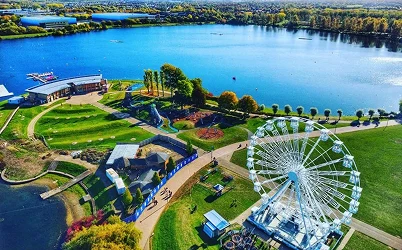
The parks network in Milton Keynes is one of the most extensive in any English city. The Linear Parks system runs north-south through the city along the valley of the River Great Ouse and Ouzel, linking a chain of lakes, wetlands, and open green spaces from Caldecotte Lake in the south to Willen Lake in the north-east. Caldecotte Lake and Willen Lake both offer watersports, sailing, windsurfing, and leisure facilities. Ouzel Valley Park and Furzton Lake provide further outdoor recreation across the western parts of the city. The Snowdome at Xscape and the broader network of sports facilities, football pitches, and leisure centres distributed across the city give Milton Keynes a genuinely comprehensive outdoor and indoor leisure infrastructure.
Safety and Community Life
Milton Keynes's rapid population growth and its relatively young demographic profile give the city a dynamic and entrepreneurial community character. The city has a high rate of business formation, with 71.5% of all businesses in the city having started up there, reflecting a strong enterprise culture. Eight million people live within a one-hour drive of Milton Keynes, underlining its position at the geographic heart of the South East Midlands region. Safety varies across different parts of the city, with the more established suburbs and surrounding market towns generally having lower recorded crime rates than some of the inner urban grid squares.
Healthcare in Milton Keynes
Milton Keynes University Hospital on Standing Way in Eaglestone is the city's main acute hospital, operated by Milton Keynes University Hospital NHS Foundation Trust. The hospital provides a full range of acute services including emergency care, maternity, surgery, and specialist outpatient appointments and is one of the city's largest employers. Multiple GP surgeries, health centres, and community health services are distributed across the city's residential areas, providing accessible primary care for residents across all parts of the city.
Selling Your Home in Milton Keynes with YooSell
If you are thinking about selling your Milton Keynes property, YooSell offers a genuinely better alternative to the traditional high street estate agency model. YooSell is a self-service home-selling platform built for homeowners across the Midlands and the wider UK, giving you complete control of your sale at a fraction of the cost of a conventional agent.
Why Milton Keynes Homeowners Choose YooSell
With YooSell, you pay no commission at any stage of the sale process. You pay a simple fixed monthly fee from £49.50 and keep 100% of your agreed sale price. There is no percentage cut at completion, no hidden extras, and no agent taking a share of the equity you have built in your home.
You can list your property on Rightmove through YooSell directly, putting your Milton Keynes home in front of millions of active buyers on the UK's biggest property portal without instructing a traditional estate agent. You set your own asking price, manage your own viewings on your own schedule, and respond to offers entirely on your own terms. Every buyer on the platform is ID-verified and financially qualified before making an offer, so you only deal with serious, genuine purchasers. When you accept an offer, access trusted conveyancers and legal partners directly through your YooSell dashboard, keeping the process streamlined from acceptance through to completion.
Free Tools for Milton Keynes Buyers and Sellers
Before listing or making an offer, use the free tools available through YooSell:
Valuation Calculator to estimate your Milton Keynes property's current market value
Cost Saving Calculator to see exactly how much you save versus a traditional agent on your sale
Mortgage Calculator to plan your next purchase and understand your monthly repayments
Stamp Duty Calculator to calculate your full tax liability before you exchange contracts
YooSell Pricing Plans to choose the listing tier that fits your sale
Frequently Asked Questions
Find Homes Available In Milton Keynes
Browse verified homes listed directly by sellers in Milton Keynes. Compare listings, arrange viewings and make offers in one place.
Find Homes Available In Milton KeynesStart Selling Your Home Today!
Take control of your sale with YooSell. Get started today and explore how we can help you sell smarter, faster, and with less hassle.