Manchester
Thinking of moving to Manchester in 2026? This original city area guide covers the best neighbourhoods from Didsbury to Ancoats, verified ONS property prices, the Metrolink tram network, two world-class universities, 63% ten-year price growth, football heritage, MediaCityUK, and how to sell your Manchester home commission-free with YooSell.

Sarah M.
Sarah focuses on pricing strategy, presentation, and getting listings ready for market. She helps sellers present homes clearly without overcomplicating the process.
Manchester is one of the most genuinely transformed cities in England over the past three decades and one of the most compelling property markets for buyers who want to live in a city that offers real cultural depth, a remarkable sporting legacy, strong graduate employment, and a property market that has delivered 63% asking-price growth over ten years while still offering meaningful affordability compared to London and the South East. Its population has grown by approximately 23% since 2011, first-time buyers accounted for 70.2% of all mortgaged purchases in the city during 2025, the highest proportion outside London, and its average house price of approximately £248,000 in March 2026 remains accessible enough to attract buyers and investors from across the UK while providing consistent long-term capital growth. Whether you are a first-time buyer, a young professional relocating for work, a family looking for a vibrant urban base, or a homeowner considering selling without paying estate agent commission, this guide gives you an accurate and original picture of Manchester in 2026.
Browse verified property listings in Manchester and the wider Greater Manchester area on the YooSell Find a Home platform, with no agent fees and direct access to verified seller listings across the M postcode.
About Manchester?
Manchester is a city and metropolitan borough in Greater Manchester, North West England. At the 2021 census, the population of Manchester City Council area was 586,982. By 2025, the population had grown to approximately 620,000, with projections placing it at approximately 635,000 in 2026, representing growth of around 23% since 2011. The wider Greater Manchester urban area is the second largest urban area in England after London, with a population of approximately 2.9 million.
Manchester is approximately 162 miles north-west of London and 92 miles north of Birmingham. It is the principal city of the Greater Manchester Combined Authority, which covers ten local authority areas including Salford, Trafford, Stockport, Tameside, Oldham, Rochdale, Bolton, Bury, and Wigan alongside Manchester city itself. The Greater Manchester Mayor oversees strategic decisions including transport, housing, and economic development across the combined authority area.
Manchester was at the heart of the Industrial Revolution, becoming the world's first industrial city in the late 18th century. It was the world's first city to use trains for passenger transport, opening the Liverpool and Manchester Railway in 1830. The Manchester Ship Canal, opened in 1894, connected the city to the sea and made Manchester an inland port at the heart of the global cotton trade. Manchester's textile and manufacturing economy dominated through the 19th and early 20th centuries before the city reinvented itself in the post-industrial era as a major centre for financial services, digital and creative industries, healthcare, and higher education.
Manchester is internationally renowned for its football, with two globally recognised clubs in Manchester City and Manchester United. The city hosted the 2002 Commonwealth Games, the 2023 Ryder Cup at neighbouring Manchester Golf Club, and has hosted major concerts and events at Manchester Arena, now the AO Arena. The BBC relocated its national and regional operations to MediaCityUK in Salford Quays in 2011, and ITV Granada, dock10 Studios, and a large concentration of creative and media businesses have made the Salford Quays area one of the most significant media clusters in the UK outside London.
Manchester Property Market 2026
Manchester's property market is characterised by a decade of strong growth, a consistent supply shortfall relative to demand, and a rental market that has outpaced house price growth in percentage terms over five years. Understanding where Manchester sits in 2026 requires both recognising its long-term trajectory and acknowledging the more complex current environment of higher mortgage costs and elevated stock.
Property Market Overview
According to ONS UK House Price Index data, the average house price in Manchester was £248,000 in March 2026, up 1.4% from March 2025. This was in line with modest national trends while remaining well below the UK average of £259,000 in Great Britain at the same time. More recent ONS provisional data shows the average for homes bought with a mortgage at £259,000 in July 2026, up 1.5% from £255,000 in July 2025. The average first-time buyer price in Manchester was £237,000 in July 2026, up 1.4% from £234,000 in July 2025.
Across all HM Land Registry transactions between August 2025 and July 2026, analysis places the average property price in Manchester at approximately £273,000, with 13,300 property sales in that period. The most affordable postcode sector in Manchester is M4 2, with an average price of approximately £100,000, while the most expensive is M2 7, with an average of approximately £2.1 million.
Over ten years, Manchester asking prices have grown by 63%, from an average of £160,422 in 2016 to £261,891 in 2026, compared to London's growth of only 7% over the same period. This long-term performance reflects how thoroughly Manchester's employment base, population growth, and regeneration have changed the city's position in UK housing demand.
Private rents in Manchester rose to an average of £1,373 per month in August 2026, an annual increase of 4.2% from £1,317 in August 2025, slightly below the North West regional rise of 5.8% over the same period. Earlier in 2026, ONS data showed average monthly private rents at £1,349 in April 2026, up 3.0% from £1,309 in April 2025, with one-bedroom rents averaging £987 and two-bedroom rents averaging £1,213. Rents for semi-detached and terraced properties rose by 4.5% in the year to August 2026, while rents for three-bedroom properties rose by 4.5% and four-or-more bedroom properties by 3.4%.
Use the free YooSell Valuation Calculator to estimate the current market value of any Manchester property before listing or making an offer.
Property Types and Market Context
Manchester's housing stock is dominated by terraced houses, Victorian and Edwardian semis in the inner suburbs, and modern city-centre and inner-suburb apartment developments. In terms of price growth by type, semi-detached houses rose by approximately 3.8% over the most recent 12-month period, terraced houses by approximately 2.5%, and flats by close to 0%, suggesting the family home market has stronger underlying demand than the apartment sector in the current environment.
Properties in Manchester are typically taking around 55 to 70 days to sell from listing to Sold Subject to Contract. Well-priced family homes in popular areas like Didsbury and Chorlton can sell in a few weeks, while overpriced city-centre flats with high service charges may take significantly longer.
New-build properties in Manchester traded at approximately £302,000 between August 2025 and July 2026, compared to approximately £272,000 for older stock. The city's five-year housing requirement for 2025 to 2030 is 21,287 dwellings but net completions in 2024/25 were only 3,864, creating a structural supply shortfall that supports both sale prices and rental demand.
Use the YooSell Cost Saving Calculator to understand how much you could keep by selling your Manchester property commission-free.
How Much Could You Save Selling Without an Agent?
Traditional estate agents typically charge between 1% and 3% commission on the final sale price. With YooSell, you pay a fixed monthly fee from just £49.50 and keep 100% of your agreed sale price. You can list your property on Rightmove through YooSell directly, giving your Manchester home maximum visibility on the UK's biggest property portal without paying estate agent commission. View the YooSell pricing plans to choose the right listing tier for your sale.
Best Areas and Neighbourhoods in Manchester
Manchester's residential landscape is richly varied, from the dense Victorian terraces and regenerated warehouses of the inner city to the leafy family suburbs of the south and the distinctive creative villages that give the city much of its cultural identity.
Didsbury
Didsbury, in the south of Manchester, is consistently named as one of Manchester's most desirable residential addresses. It has a village-like character with an excellent range of independent shops, restaurants, and cafes on Didsbury village high street, well-regarded schools, period Victorian and Edwardian housing on leafy streets, and the River Mersey running along its southern edge with Mersey Valley walks extending through Chorlton Water Park and beyond. Didsbury is popular with young professionals, families, and media and creative sector workers, and consistently commands premium prices within the Manchester market.
Chorlton
Chorlton, to the west of Didsbury along the River Mersey, is one of Manchester's most characterful and popular inner-south neighbourhoods. It has a strong independent retail and food offer, a thriving arts and live music scene, Chorlton Water Park on the Mersey, and a community identity built around sustainability, independent business, and creative culture. Chorlton is popular with young families and professionals who want community and green space without moving to the more expensive Didsbury streets.
Ancoats and New Islington
Ancoats, immediately north-east of the city centre, is Manchester's most rapidly transforming inner-city neighbourhood and one of the most discussed regeneration stories in UK property markets. Historically the world's first industrial suburb, Ancoats is now an award-winning urban village with converted Victorian cotton mills, independent restaurants, bars, and coffee shops, new-build apartments, and a growing permanent population of young professionals. Ancoats and New Islington are estimated to have seen annual price growth of approximately 5% to 6% in 2025, according to independent market analysis. Browse available properties in Ancoats on the YooSell Find a Home platform.
Northern Quarter
The Northern Quarter, immediately north of Piccadilly Gardens, is Manchester's creative and independent retail quarter. Its Victorian warehouse buildings and cobbled streets host a dense concentration of independent music shops, boutiques, galleries, bars, and restaurants that define Manchester's alternative culture scene. Residential conversions of the area's warehouse buildings have created distinctive loft-style apartments and the area has a consistent waiting list of renters and buyers who want to live at the heart of the creative city.
Salford Quays and MediaCityUK
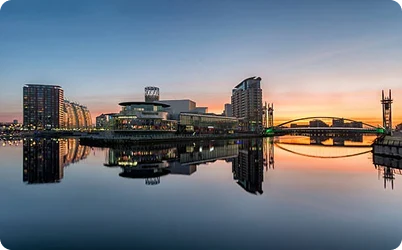
Salford Quays, across the Irwell from Manchester city centre, has been transformed from derelict dockyards into one of the most recognisable waterfront developments in the UK. The arrival of BBC North, ITV Granada, dock10 Studios, and over 200 media and creative businesses at MediaCityUK has given the area a strong employment base that sustains consistent residential demand from media workers and young professionals. The waterfront apartments and the improved Metrolink connections to the city centre and Manchester Airport make Salford Quays one of the most practically convenient residential locations in Greater Manchester for those who work in the media sector.
Levenshulme
Levenshulme, between Didsbury and Longsight on the A6, is one of Manchester's fastest gentrifying areas in 2026. Its Victorian terraced housing, accessible prices, growing independent food and drink scene, and direct rail access to Manchester Piccadilly have made it increasingly popular with first-time buyers and young professionals priced out of Didsbury and Chorlton. Independent market analysis estimates annual price growth in Levenshulme of approximately 4% to 5% in the most recent period.
Hulme
Hulme, immediately south of the city centre, has undergone substantial regeneration since the demolition of the notorious Hulme Crescents high-rise estate in 1993. The area now has a mix of affordable social housing and private homes, good transport connections to the city centre and the universities, and is one of the more accessible inner-city neighbourhoods for buyers who want city-centre proximity at lower prices.
Fallowfield and Withington
Fallowfield and Withington, in the south of Manchester between Didsbury and Rusholme, form the principal student and young professional neighbourhood for the University of Manchester and Manchester Metropolitan University. Fallowfield is dominated by student housing during term time but has a lively independent food and social scene that gives it year-round vitality. Withington has a stronger permanent residential character and a well-regarded high street.
Schools in Manchester
Manchester has a large and varied education sector across its different neighbourhoods. School performance in Manchester is mixed at secondary level, and families making residential decisions based on school catchment are strongly advised to research individual school Ofsted reports and performance data directly.
Primary Schools
Manchester has a significant number of primary schools across its neighbourhoods, with considerable variation in performance and Ofsted outcomes. The southern suburbs of Didsbury, Chorlton, and West Didsbury generally have the strongest primary provision and are the areas where school catchment drives the most significant residential premium. Parents should confirm current Ofsted ratings and catchment boundaries with Manchester City Council's school admissions team before committing to a specific area. The Ofsted report card system introduced from September 2024 no longer issues a single overall effectiveness judgement for most state school inspections, and parents should review individual school report cards directly.
Secondary Schools
Manchester Grammar School, a selective independent school in Fallowfield, is one of the highest-performing schools in England and consistently ranks among the top academic secondary schools in the country. Manchester High School for Girls is a similarly high-performing selective independent school. For state secondary provision, performance varies significantly across the city's different areas and families are strongly advised to research individual school performance data and Ofsted status directly.
Universities
Manchester has two major universities within the city boundaries, together generating one of the largest student populations of any UK city and one of the most significant concentrations of graduate talent in England outside London.
The University of Manchester
The University of Manchester is a member of the Russell Group and one of the UK's top research universities. It is consistently ranked among the world's top 50 universities and has produced 25 Nobel Prize winners associated with the institution, more than any other British university outside Oxford and Cambridge. The university has over 40,000 students and is particularly renowned for its research in physics, including graphene, material science, medicine, and computer science, with Alan Turing, the father of computer science and artificial intelligence, having worked in Manchester. The main campus is in Fallowfield and Oxford Road, approximately one mile south of the city centre.
Manchester Metropolitan University
Manchester Metropolitan University (MMU) has its main campus in the All Saints area of the city centre, directly adjacent to Oxford Road. It has over 38,000 students and is one of the largest universities in the UK by student numbers, with a strong reputation for business, law, art, design, and sport science. The combination of the University of Manchester and MMU gives the Oxford Road corridor one of the highest concentrations of academic and research activity in England outside London.
Transport and Commuting from Manchester
Manchester has one of the most comprehensive urban transport networks in the UK, anchored by Piccadilly station on the national rail network and the Metrolink tram system, one of the largest and most heavily used light rail networks in England.
Rail Connections
Manchester Piccadilly is the city's principal intercity station, served by Avanti West Coast, TransPennine Express, CrossCountry, Northern, and other operators. Direct trains reach London Euston in approximately 2 hours 10 minutes on faster Avanti services. Birmingham New Street is approximately 80 to 90 minutes away. Leeds is approximately 55 to 60 minutes, Sheffield approximately 1 hour, and Liverpool approximately 40 minutes by direct train. Manchester Airport station provides additional connectivity, with direct trains to Manchester Piccadilly in approximately 20 minutes and connections to national rail services.
Manchester Victoria station in the city centre serves northern and eastern routes, including trains to Bradford, Halifax, and the Calder Valley corridor. The planned Northern Powerhouse Rail (NPR) project, which would provide high-speed connections between Manchester, Leeds, Sheffield, and Hull, is at various stages of planning and funding review.
Metrolink Tram Network
The Metrolink is one of the largest urban tram networks in the UK, extending across 10 lines and 99 stops connecting Manchester city centre to Altrincham, Bury, Eccles, Didsbury Village, Rochdale, Ashton-under-Lyne, Oldham, Salford Quays, MediaCityUK, and Manchester Airport. The network carries approximately 47 million passenger journeys per year and has been significantly expanded in recent years as part of the Greater Manchester Combined Authority's investment in sustainable transport.
The Bee Network, Greater Manchester's integrated transport system, combines Metrolink, Bee Network buses, cycling, and walking routes under a single integrated ticketing and payment system. Bus services in Greater Manchester were re-regulated in 2023 under the Bee Network, giving the Combined Authority direct control over routes, frequencies, and fares for the first time since deregulation in 1986.
Use the YooSell Mortgage Calculator to understand your monthly repayment costs on any Manchester property before making an offer.
Road Access
Manchester sits at the heart of the national motorway network in the North West. The M60 orbital motorway encircles the city, connecting to the M56 south towards Cheshire and the M6, the M62 east towards Leeds and Hull, the M61 north towards Bolton and Preston, and the M67 east towards Tameside and Sheffield via the A628. Manchester city centre is approximately 30 to 40 minutes from the M6 in normal traffic conditions, and Manchester Airport, on the southern edge of the conurbation, is accessible from the city in approximately 20 to 30 minutes.
Living in Manchester: Culture, Heritage and Community
Football Heritage
Manchester's global identity is inseparable from its football. Manchester City, based at the Etihad Stadium in east Manchester, won the Premier League title in six seasons between 2012 and 2024 and completed an unprecedented Treble in the 2022/23 season, winning the Premier League, FA Cup, and Champions League. Manchester United, based at Old Trafford in Trafford to the west of the city centre, won 20 First Division and Premier League titles under Sir Alex Ferguson between 1992 and 2013 and won the Champions League in 1999 and 2008. Old Trafford is the largest club football stadium in England with a capacity of approximately 74,000.
The Lowry and MediaCityUK
The Lowry at Salford Quays is one of the UK's premier performing arts venues, named after L.S. Lowry, the Salford-born artist famous for his industrial paintings of northern England. The theatre complex, which opened in 2000, includes two main performance spaces, a gallery of Lowry's paintings, and a restaurant with waterfront views over Salford Quays. Adjacent to the Lowry, MediaCityUK hosts the BBC, ITV, dock10 Studios, and over 200 media businesses, making Salford Quays the most concentrated media cluster outside London.
Manchester's Music Heritage
Manchester's contribution to popular music is extraordinary for a city of its size. The Hacienda nightclub, which closed in 1997, defined the 1980s acid house and rave culture globally and gave Manchester an enduring identity in contemporary music history. The bands and musicians associated with Manchester span multiple genres and eras, from The Hallé Orchestra, founded in 1858 and the UK's oldest professional symphony orchestra, to the post-punk, Madchester, Britpop, and contemporary electronic and indie scenes that have emerged from the city across the past four decades.
The AO Arena, with a capacity of approximately 21,000, is one of the UK's largest indoor music and events venues and one of the most visited concert arenas in the world, consistently ranked in the global top 10 for ticket sales.
Manchester Cathedral and the Historic City Centre
Manchester Cathedral, on the northern edge of the city centre, is a Gothic building largely from the 15th and early 16th centuries and one of the oldest buildings in central Manchester. The cathedral sits at the head of the Cathedral Quarter, which includes the Corn Exchange and the Exchange Theatre. Chetham's Library, adjacent to the cathedral, is the oldest public library in the English-speaking world, having opened in 1653. The reading room at Chetham's is where Karl Marx and Friedrich Engels studied and researched while developing their theories of communism in the 1840s.
The John Rylands Library
The John Rylands Library on Deansgate is one of the finest examples of Victorian Gothic architecture in England and holds one of the most important collections of rare books and manuscripts in the world, including the St John Fragment, the oldest surviving piece of the New Testament, written in Greek on papyrus in the early 2nd century AD. The library was founded in 1900 and is now part of the University of Manchester. It is freely accessible to the public and is one of Manchester's most extraordinary architectural and scholarly treasures.
The Museum of Science and Industry
The Museum of Science and Industry (MOSI) in Castlefield occupies the site of the world's oldest surviving passenger railway station, where the Liverpool and Manchester Railway opened in 1830. The museum covers the history of science and industrial innovation, with particular focus on Manchester's extraordinary role in the development of computers, including a working replica of the Manchester Baby, the world's first stored-programme computer, which ran its first programme in 1948. The museum is freely accessible and is one of the finest science and industry museums in the UK.
Safety and Community Life
Safety in Manchester varies significantly across different wards and postcodes. The city centre and inner-city areas have higher recorded crime rates than the outer suburbs and the southern neighbourhoods of Didsbury, Chorlton, and West Didsbury, which are generally regarded as safe and family-friendly. Buyers and renters are encouraged to review current Greater Manchester Police crime statistics by specific postcode before making residential decisions.
Healthcare in Manchester
Manchester University NHS Foundation Trust (MFT), which includes Manchester Royal Infirmary and ten other hospitals across Greater Manchester, is one of the largest NHS trusts in England. Manchester Royal Infirmary in the Oxford Road Corridor is a major teaching hospital adjacent to the University of Manchester's medical school and provides specialist and emergency care for Manchester and the wider region. Wythenshawe Hospital in south Manchester is the base for the UK's largest organ transplant programme and provides cardiothoracic services for the North West. Multiple GP practices operate across all residential areas of the city, with levels of access varying between different communities.
Selling Your Home in Manchester with YooSell
If you are thinking about selling your Manchester property, YooSell offers a genuinely better alternative to the traditional high street estate agency model. YooSell is a self-service home-selling platform built for homeowners across the Midlands and wider England, giving you complete control of your sale at a fraction of the cost of a conventional agent.
Why Manchester Homeowners Choose YooSell
With YooSell, you pay no commission at any stage of the sale process. You pay a simple fixed monthly fee from £49.50 and keep 100% of your agreed sale price. There is no percentage cut at completion, no hidden extras, and no agent taking a share of the equity you have built in your home.
You can list your property on Rightmove through YooSell directly, putting your Manchester home in front of millions of active buyers on the UK's biggest property portal without instructing a traditional estate agent. You set your own asking price, manage your own viewings on your own schedule, and respond to offers entirely on your own terms. Every buyer on the platform is ID-verified and financially qualified before making an offer, so you only deal with serious, genuine purchasers. When you accept an offer, access trusted conveyancers and legal partners directly through your YooSell dashboard, keeping the process streamlined from acceptance through to completion.
Free Tools for Manchester Buyers and Sellers
Before listing or making an offer, use the free tools available through YooSell:
Valuation Calculator to estimate your Manchester property's current market value
Cost Saving Calculator to see exactly how much you save versus a traditional agent on your sale
Mortgage Calculator to plan your next purchase and understand your monthly repayments
Stamp Duty Calculator to calculate your full tax liability before you exchange contracts
YooSell Pricing Plans to choose the listing tier that fits your sale
Frequently Asked Questions
Find Homes Available In Manchester
Browse verified homes listed directly by sellers in Manchester. Compare listings, arrange viewings and make offers in one place.
Find Homes Available In ManchesterStart Selling Your Home Today!
Take control of your sale with YooSell. Get started today and explore how we can help you sell smarter, faster, and with less hassle.