Buxton
Thinking of moving to Buxton in 2026? This original area guide covers the best neighbourhoods, England's highest market town, the Crescent Hotel, Opera House and Pavilion Gardens, the Peak District on the doorstep, verified property prices, schools, rail to Manchester, and how to sell your Derbyshire home on Rightmove commission-free with YooSell.

George K.
George specialises in local area insights across Leicestershire and the wider Midlands. He highlights schools, transport, and neighbourhood character for relocating buyers.
Buxton is England's highest market town, a spa town of Roman origins, and one of the most architecturally extraordinary small towns in the country. Sitting at approximately 1,000 feet above sea level on the edge of the Peak District National Park, it has drawn visitors to its natural thermal springs for nearly two thousand years and has been named one of the best places to live in the United Kingdom by the Sunday Times in both 2018 and 2024. With its extraordinary Georgian and Victorian architecture, the restored Buxton Crescent Hotel and Thermal Spa, the landmark Devonshire Dome with a span wider than St Paul's Cathedral, more than a million visitors per year, and a property market within the High Peak district that is outperforming the wider East Midlands region, Buxton is a genuinely unique destination for buyers who want a distinctive place to call home.
Whether you are searching for a period property in one of England's most beautifully preserved spa towns, relocating for the countryside and fresh air of the Peak District, or a homeowner considering selling your Buxton property without paying estate agent commission, this guide gives you an accurate and original picture of the town in 2026.
Browse verified property listings in and around Buxton on the YooSell Find a Home platform, with no agent fees and direct access to verified seller listings in the SK17 postcode.
About Buxton?
Buxton is a spa town in the borough of High Peak, Derbyshire, in the East Midlands region of England. It is England's highest market town, sited at approximately 1,000 feet, or 300 metres, above sea level. The town population was 20,048 at the 2021 census, a slight decrease from 21,108 at the 2011 census, reflecting the broader demographic characteristics of an older, more stable community. Buxton lies close to Cheshire to the west and Staffordshire to the south, positioned on the edge of the Peak District National Park. It is encircled by but excluded from the National Park itself, giving the town a unique administrative position as the principal service centre for the surrounding National Park communities.
Buxton's history as a spa resort stretches back to Roman times. The Romans knew the place as Aquae Arnemetiae, meaning "the Spa of the Goddess of the Grove", reflecting the geothermal springs that emerge from the limestone bedrock at a constant 82 degrees Fahrenheit, or 28 degrees Celsius. These springs, which have been flowing continuously since before recorded history, made Buxton one of the most visited places in Roman Britain. The medieval period saw continued use of the waters, and by the 16th century the baths had been rebuilt and the Church of St Anne, built in 1625, became known for the supposed healing properties of the spring that flowed beside it. St Ann's Well, at the bottom of the Slopes in the town centre, remains the most accessible public expression of this extraordinary geological heritage, where natural spring water flows freely for visitors and residents to drink at any time of the day.
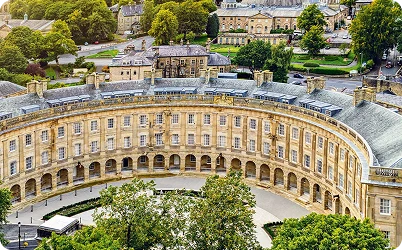
The town's most dramatic architectural transformation came in the late 18th century when William Cavendish, the 5th Duke of Devonshire, resolved to transform Buxton into a spa town to rival Bath. His ambitions produced two of the most remarkable buildings in Derbyshire. The Crescent, built between 1780 and 1786 by architect John Carr in the Doric style to mirror the Royal Crescent in Bath, was intended as a hotel and lodgings for wealthy visitors taking the waters. It was restored after lying derelict for many years and reopened in 2020 as the five-star Buxton Crescent Hotel and Thermal Spa, one of the most celebrated hotel restorations in England. The Devonshire Dome, built by the 6th Duke of Devonshire in 1880 as a stable block, has a dome spanning 44.5 metres, which is larger in diameter than the dome of St Paul's Cathedral in London. It is now used by the University of Derby as an academic building and is one of the most striking landmarks in the entire Peak District region.
Buxton Property Market 2026
Buxton's property market reflects its dual character as both a distinctive historic town and a gateway to the Peak District National Park. The combination of extraordinary architecture, a growing tourism economy, and strong demand from buyers relocating from Manchester and other northern cities drives values above the Derbyshire county average.
Property Market Overview
Buxton sits within the High Peak district, where ONS UK House Price Index data shows the average house price was approximately £260,000 for homes bought with a mortgage in October 2025, up 4.5% from £249,000 the year before. Home movers in High Peak paid an average of £300,000 in October 2025, up from £288,000 a year earlier. The average price paid by first-time buyers in High Peak was £222,000 in October 2025, up 4.2% from £213,000 in October 2024. Private rents in High Peak averaged £881 in November 2025, broadly stable over the year.
Looking specifically at Buxton town, Rightmove analysis of HM Land Registry data places the average property price in Buxton at £278,558 over the last year, updated as of July 2026. Nethouseprices analysis places the overall average at £259,491 for the most recent 12-month period. In the past 12 months to November 2024, 209 properties were sold in Buxton, including 64 semi-detached properties, 55 flats and apartments, 45 detached houses, and 45 terraced properties. Of those 209 sales, 14 achieved a price over £500,000, reflecting the premium end of the market in the most desirable Georgian and Victorian streets.
Property Types in Buxton
Buxton's housing stock reflects the town's two principal phases of development: the Georgian and Regency period when the 5th and 6th Dukes of Devonshire built terraced properties along formal streets close to the Crescent, and the Victorian era when more varied housing spread across the hillsides surrounding the spa centre. Flats and apartments are unusually prevalent in Buxton relative to comparable market towns, reflecting the conversion of large Victorian properties and the presence of the University of Derby campus. Detached homes in Buxton have historically commanded the highest premiums, with examples in the most sought-after streets achieving well above the district average.
Use the free YooSell Cost Saving Calculator to see how much you could save by selling your Buxton property commission-free rather than through a traditional agent.
The Rental Market
Private rents in High Peak averaged £881 per month in November 2025, broadly stable compared to the previous year, according to ONS Price Index of Private Rents data. This stability was in contrast to the East Midlands regional average rise of 5.7% over the same period, suggesting the High Peak rental market has been relatively subdued. Buxton's rental market draws demand from University of Derby students and staff on the Buxton campus, from workers in the town's tourism, quarrying, and light industry sectors, and from younger residents who have not yet been able to purchase in an area where property-to-income ratios are above the county average.
Best Areas and Neighbourhoods in Buxton
Buxton's topography is dramatic. The town sits in a natural bowl surrounded by hills on three sides, and its residential areas spread across and up these hillsides in distinct layers. Understanding the different parts of the town helps buyers identify where their priorities are best met.
The Spa Quarter and the Crescent
The heart of historic Buxton, centred on the restored Crescent, the Devonshire Dome, and the formal gardens and parks of The Slopes and Pavilion Gardens, is the most architecturally significant area in the town. Properties here include Georgian and Regency terraces, townhouses, and substantial Victorian mansions, many of which have been converted into apartments and hotels. Buyers seeking genuine period character in a walkable town centre setting are drawn to this area, with the understanding that values reflect the exceptional quality and rarity of these properties.
Use the YooSell Valuation Calculator to understand the current market value of properties in this distinctive part of the town before listing or making an offer.
Fairfield
Fairfield, to the east of the town centre, is one of Buxton's most consistently popular residential areas. Analysis from Nethouseprices places average property values in Fairfield at £311,500, above the overall Buxton average, reflecting the quality of the established housing stock and the area's family-friendly character. Fairfield is close to Buxton Community School on Temple Road and several well-regarded primary schools, making it a natural destination for families who have chosen Buxton for its schools and outdoor lifestyle.
Burbage
Burbage, to the south of the town centre, is a distinct settlement on the edge of Buxton that merges with the moorland landscape of the Peak District. Properties here range from period stone cottages to more modern homes, with the open moorland accessible almost directly from the doorstep. Burbage offers a genuine countryside feel while remaining within a short walk or drive of the town centre amenities. It is popular with buyers who want the spa town's cultural and shopping offer combined with direct access to walking and outdoor recreation.
Lightwood and Harpur Hill
Lightwood and Harpur Hill, to the south and south-east of the town, offer a mix of established post-war and later 20th-century housing providing more accessible entry points into the Buxton market. These areas are popular with first-time buyers and younger families and are within reasonable distance of the schools and supermarkets along the southern approaches to the town.
Surrounding Villages
Buxton is surrounded by a remarkable network of Peak District villages accessible within 10 to 20 minutes by road, each with its own distinct character. Chapel-en-le-Frith, approximately 5 miles to the north, is a substantial market town in its own right with its own secondary school and good everyday amenities. Tideswell, Taddington, Chelmorton, and the villages of the White Peak limestone plateau to the south and east offer character stone cottages and farmhouses at premiums that reflect both their scarcity and the extraordinary landscape they sit within.
Search for available properties across Buxton and the surrounding Peak District villages on the YooSell Find a Home platform.
Schools in Buxton
School provision is a key consideration for families choosing Buxton as their home. The town has its own secondary school and a range of primary provision, alongside access to the University of Derby campus within the town itself.
Primary Schools in Buxton
Buxton has several primary schools serving the town's different residential areas and surrounding parishes. The High Peak district primary sector overall has good Ofsted coverage, with many schools in the area holding Good ratings. Parents are encouraged to confirm the current Ofsted status and catchment boundaries for individual schools directly with Derbyshire County Council ahead of each year's admissions process, as the new Ofsted report card system introduced from September 2024 no longer issues a single overall effectiveness judgement for most state-funded school inspections.
Secondary School in Buxton
Buxton Community School
Buxton Community School on Temple Road, Buxton is a coeducational secondary school and sixth form with approximately 1,030 to 1,038 students aged 11 to 18. The school converted to academy status in June 2023 and is now sponsored by the Embark Multi Academy Trust, under the headship of Sam Jones. The school's last full Ofsted inspection, conducted in May 2013 under the previous inspection framework, rated the school as Good. Under the new Ofsted report card framework introduced from September 2024, overall effectiveness judgements are no longer issued as single-word gradings. The school opened in its present form in 2023 following the conversion to academy status. Parents should review the most current Ofsted monitoring visits and school performance data directly before making residential decisions based on this school's catchment.
Chapel-en-le-Frith High School
Chapel-en-le-Frith High School on Long Lane, Chapel-en-le-Frith SK23 0TQ is a mixed-gender comprehensive community school with approximately 932 pupils aged 11 to 16. The school was established in 1952 and is located in Chapel-en-le-Frith, approximately 5 miles north of Buxton town centre. For families in the northern parts of Buxton and in the surrounding villages of the High Peak, it provides an alternative secondary option. The school's current headteacher is Greg Raynor, who took up the post in May 2025.
Special Educational Needs Provision
Derbyshire County Council provides SEND home-to-school transport support for eligible children across the High Peak district. Families with children who have additional needs should contact Derbyshire County Council's SEND team directly to discuss eligibility and available specialist provision.
Higher Education in Buxton
The University of Derby has a significant campus presence in Buxton, operating from the magnificent Devonshire Dome building. The university uses the dome and surrounding buildings for academic provision, making Buxton one of the very few small English market towns with a university campus at the heart of its most celebrated heritage building. The University of Derby is a major employer in the town and attracts staff and students who contribute to the local economy. The main University of Derby campus in Derby city centre is accessible by direct train in approximately 55 to 60 minutes.
Transport and Commuting from Buxton
Transport is one of Buxton's acknowledged challenges for daily commuters, though the town's position as a destination rather than a commuter settlement means many residents work locally in tourism, healthcare, education, and the University.
Rail Connections
Buxton railway station is the terminus of the Buxton Branch Line, operated by Northern Trains, which runs direct services to Manchester Piccadilly. The journey time from Buxton to Manchester Piccadilly is approximately 55 to 60 minutes, with a change at Stockport. Services run approximately hourly. This makes Buxton a practical if not fast choice for professionals who work in Manchester, and increasingly popular with buyers priced out of Manchester's commuter belt who are willing to accept a longer commute in exchange for Buxton's extraordinary quality of life and architectural character.
It is important for buyers to note that Buxton does not have a direct train to Derby. The line that once connected Buxton to Derby via Matlock was closed in 1968 as part of the Beeching cuts. Derby is most practically reached from Buxton by car via the A515 and A6, a journey of approximately 45 to 55 minutes.
Road Access
Buxton sits on the A6, which runs southward to Derby and northward towards Stockport and Manchester. The A53 connects the town northward to Macclesfield and Leek. The A515 runs southward towards Ashbourne and the A50. Buxton is approximately 25 miles from Manchester city centre, 45 miles from Derby, and 40 miles from Sheffield by road. The nearest motorway junction is on the M60 Manchester orbital motorway, approximately 20 to 25 miles from the town, accessible via the A6 through Stockport.
Bus Services
Buxton is served by regional bus routes connecting the town to Macclesfield, Stockport, Sheffield, Derby, and the surrounding Peak District villages. The High Peak Buses network, operated by Hulleys of Baslow and other operators, provides connections across the Peak District. Buxton acts as a hub for bus services serving a wide catchment of surrounding villages, making it an important service centre for communities that lack their own local services.
Manchester Airport
Manchester Airport, one of the UK's busiest international airports, is approximately 45 minutes from Buxton via the A6 and A538. This gives Buxton residents practical access to a wide range of international flights without needing to travel to London, a significant advantage for those who travel frequently for business or leisure.
Living in Buxton: Heritage, Culture and Community
The Buxton Crescent Hotel and Thermal Spa
The Buxton Crescent Hotel and Thermal Spa is the most significant single building in the town and one of the most celebrated Georgian buildings in the North of England. Built between 1780 and 1786 by John Carr under the patronage of the 5th Duke of Devonshire, the Grade I listed Crescent was modelled on the Royal Crescent in Bath and was intended to establish Buxton as an equal rival to the Somerset spa town. After years of dereliction, the building was restored in a major project completed in 2020 and reopened as a five-star hotel and thermal spa. The restoration included the reinstatement of the historic thermal baths using the natural geothermal spring water that has flowed beneath Buxton since before Roman times. The hotel is now the defining feature of the town's luxury tourism offer and a focal point for visitors from across the UK and internationally.
The Devonshire Dome
The Devonshire Dome, built in 1880 as stables by the 6th Duke of Devonshire to complement the Crescent, has a spectacular dome with a span of 44.5 metres, making it larger in diameter than the dome of St Paul's Cathedral in London. The building was later used as a military hospital during the First World War and is now part of the University of Derby's Buxton campus. The dome houses academic facilities and a restaurant, and the building's exterior is one of the most striking architectural set pieces in any English market town.
Buxton Opera House and Festival
Buxton Opera House, built in 1903 and designed by Frank Matcham, the greatest theatre architect of the Edwardian age, is one of the best-preserved examples of an Edwardian theatre in the country. It seats 902 people and is the centrepiece of the annual Buxton International Festival, held each July and described by the Times as "the most varied festival programme in the UK." The festival includes world-class opera performed at the Opera House, music recitals, literary talks, and comedy, drawing audiences from across the country to the town. For residents, having the Opera House and a major international arts festival within walking distance is a quality-of-life asset that few towns of Buxton's size can match.
Pavilion Gardens
Pavilion Gardens is a 23-acre Victorian public park in the heart of Buxton, created in 1871 by Edward Milner, the lead designer of the Great Exhibition at Crystal Palace. The park stretches along the banks of the River Wye and includes formal gardens, a serpentine lake, a Victorian pavilion used for concerts and events, a café, a miniature railway, and a bandstand. It is freely accessible throughout the year and forms the green heart of the town centre, linking the Crescent and the Devonshire Dome to the broader park landscape. A Parkrun takes place in the gardens every Saturday morning.
Poole's Cavern and Country Park
Poole's Cavern is a remarkable limestone cave system within Buxton Country Park, on the southern edge of the town. The cave was formed by the natural dissolution of limestone by the River Wye and has been visited by humans since the Stone Age, with evidence of Mesolithic, Neolithic, Bronze Age, and Roman use found during archaeological excavations. The cavern features dramatic geological formations including stalactites, stalagmites, and flowstone deposits. The Country Park above the cavern provides woodland walking trails and access to Grin Low Tower, known locally as Solomon's Temple, a Victorian folly with panoramic views across the town and surrounding Peak District landscape.
The Slopes and St Ann's Well
The Slopes is a formal Victorian garden landscape rising steeply from the town centre to the ridge above, designed to provide a promenade setting for spa visitors taking the waters. At the foot of the Slopes sits St Ann's Well, where the natural geothermal spring water flows constantly and freely for anyone to drink. The water, which emerges at a constant 82 degrees Fahrenheit after a journey estimated at between 1,500 and 5,000 years through the limestone aquifer, is the same water that made Buxton famous in Roman times. Local residents often bring bottles to fill at the well as part of their daily routine, a practice that has continued for centuries.
Buxton Well Dressing Festival
Buxton's Well Dressing Festival, held in the week leading up to the second Saturday in July, has been running in its current form since 1840. The festival celebrates the town's spring water by decorating the wells with elaborate pictures made from flower petals, leaves, and natural materials, a practice unique to Derbyshire and the Peak District. The festival also includes a carnival procession and a funfair on the marketplace. Well dressing is an ancient custom believed to date back to Roman and Celtic times, when communities decorated wells to give thanks for fresh water. In Buxton, it connects the town's Roman spa heritage directly to its living community traditions.
Outdoor Recreation and the Peak District
Buxton's position on the edge of the Peak District National Park gives residents some of the finest walking, cycling, and outdoor recreation in England on the doorstep. The Monsal Trail, an 8.5-mile traffic-free walking and cycling trail, begins near Bakewell and follows the trackbed of the former Midland Railway line that once connected Buxton to Derby via Matlock. Mam Tor, Kinder Scout, the Manifold Valley, Dovedale, and the limestone plateau of the White Peak are all within a short drive. The Peak District National Park attracts approximately 26 million visitors annually, and Buxton's position as the gateway town at the park's south-western edge makes it a constant beneficiary of this extraordinary visitor economy.
Community Life and Safety
Buxton has a genuine and active community life built around its festivals, its markets, its thriving independent retail sector, and its extraordinary architectural heritage. The Borough of High Peak had a population of 91,959 in 2024. The town is served by Derbyshire Police. Buxton's compact, walkable character and its well-maintained public spaces contribute to a strong sense of civic pride and a safe, community-minded environment.
Healthcare in Buxton
Buxton has multiple GP practices serving the town and surrounding High Peak parishes, providing accessible primary healthcare close to home. Stepping Hill Hospital in Stockport, managed by Stockport NHS Foundation Trust, is the main district general hospital for much of the Buxton catchment, accessible in approximately 35 to 45 minutes via the A6. Chesterfield Royal Hospital is also accessible from the eastern parts of the High Peak district. For residents of Buxton, the nearest major emergency department is at Stepping Hill Hospital.
Selling Your Home in Buxton with YooSell
If you are thinking about selling your Buxton property, YooSell offers a genuinely better alternative to the traditional high street estate agency model. YooSell is a self-service home-selling platform built for homeowners across the East Midlands and the wider Midlands, giving you complete control of your sale at a fraction of the cost of a conventional agent.
Why Buxton Homeowners Choose YooSell
With YooSell, you pay no commission at any stage of the sale process. You pay a simple fixed monthly fee from £49.50 and keep 100% of your agreed sale price. There is no percentage cut at completion, no hidden extras, and no agent taking a share of the equity you have built in your home.
You can list your property on Rightmove through YooSell directly, putting your Buxton home in front of millions of active buyers on the UK's biggest property portal without instructing a traditional estate agent. You set your own asking price, manage your own viewings on your own schedule, and respond to offers entirely on your own terms. Every buyer on the platform is ID-verified and financially qualified before making an offer, so you only deal with serious, genuine purchasers. When you accept an offer, access trusted conveyancers and legal partners directly through your YooSell dashboard, keeping the process streamlined from acceptance through to completion.
Free Tools for Buxton Buyers and Sellers
Before listing or making an offer, use the free tools available through YooSell:
Valuation Calculator to estimate your Buxton property's current market value
Cost Saving Calculator to see exactly how much you save versus a traditional agent on your sale
Mortgage Calculator to plan your next purchase and understand your monthly repayments
Stamp Duty Calculator to calculate your full tax liability before you exchange contracts
YooSell Pricing Plans to choose the listing tier that fits your sale
Frequently Asked Questions
Find Homes Available In Buxton
Browse verified homes listed directly by sellers in Buxton. Compare listings, arrange viewings and make offers in one place.
Find Homes Available In BuxtonStart Selling Your Home Today!
Take control of your sale with YooSell. Get started today and explore how we can help you sell smarter, faster, and with less hassle.