Boston
Thinking of moving to Boston, Lincolnshire in 2026? This original area guide covers St Botolph's Church, the Pilgrim Fathers connection, the tallest working windmill in England, affordable property, grammar schools, the Wash nature reserves, and how to sell commission-free with YooSell.

George K.
George specialises in local area insights across Leicestershire and the wider Midlands. He highlights schools, transport, and neighbourhood character for relocating buyers.
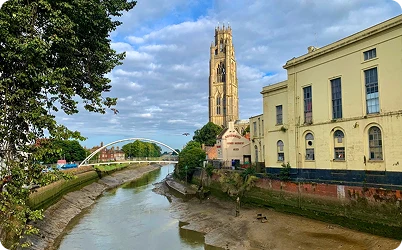
Boston is a market town and inland port in Lincolnshire with a history and heritage far larger than its size would suggest. Its parish church, the magnificent St Botolph's, nicknamed the Boston Stump, has the tallest tower of any parish church in England and was the landmark that Lincolnshire emigrants looked back at as they sailed away to found a new settlement in Massachusetts, naming it Boston after their home. The town gave the world one of the most famous cities in North America, retains one of England's largest marketplaces, and offers a property market that is the most accessible of any principal town in Lincolnshire, with average prices well below both the county and national medians. Whether you are a first-time buyer seeking genuinely accessible property in the East Midlands, a buyer relocating from a more expensive area who wants space and community at Lincolnshire prices, or a homeowner considering selling your Boston property without paying estate agent commission, this guide gives you an accurate and original picture of the town in 2026.
Start your property search in Boston on the YooSell Find a Home platform, with no agent fees and direct access to verified seller listings across the PE21 postcode.
About Boston?
Boston is a market town and inland port in the borough of the same name in the county of Lincolnshire, England. It lies to the south-east of Lincoln, east of Nottingham, and north-east of Peterborough. The town had a population of 45,339 at the 2021 census. The wider Boston borough had a population of 71,080 at the 2024 ONS mid-year estimate and 64,637 at another 2024 estimate depending on the boundaries used. The town's market is held every Wednesday and Saturday in one of England's largest marketplaces, a tradition stretching back to at least the medieval period.
Boston's name most likely derives from Saint Botolph's town, with the monk Saint Botolph being the patron of the parish church that still stands in the centre of the town today. The town received its charter from James I in 1604, though settlement in the area stretches back considerably further. In the Domesday Book survey of 1086, the settlement around the River Witham was already of some significance.
Boston was one of the most important ports in medieval England, second only to London in terms of the volume of wool exports that passed through it during the 13th century, when the town was one of the wealthiest in the kingdom. The height of this medieval prosperity is reflected in the extraordinary scale of St Botolph's Church, which was built during this period and whose massive tower, at 83 metres tall, was the most ambitious parish church building project in England. The gradual silting of the Haven, the tidal inlet on which the port stood, and the subsequent shift of trade to east coast ports further north led to Boston's decline from its medieval peak, though the town remained a significant regional market and agricultural processing centre.
The most defining moment in Boston's international history came in 1607, when a group of Puritan Separatists from the Gainsborough area, led by William Brewster, attempted to sail to Holland from Boston to escape religious persecution. They were betrayed to the authorities before they could leave and most were briefly imprisoned. The group eventually escaped from the Humber estuary the following year and made their way to Holland, before eventually becoming the Pilgrim Fathers who sailed on the Mayflower to North America in 1620, founding Plymouth Colony in Massachusetts. The New England settlement that grew into the city of Boston, Massachusetts, was named by former inhabitants of the town, as were numerous other Bostons across North America. This connection gives the Lincolnshire Boston a unique claim to transatlantic heritage that distinguishes it from every other market town of its size in the East Midlands.
The new Boston Dock with its associated wharves on the Haven was constructed in 1884, reviving the town's role as a working port. Boston remains a working port today, handling over a million tonnes of cargo each year, importing steel and timber and exporting grain and recycled materials. The port is connected by rail and major roads and provides significant employment in the local economy alongside the food production, agricultural processing, and transport sectors that dominate the wider Boston district employment base.
Boston Property Market 2026
Boston offers the most accessible property market of any principal town in Lincolnshire, and one of the most accessible in the East Midlands. For buyers who prioritise value, space, and a distinctive historic community over proximity to a major city, Boston represents an exceptional opportunity in 2026.
Property Market Overview
According to ONS UK House Price Index data, the average house price in Boston district was broadly stable in recent months, with the average price for homes bought with a mortgage at £174,000 in March 2026, in line with an average of £175,000 in March 2025. The average price paid by first-time buyers in Boston was £155,000 in March 2026, in line with the revised March 2025 average of £156,000. Home movers in Boston paid an average of £205,000 in March 2026, in line with £207,000 a year earlier.
Construction Capital's analysis of HM Land Registry price-paid data places the Boston property market median at £187,000, with 655 residential sales recorded over the past 12 months. This places Boston £26,000 below the Lincolnshire county median of £212,500 and £98,000 below the UK national median, making it the seventh most affordable of the eight principal Lincolnshire towns by price. Detached homes in Boston command an average of £251,500, while flat properties are accessible at approximately £86,250. The range across property types illustrates a market with genuine entry-level opportunity as well as more substantial family homes.
In the year to March 2026, the average price for semi-detached properties in Boston remained broadly stable, while the average price for flats decreased by 6.1%, according to ONS data.
The average monthly private rent in Boston was £794 in April 2026, an increase of 2.2% from £777 in April 2025, according to ONS Price Index of Private Rents data. This was below the East Midlands regional average of £911 per month in April 2026, making Boston one of the most affordable rental markets in the region for tenants who need accommodation in Lincolnshire.
Use the YooSell Cost Saving Calculator to understand exactly what you could save by selling your Boston property commission-free rather than through a traditional agent taking a percentage.
How Much Could You Save Selling Without an Agent?
Traditional estate agents typically charge between 1% and 3% commission on the final sale price. With YooSell, you pay a fixed monthly fee from just £49.50 and keep 100% of your agreed sale price. You can list your property on Rightmove through YooSell directly, giving your Boston home full visibility on the UK's biggest property portal without paying estate agent commission. View the YooSell pricing plans to choose the right listing tier for your sale.
Best Areas and Neighbourhoods in Boston
Boston's residential areas reflect both its historic market town centre and its 20th-century suburban expansion. Understanding the town's geography helps buyers identify where their priorities are best met.
The Town Centre and the Market Place
The heart of historic Boston, centred on the vast Market Place and the towering presence of St Botolph's Church, is one of the most distinctive town centre environments in Lincolnshire. The Market Place is one of England's largest, reflecting the scale of trade that once passed through this medieval port town, and continues to host the Wednesday and Saturday market that has operated here for centuries. Properties close to the town centre tend to be period terraced and Victorian homes, offering buyers a walkable lifestyle within easy reach of the shops, the market, the Pescod Square shopping centre, and the River Witham. Browse available properties in this area on the YooSell Find a Home platform.
Skirbeck and the Eastern Areas
Skirbeck, to the east of the town centre, is an historic parish that has been absorbed into the Boston built-up area over the centuries. It includes the Maud Foster Windmill, one of Boston's most distinctive landmarks, a five-sailed working windmill on the Maud Foster Drain that is the tallest working windmill in England. The area offers a mix of older terraced and more recent semi-detached housing and is popular with families and first-time buyers who want to remain close to the town centre amenities.
Wyberton
Wyberton, on the southern edge of Boston's built-up area, is a parish that provides a slightly more suburban or village-adjacent setting for buyers who want to remain close to the town while gaining a quieter residential street environment. The area has seen residential development that has extended Boston's southern boundary and offers a range of semi-detached and detached family homes.
Newer Residential Developments
Boston has seen residential development on its outer fringes, particularly to the south and west, offering modern semi-detached and detached family homes with contemporary specifications. These areas attract buyers who want new-build quality and energy efficiency at prices that remain significantly below the national average. Use the YooSell Valuation Calculator to understand how new-build and existing stock compare in value in the Boston market.
Surrounding Villages
The wider Boston borough includes a ring of attractive Lincolnshire villages accessible within a short drive of the town. Kirton, Sutterton, Algarkirk, and the communities along the River Witham and the surrounding fen landscape attract buyers who want a rural Lincolnshire setting while remaining within reach of Boston's amenities and transport links. The flat, open fenland landscape surrounding Boston is distinctive and gives the area a sense of space and sky that is unique to this part of England.
Schools in Boston
Boston has a range of primary and secondary schools serving its residential communities, with provision across the town and the wider borough.
Primary Schools in Boston
Boston has multiple primary schools serving its different residential areas. Parents are encouraged to confirm current Ofsted ratings and catchment boundaries directly with Lincolnshire County Council ahead of each year's admissions process. The new Ofsted report card system introduced from September 2024 no longer issues a single overall effectiveness judgement for most state-funded school inspections.
Secondary Schools in Boston
Haven High Academy
Haven High Academy is one of Boston's main secondary schools, providing education for students aged 11 to 16. The school serves the town and some of the surrounding community. Parents should review the current Ofsted inspection report and school performance data directly before making any residential decisions based on school catchment.
Boston Grammar School
Boston Grammar School is a selective boys' grammar school in the town, providing selective secondary education for boys who pass the 11-plus selection test in Year 6. The school has a long history and provides an academic secondary option for Boston and the wider South Lincolnshire area.
Boston High School
Boston High School is a selective girls' grammar school, providing selective secondary education for girls in Boston and the surrounding area. Like Boston Grammar School, entry is by the 11-plus selection test at age 11. Boston's retention of two selective grammar schools alongside non-selective provision gives the town a secondary education landscape that is unusual among East Midlands market towns.
Special Educational Needs Provision
Lincolnshire County Council provides SEND home-to-school transport support for eligible children across the Boston borough. Families with children who have additional needs should contact Lincolnshire County Council's SEND team directly to discuss eligibility and available provision.
Higher Education Within Reach of Boston
The University of Lincoln is accessible by direct train from Boston in approximately 1 hour 30 minutes via the Poacher Line to Grantham and then northward, or by road in approximately 35 to 40 minutes via the A17. Lincoln offers higher education programmes across engineering, law, architecture, media, and the sciences. Bishop Grosseteste University in Lincoln is also accessible. For students who want to study further afield, the direct Poacher Line train connection to Grantham and then the East Coast Main Line gives access to Nottingham, Sheffield, and London's universities within a manageable journey.
Transport and Commuting from Boston
Boston's transport connectivity reflects its position in the Lincolnshire fens, with good road access across the flat landscape but rail connectivity that is more limited than the larger Lincolnshire towns to the north.
Rail Connections
Boston railway station is served by East Midlands Railway on the Poacher Line, which runs from Nottingham through Grantham, Sleaford, and Boston to Skegness. Direct trains from Boston reach Grantham in approximately 45 minutes, where connections can be made onto the East Coast Main Line for onward travel to London King's Cross, York, and Edinburgh. Nottingham is accessible from Boston in approximately 1 hour 45 minutes by direct Poacher Line train. Lincoln is reachable via Sleaford.
The Poacher Line does not currently provide a direct fast service to London. Passengers travelling to London typically travel to Grantham and change onto the East Coast Main Line, making the total journey to London approximately 2 hours to 2 hours 30 minutes depending on connections. This means Boston functions more as a self-sufficient community than as a commuter town for London, and its property prices reflect this: the most affordable market in Lincolnshire rather than the premium commanded by Grantham and its direct London connection.
Road Access
Boston sits on the A16, which connects northward to Grimsby and southward to Spalding, Peterborough, and the A1. The A17 connects westward to Sleaford, Newark-on-Trent, and the A1. The A52 connects north-westward to Boston Dock and the wider port area. Road access to the A1 at Newark is approximately 35 to 40 minutes via the A17, giving drivers access to the national road network for longer journeys.
The Boston bypass, which has been a subject of sustained local campaign activity for many years, remains a significant infrastructure priority for the town. Road congestion through the town centre, particularly on routes crossing the Haven, has been an ongoing challenge. Progress on a bypass solution continues to be discussed at a strategic level.
Bus Services
Boston is served by Lincolnshire County Council-supported bus services connecting the town to surrounding villages, Spalding, Sleaford, Skegness, and Lincoln. The Centrebus and Stagecoach networks provide the main local and regional services. Frequent local services connect the town centre to residential areas and the port.
Living in Boston: Heritage, Culture and Community
St Botolph's Church and the Boston Stump
St Botolph's Church is Boston's defining landmark and one of the most magnificent parish churches in England. The church dates substantially from the 14th and 15th centuries, reflecting the extraordinary wealth that flowed through Boston during its medieval peak as England's second busiest port. The tower, 83 metres tall, is the tallest parish church tower in England and is visible for miles across the flat Lincolnshire landscape. Known universally as the Boston Stump, the tower was the landmark that emigrants from Lincolnshire looked back at as they sailed away to found new settlements in North America, naming their own Boston in Massachusetts after the town they had left behind. Visitors can climb the tower for panoramic views across the Fens, the Wash, and on a clear day, Lincoln Cathedral some 30 miles to the north.
The interior of St Botolph's Church is equally remarkable, with 64 misericords, decorative wooden carvings under the choir stalls that are among the finest medieval examples in Lincolnshire, and a series of impressive medieval fittings that have survived the centuries. The church is still an active place of worship and a significant tourist destination, drawing visitors from across the UK and internationally due to its connection to the Pilgrim Fathers and the founding of Boston, Massachusetts.
Fydell House and the American Connection
Fydell House on South Street is a fine Georgian town house, one of the best-preserved Georgian domestic buildings in Lincolnshire. It now houses the Guildhall Museum and a room dedicated to the American connection that sets Boston apart from every other market town in the East Midlands. The Pilgrim Fathers Memorial in Central Park commemorates the attempted departure of the Puritan group in 1607. Each year, events mark Boston's transatlantic heritage and its founding connection to one of the great cities of the eastern United States.
Maud Foster Windmill
The Maud Foster Windmill on Willoughby Road is the tallest working windmill in England, standing at approximately 24 metres, and is one of Boston's most distinctive visual landmarks. The mill was built in 1819 and is still operated commercially, grinding flour and producing bread and other products available for sale at the windmill's shop. The Maud Foster Drain alongside it is one of the drainage channels that define the fenland landscape of the wider Boston area. The windmill is open to visitors on certain days and is a remarkable piece of surviving industrial heritage.
The Boston Market and Town Centre
Boston's Wednesday and Saturday markets in the vast Market Place are among the most significant surviving weekly markets in Lincolnshire, continuing a trading tradition that stretches back to the medieval period when Boston was one of the wealthiest trading towns in England. The market attracts stall holders and shoppers from across the South Lincolnshire area. The town centre shopping offer includes the Pescod Square shopping centre, opened in 2004, housing Next, Tesco, TK Maxx, and other national retailers, as well as high street names and independent businesses on the surrounding streets. Supermarkets including Asda, Aldi, and Lidl serve everyday grocery needs.
Hussey Tower
Hussey Tower, standing close to the Haven in the town centre, is a surviving fragment of a medieval brick tower house dating to the 15th century, one of the earliest brick buildings surviving in Lincolnshire. It is managed by English Heritage and open to external viewing. Its survival in the centre of a working market town is a reminder of the depth of Boston's medieval heritage.
Sessions House
Sessions House, on the south side of Market Place, is a handsome Victorian Italianate building that served as the Lincolnshire Quarter Sessions courthouse. It is now a Grade II* listed building and a prominent feature of the Market Place's architectural character.
Outdoor Life and the Fens
Boston's surrounding landscape, the flat, open Lincolnshire Fens, provides a distinctive outdoor environment unlike anything found in more inland parts of the East Midlands. The network of drainage channels, the expanse of agricultural land, and the long views across to the coast give the area a particular quality of light and openness. The Wash, a large shallow estuarine inlet to the east, is one of the most important nature reserves in Britain, providing habitat for hundreds of thousands of wading birds, seals, and migratory species. The RSPB manages reserves at Frampton Marsh and Freiston Shore on the outskirts of Boston, both of which are outstanding wildlife watching destinations for residents and visitors. Central Park, the town's main public park, provides accessible green space with formal gardens, a play area, a boating lake, and the Pilgrim Fathers Memorial.
Safety and Community Life
Boston has an active community life built around its market, its heritage events, and its strong Polish and Eastern European community, which grew significantly following EU enlargement in 2004. Boston has one of the highest proportions of Eastern European-born residents of any town in England, giving it a more culturally diverse community than its overall demographic profile suggests. The Boston Borough Council addresses community cohesion and integration as part of its civic priorities.
Healthcare in Boston
Pilgrim Hospital on Sibsey Road is the main acute hospital serving Boston and the wider South Lincolnshire area, operated by United Lincolnshire Hospitals NHS Trust. The hospital provides a full range of acute healthcare services including emergency care, maternity, surgery, and specialist outpatient services and is one of the most significant public sector employers in Boston. Multiple GP surgeries operate across the town and borough, providing accessible primary healthcare. Lincolnshire County Council's community health services also operate across the area.
Selling Your Home in Boston with YooSell
If you are considering selling your Boston property, YooSell offers a genuinely better alternative to the traditional high street estate agency model. YooSell is a self-service home-selling platform built for homeowners across the East Midlands and the wider Midlands, giving you complete control of your sale at a fraction of the cost of a conventional agent.
Why Boston Homeowners Choose YooSell
With YooSell, you pay no commission at any stage of the sale process. You pay a fixed monthly fee from £49.50 and keep 100% of your agreed sale price. There is no percentage cut at completion, no hidden extras, and no agent taking a share of the equity you have built in your home.
You can list your property on Rightmove through YooSell directly, putting your Boston home in front of millions of active buyers on the UK's biggest property portal without instructing a traditional estate agent. You set your own asking price, manage your own viewings on your own schedule, and respond to offers entirely on your own terms. Every buyer on the platform is ID-verified and financially qualified before making an offer, so you only deal with serious, genuine purchasers. When you accept an offer, access trusted conveyancers and legal partners directly through your YooSell dashboard, keeping the process streamlined from acceptance through to completion.
Free Tools for Boston Buyers and Sellers
Before listing or making an offer, use the free tools available through YooSell:
Valuation Calculator to estimate your Boston property's current market value
Cost Saving Calculator to see exactly how much you save versus a traditional agent on your sale
Mortgage Calculator to plan your next purchase and understand your monthly repayments
Stamp Duty Calculator to calculate your full tax liability before you exchange contracts
YooSell Pricing Plans to choose the listing tier that fits your sale
Frequently Asked Questions
Find Homes Available In Boston
Browse verified homes listed directly by sellers in Boston. Compare listings, arrange viewings and make offers in one place.
Find Homes Available In BostonStart Selling Your Home Today!
Take control of your sale with YooSell. Get started today and explore how we can help you sell smarter, faster, and with less hassle.