Birmingham
Thinking of moving to Birmingham in 2026? This original city area guide covers the best neighbourhoods from Edgbaston to Digbeth, verified ONS property prices, five universities, rail connections, the Commonwealth Games legacy, Cadbury World, and how to sell your West Midlands home commission-free with YooSell.

George K.
George specialises in local area insights across Leicestershire and the wider Midlands. He highlights schools, transport, and neighbourhood character for relocating buyers.
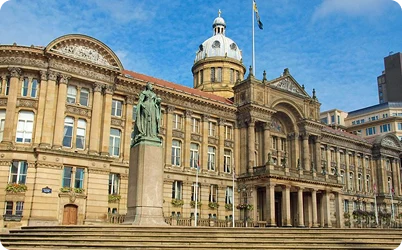
Birmingham is the second largest city in the United Kingdom, the largest city economy outside London, and one of the most genuinely diverse and dynamically changing urban environments in England. With a population of approximately 1,144,900 at the 2021 census, a city economy worth £38.9 billion in 2023 that grew at 2.7% in real terms that year, well above the national average of 0.4%, and a property market that offers meaningful affordability compared to London and the South East while delivering consistent long-term demand from graduates, professionals, and families, Birmingham has a property story that is more complex and more interesting than its headline figures suggest. Whether you are buying your first home in one of the city's regenerating inner neighbourhoods, relocating to Birmingham for work or lifestyle, searching for a family home in one of its sought-after suburbs, or considering selling your Birmingham property without paying estate agent commission, this guide gives you an accurate and original picture of the city in 2026.
Browse verified property listings across Birmingham and the wider West Midlands on the YooSell Find a Home platform, with no agent fees and direct access to verified seller listings across the B postcode.
About Birmingham?
Birmingham is a city and metropolitan borough in the West Midlands of England. It is England's second largest city by population, the UK's second largest city economy, and the second most visited city in the UK after London. The population of Birmingham at the 2021 census was 1,144,900 and the wider Birmingham urban area had a population of approximately 2.7 million, making it the largest urban area in England outside London.
Birmingham was the engine of the Industrial Revolution. By 1792 it was already being described as the first manufacturing town in the world. Its absence of trade guilds gave entrepreneurs unusual freedom to innovate, and the city became the global centre for the production of metal goods ranging from guns and buttons to jewellery and scientific instruments. Matthew Boulton and James Watt developed and commercialised the steam engine in Birmingham. Joseph Priestley discovered oxygen in the city in 1774. The Boulton and Watt company, which operated from the Soho Manufactory in Birmingham, drove much of the technology that powered British industrialisation in the late 18th and early 19th centuries.
Today Birmingham is a post-industrial city that has diversified extensively from its manufacturing origins. The service sector accounted for 88% of the city's employment by 2012. Greater Birmingham contributed an estimated £60.78 billion in Gross Value Added to the UK economy in 2022, accounting for 2.7% of the nation's total. The city hosted the Commonwealth Games in 2022, delivering more than £870 million of investment in infrastructure and legacy facilities, and significantly raised Birmingham's international profile.
Birmingham has the youngest population of any major UK city and the largest Muslim population in the UK. At the 2021 census, 51.4% of Birmingham residents identified from diverse ethnic backgrounds, making it one of the most ethnically diverse major cities in the UK. The city's diversity is one of its most frequently celebrated strengths, reflected in its food culture, its arts, its religious landscape, and the extraordinary breadth of communities that give Birmingham its distinctive social character.
Birmingham Property Market 2026
Birmingham's property market offers a genuinely distinctive combination of urban scale, regeneration momentum, and affordability relative to the UK's most expensive city markets. It is supported by consistent demand from graduates, young professionals, families, and investors drawn to the city's universities, employment base, and lifestyle offer.
Property Market Overview
According to ONS UK House Price Index data, the average house price in Birmingham was £231,000 in January 2026, broadly flat compared to January 2025. More recent provisional ONS data shows the average house price for homes bought with a mortgage at £282,000 in July 2026, while cash buyers paid an average of £220,000 in July 2026. The provisional average price paid by first-time buyers was £212,000 in July 2026, higher than the revised July 2025 average of £206,000.
Across all transactions between August 2025 and July 2026, analysis of HM Land Registry price-paid data puts the average property price in Birmingham at approximately £288,000, with 18,700 property sales in that period. The most affordable postcode sector in Birmingham is B2 5, with an average price of approximately £108,000, while the most expensive is B94 5, with an average approaching £740,000, illustrating the extraordinary breadth of the market across the city's different neighbourhoods and suburbs.
Private rents in Birmingham averaged £1,087 per month in February 2026, up 3.7% from £1,048 a year earlier. By August 2026, ONS data shows the average rent rising further to a figure consistent with ongoing upward pressure, with rents for semi-detached and terraced properties rising by 3.3% and rents for three-bedroom properties rising by 3.4% in the year to August 2026.
Use the free YooSell Valuation Calculator to estimate the current market value of any Birmingham property before listing or making an offer.
Property Types and Neighbourhoods
Birmingham's property market is not a single market. It is a collection of micro-markets that behave differently depending on neighbourhood, property type, and buyer profile. Completed sale prices in 2026 are typically about 3% to 5% below asking prices, and the gap can be larger for overpriced family houses or older homes needing renovation, but smaller for well-priced homes in Harborne, Moseley, Edgbaston, and Sutton Coldfield.
The median housing price per square metre in Birmingham is approximately £2,600 as of 2026, or around £242 per square foot, providing a useful benchmark for comparing value across different parts of the city and different property sizes.
For buyers seeking long-term value, the areas showing the clearest signs of regeneration-driven demand growth in 2026 are Digbeth and Eastside, the Jewellery Quarter, Stirchley, Ladywood, and Moseley Village and Kings Heath. The city centre itself, transformed by the Commonwealth Games legacy and the ongoing HSBC UK headquarters relocation and the Birmingham Curzon Street HS2 terminus development, continues to attract significant investment.
How Much Could You Save Selling Without an Agent?
Traditional estate agents typically charge between 1% and 3% commission on the final sale price. With YooSell, you pay a fixed monthly fee from just £49.50 and keep 100% of your agreed sale price. You can list your property on Rightmove through YooSell directly, giving your Birmingham home maximum visibility on the UK's biggest property portal without paying estate agent commission. Use the YooSell Cost Saving Calculator to see exactly what you could keep based on your own property value.
Best Areas and Neighbourhoods in Birmingham
Birmingham's residential landscape spans more than 40 distinct neighbourhoods, ranging from inner-city regeneration zones close to the city centre through to leafy suburban villages with strong independent high streets and outstanding schools. Understanding the character of each helps buyers and residents make more confident decisions.
Edgbaston
Edgbaston is one of Birmingham's most prestigious residential addresses, located to the south-west of the city centre. It is home to the University of Birmingham and its main campus, Edgbaston Cricket Ground, and a large concentration of high-quality Victorian and Edwardian homes. The suburb has wide, tree-lined streets, excellent private and state schools, and consistent demand from professionals, academics, and established families. Edgbaston consistently commands some of the highest residential values within the Birmingham City Council boundary.
Harborne
Harborne sits to the west of Edgbaston and is widely regarded as one of Birmingham's finest residential villages. It has an outstanding high street of independent shops, cafes, restaurants, and delicatessens that give it a community character quite unlike the city's more commercial retail destinations. Harborne is popular with young families and professionals and has well-regarded primary schools, access to the Queen Elizabeth Hospital complex, and good tram connections to the city centre and the University of Birmingham campus.
Moseley and Kings Heath
Moseley and Kings Heath, in the south of the city, form one of Birmingham's most characterful independent retail and arts corridors. Moseley village has a bohemian character, with an eclectic mix of period Victorian villas, creative businesses, independent music venues, and a weekly farmers market. Kings Heath, adjacent to the south, offers a strong independent high street and good access to green space. Both areas are popular with young professionals, artists, and families who value community and independent lifestyle over proximity to city centre corporate offices.
Sutton Coldfield
Sutton Coldfield, to the north of the city, is technically a Royal Town and one of the most affluent and sought-after residential addresses in the wider Birmingham conurbation. It is immediately adjacent to Sutton Park, one of the largest urban nature reserves in Europe at 2,400 acres. Sutton Coldfield has its own town centre with an excellent range of shops and restaurants, outstanding schools, large detached homes on generous plots, and a community character quite distinct from the denser inner-city neighbourhoods. It consistently achieves some of the highest property prices in the wider West Midlands.
Jewellery Quarter
The Jewellery Quarter, immediately north-west of the city centre, is one of Birmingham's most architecturally distinctive and culturally rich neighbourhoods. The area has been the centre of Britain's jewellery manufacturing industry for over 250 years and still contains approximately 40% of the UK's working jewellery businesses. In recent years the Jewellery Quarter has been extensively regenerated as a residential neighbourhood, with Victorian factory buildings and warehouses converted into apartments and loft spaces alongside new residential developments. It attracts young professionals and creatives who want an urban, characterful environment close to the city centre.
Digbeth and Eastside
Digbeth, immediately south-east of the city centre, is the area most commonly associated with Birmingham's creative and cultural scene. It is home to independent music venues, arts studios, design businesses, restaurants, and bars that form the backbone of Birmingham's evening cultural economy. The area is undergoing major transformation through the £1.9 billion Digbeth Regeneration Scheme and the arrival of the HS2 Birmingham Curzon Street terminus, which will bring high-speed rail to the eastern edge of Digbeth. This combination of creative culture and large-scale infrastructure investment makes Digbeth one of the most discussed investment locations in Birmingham in 2026.
Stirchley
Stirchley, in the south of Birmingham, is one of the city's most rapidly gentrifying neighbourhoods. The area's Victorian terraced housing and its high street, which has developed a growing concentration of independent food and drink businesses, have attracted increasing numbers of young professional buyers seeking accessible prices combined with a distinctive local character.
Selly Oak and Bournville
Selly Oak, to the south-west of the city centre, is the principal student neighbourhood for the University of Birmingham, with a large proportion of its housing stock in student or young professional occupation. Adjacent Bournville is one of the most historically significant planned communities in England. Built by George Cadbury from 1895 onwards as a model village for workers at the Cadbury chocolate factory, Bournville is a conservation area with distinctive Arts and Crafts architecture. Bournville Village Trust continues to manage much of the estate and properties are subject to specific conditions regarding their use and maintenance. The Cadbury World visitor attraction at the Cadbury factory site draws over 600,000 visitors per year.
Perry Barr and Great Barr
Perry Barr and Great Barr in the north of Birmingham saw significant investment through the 2022 Commonwealth Games. The Alexander Stadium, home to the athletics events during the Games, was redeveloped and Birmingham City Council's wider Perry Barr regeneration programme is delivering new housing, improved public realm, and transport improvements to an area that has historically been overlooked relative to the city's southern suburbs.
Search for available properties across all of Birmingham's neighbourhoods on the YooSell Find a Home platform.
Schools in Birmingham
Birmingham has a large and varied education sector, reflecting the scale and diversity of the city. At primary level, the majority of Birmingham's schools hold Good or Outstanding Ofsted ratings. Secondary school performance is more variable, and families choosing a Birmingham home based on school catchment are strongly advised to research individual school Ofsted reports and current performance data directly rather than relying on general city-level statistics.
Primary Schools
Birmingham has hundreds of primary schools across its more than 40 neighbourhoods, with particularly strong primary provision in the southern suburbs including Edgbaston, Harborne, Moseley, and Sutton Coldfield. Outstanding-rated primary schools are concentrated in the more affluent residential areas, and competition for places is intense in the most sought-after catchments. Parents should confirm current Ofsted ratings and catchment boundaries with Birmingham City Council's school admissions team ahead of each year's admissions process.
Secondary Schools
Birmingham has a range of secondary schools including selective King Edward's Schools, which are among the highest-performing state schools in England and one of the most significant reasons many families choose specific residential locations in Birmingham's south. The King Edward VI Foundation operates a group of selective grammar and non-selective schools across Birmingham, with King Edward VI Five Ways, King Edward VI Aston, and King Edward VI Handsworth Girls' School among the most academically distinguished. For non-selective secondary provision, outcomes and quality vary significantly across the city's different areas.
Universities
Birmingham has five universities, giving the city one of the largest concentrations of higher education in England outside London.
University of Birmingham
The University of Birmingham is a member of the Russell Group and one of the UK's leading research universities. Its main campus in Edgbaston is a stunning Victorian redbrick complex centred on the Joseph Chamberlain Memorial Clock Tower, known locally as Old Joe and the tallest freestanding clock tower in the world. The university has over 37,000 students and is consistently ranked among the UK's top universities, with particular strengths in medicine, law, engineering, and the sciences. Use the free YooSell Mortgage Calculator to plan your monthly repayments before making an offer on any property near the campus.
Aston University
Aston University is located on the eastern edge of Birmingham city centre and is ranked highly for graduate employability and business education, with particular strengths in pharmacy, engineering, and business. The university has over 18,000 students and has been recognised as University of the Year for Teaching Quality.
Birmingham City University
Birmingham City University (BCU) has multiple campuses across the city and the wider West Midlands region. It is one of the largest universities in the UK by student numbers and has particular strengths in creative arts, business, and technology.
Transport and Commuting from Birmingham
Birmingham is one of the most comprehensively connected cities in England, with road, rail, and tram connections that give residents access to the wider Midlands, London, and the national network.
Rail Connections
Birmingham New Street station is the busiest rail interchange in the UK outside London, with more trains passing through it every day than any other station outside the capital. It serves as the primary rail hub for the West Midlands, with direct services to London Euston in approximately 80 to 90 minutes, to Manchester Piccadilly in approximately 80 to 90 minutes, to Bristol Temple Meads in approximately 85 minutes, and to Leeds in approximately 100 minutes. CrossCountry, Avanti West Coast, London Northwestern Railway, Transport for Wales, and other operators all serve New Street, giving Birmingham residents direct access to most of the UK's major cities.
Birmingham Moor Street station, adjacent to New Street, provides services to London Marylebone via Leamington Spa and Banbury, with Chiltern Railways running an alternative London route in approximately 120 minutes. Birmingham International station, within the airport campus, connects directly to both New Street and Coventry.
HS2 will eventually provide a new Birmingham Curzon Street station in Digbeth with high-speed connections to London Euston in approximately 45 minutes, though the line's opening date continues to be subject to Government review and delay.
West Midlands Metro Tram
The West Midlands Metro tram network connects Birmingham city centre to Wolverhampton, with an extension towards Dudley under development. The Centenary Square extension opened in 2019 and the tram now serves the main city centre streets including Corporation Street and Bull Street. Further extensions are planned as part of the West Midlands Combined Authority's transport investment programme.
West Midlands Rail and Bus
The West Midlands Rail network connects Birmingham's outer suburbs and surrounding towns to New Street and Moor Street through a network of electrified suburban rail lines. Transport for West Midlands operates the wider public transport network under the West Midlands Combined Authority, including National Express West Midlands buses, the Metro tram, and local rail services.
Road Access
Birmingham is at the centre of the national motorway network. The M6, M5, M42, M40, and A45 all converge in or around the city, giving Birmingham residents access to the national motorway system that is unmatched in its comprehensiveness by any other regional English city. The M6 connects north towards Walsall, Stoke-on-Trent, and Manchester, and south towards Coventry and London via the M1. The M5 connects south-west towards Worcester and Bristol. The M42 and M40 provide routes south-east towards London via Oxford.
Living in Birmingham: Culture, Heritage and Community
Birmingham Museum and Art Gallery
Birmingham Museum and Art Gallery in Chamberlain Square is one of the finest regional museums in England, with an outstanding collection of Pre-Raphaelite paintings, one of the largest collections of Staffordshire Hoard gold in the world, and significant collections of ancient Egyptian, Greek, Roman, and local history artefacts. The museum is currently undergoing a major refurbishment programme and sections have been closed to the public in phases while the work is completed.
The Custard Factory and Digbeth Cultural Quarter
The Custard Factory, built in the former Bird's Custard factory complex in Digbeth, is one of Birmingham's most distinctive creative and cultural landmarks. It houses independent shops, design studios, creative businesses, restaurants, and bars, and hosts regular markets and cultural events. The surrounding Digbeth area has developed into one of the most dynamic arts and independent culture districts in the UK.
Cadbury World and Bournville
Cadbury World at the Cadbury factory site in Bournville draws over 600,000 visitors per year, making it one of the most visited paid attractions in the UK. The visitor experience covers the history of chocolate and the Cadbury family, with interactive exhibits and, famously, generous quantities of sample chocolate. The adjacent Bournville Village, built by George Cadbury from 1895 as a model workers' community, is one of the most beautifully preserved Arts and Crafts planned settlements in England.
The Bullring and Shopping
The Bullring, with its iconic Selfridges building clad in 15,000 aluminium discs, is one of the most recognisable retail destinations in England. The Bullring and Grand Central shopping centres together provide one of the largest city-centre retail environments outside London. Grand Central, above New Street station, anchors the southern end of the retail core with a John Lewis department store and a wide range of restaurants. The Mailbox, a converted Royal Mail sorting office south of New Street, houses Harvey Nichols, a mix of designer retailers, restaurants, and bars, alongside the BBC's Birmingham studios.
Symphony Hall and the Arts
Birmingham Symphony Hall on Broad Street is consistently rated among the best concert halls in the world for its acoustics and is the home of the City of Birmingham Symphony Orchestra, one of the UK's finest orchestras. The adjacent Town Hall, a magnificent neoclassical building from 1834, provides a second performance venue within the same complex. The Birmingham Hippodrome, Birmingham Repertory Theatre, and the Victoria and Albert Museum Birmingham, due to open in a new building in the early 2030s, complete a significant arts infrastructure for the city.
Sutton Park
Sutton Park, adjacent to Sutton Coldfield in the north of the city, is one of the largest urban nature reserves in Europe, covering 2,400 acres of ancient woodland, heathland, marshland, pools, and grassland. It has been a Site of Special Scientific Interest since 1956 and a National Nature Reserve since 1997. For residents of Sutton Coldfield and the northern suburbs, Sutton Park represents an extraordinary natural asset on the doorstep.
Safety and Community Life
Safety in Birmingham varies considerably across different wards and neighbourhoods. The city as a whole has higher levels of recorded crime than the England average, but this figure is heavily influenced by the inner-city wards and city centre areas, while the southern and northern suburbs including Harborne, Edgbaston, Moseley, and Sutton Coldfield are generally regarded as safe and family-friendly residential environments. Buyers are strongly advised to review current crime statistics by specific postcode before making residential decisions.
Healthcare in Birmingham
Queen Elizabeth Hospital Birmingham, operated by University Hospitals Birmingham NHS Foundation Trust, is one of the largest teaching hospitals in England and a major trauma centre. The hospital is located in Edgbaston adjacent to the University of Birmingham campus and is accessible from across the city. Birmingham Children's Hospital in the city centre provides specialist paediatric care. Birmingham and Solihull Mental Health NHS Foundation Trust provides mental health services across the Birmingham area. Multiple GP practices operate across all residential areas of the city, with levels of access varying between different communities.
Selling Your Home in Birmingham with YooSell
If you are thinking about selling your Birmingham property, YooSell offers a genuinely better alternative to the traditional high street estate agency model. YooSell is a self-service home-selling platform built for homeowners across the East Midlands and the wider Midlands, giving you complete control of your sale at a fraction of the cost of a conventional agent.
Why Birmingham Homeowners Choose YooSell
With YooSell, you pay no commission at any stage of the sale process. You pay a simple fixed monthly fee from £49.50 and keep 100% of your agreed sale price. There is no percentage cut at completion, no hidden extras, and no agent taking a share of the equity you have built in your home.
You can list your property on Rightmove through YooSell directly, putting your Birmingham home in front of millions of active buyers on the UK's biggest property portal without instructing a traditional estate agent. You set your own asking price, manage your own viewings on your own schedule, and respond to offers entirely on your own terms. Every buyer on the platform is ID-verified and financially qualified before making an offer, so you only deal with serious, genuine purchasers. When you accept an offer, access trusted conveyancers and legal partners directly through your YooSell dashboard, keeping the process streamlined from acceptance through to completion.
Free Tools for Birmingham Buyers and Sellers
Before listing or making an offer, use the free tools available through YooSell:
Valuation Calculator to estimate your Birmingham property's current market value
Cost Saving Calculator to see exactly how much you save versus a traditional agent on your sale
Mortgage Calculator to plan your next purchase and understand your monthly repayments
Stamp Duty Calculator to calculate your full tax liability before you exchange contracts
YooSell Pricing Plans to choose the listing tier that fits your sale
Frequently Asked Questions
Find Homes Available In Birmingham
Browse verified homes listed directly by sellers in Birmingham. Compare listings, arrange viewings and make offers in one place.
Find Homes Available In BirminghamStart Selling Your Home Today!
Take control of your sale with YooSell. Get started today and explore how we can help you sell smarter, faster, and with less hassle.