|Reading time: 9 minutes
How to Check Sold House Prices in the UK: A Complete Guide for Buyers and Sellers

Sarah M.
Sarah focuses on pricing strategy, presentation, and getting listings ready for market. She helps sellers present homes clearly without overcomplicating the process.
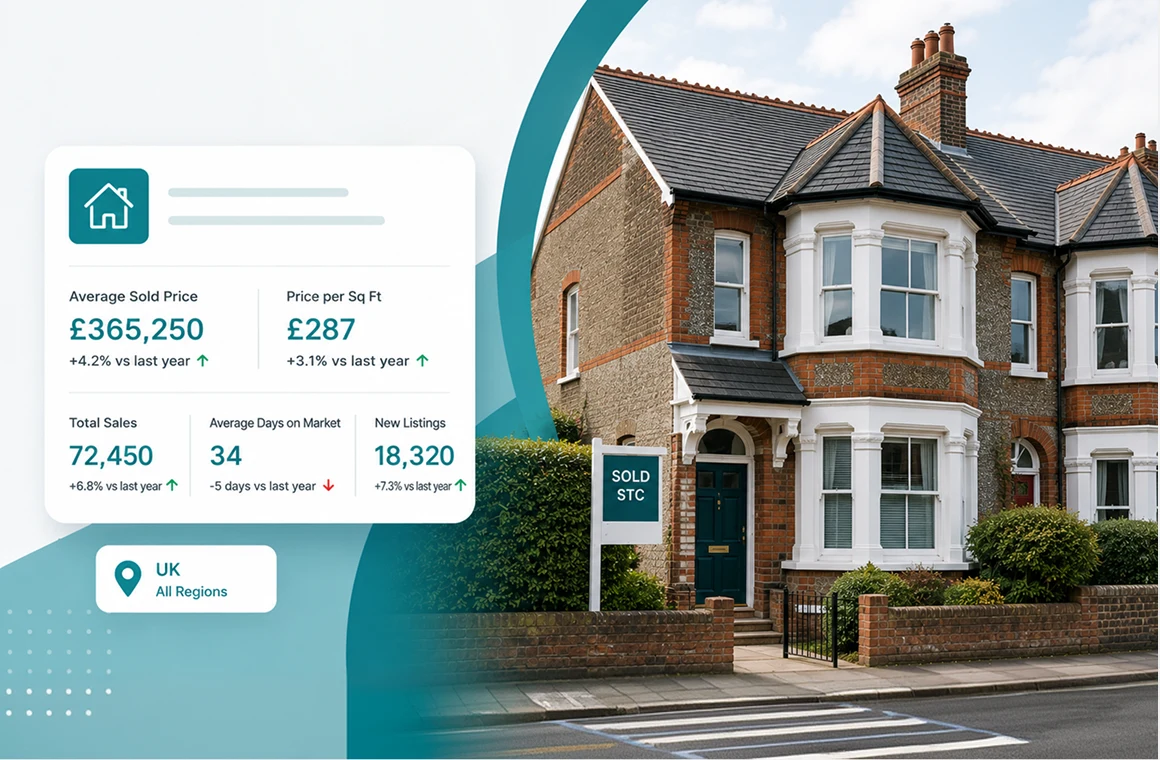
You can check sold house prices in the UK for free using the HM Land Registry Price Paid Data, accessible directly on GOV.UK or through portals like Rightmove and Zoopla. Just enter a postcode or full address and you'll see every registered sale price going back to 1995. That's your starting point, and this guide walks you through every tool, every trick, and exactly how to use the data once you have it.
Knowing what a home actually sold for, not just its asking price, is one of the most powerful things you can do before buying or selling. I've spent years helping homeowners make sense of property data, and the single biggest mistake I see is people making six-figure decisions based on asking prices alone. Actual sold house prices in the UK tell a completely different story.
Why Sold House Prices Matter More Than Asking Prices
Asking prices are marketing. Sold prices are reality.
Estate agents set asking prices to attract interest, not to reflect what a property is truly worth. According to the UK House Price Index published by the ONS and HM Land Registry, the average UK house price in December 2025 was approximately £268,000, but regional variation means that figure tells you very little about the street you're actually interested in.
When you check sold house prices, you're looking at what real buyers with real money, backed by mortgage valuers, actually agreed to pay. That's the number that matters.
If you're a seller, comparable sold prices anchor your listing strategy. If you're a buyer, they tell you whether an asking price is realistic or inflated. Either way, use YooSell's free Valuation Calculator to pair this data with an instant estimate for any Leicestershire or Midlands property.
Where Can I Check Sold House Prices in the UK for Free?
You have several solid options, all free, all pulling from the same underlying source.
The official source for England and Wales is HM Land Registry, which maintains a complete record of every residential sale since April 1995. That dataset, known as the Price Paid Data, covers over 28 million transactions. You can search it at gov.uk/search-house-prices by address or postcode.
For Scotland, sold prices come from Registers of Scotland via ScotLIS. For Northern Ireland, the Land and Property Services (LPS) publishes its own house price index, though individual sold prices aren't publicly accessible there in the same way.
Here's a quick comparison of the main tools:
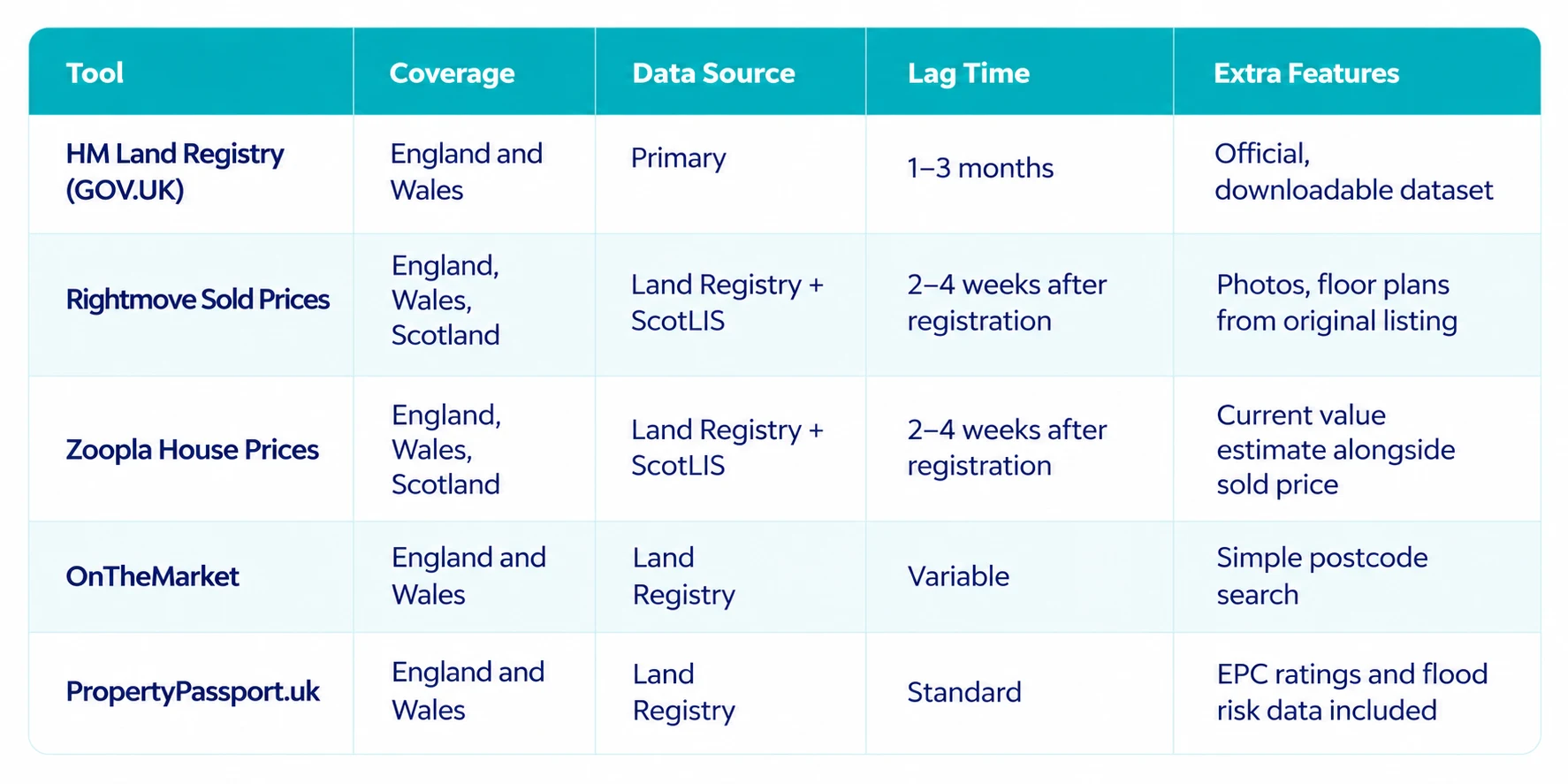
All of these portals are delayed copies of Land Registry data. They don't create their own records. So if a sale happened last week, it won't show up anywhere yet.
How Do I Use HM Land Registry to Find Sold Prices?
The official Land Registry route is straightforward and costs nothing.
Enter the full postcode or property address in the search box
Review the results, which show the sale price, completion date, property type, and whether it was freehold or leasehold
For a full history on a specific property, click through to see all registered transactions
One thing to be clear about: the Land Registry only shows the registered sale price. It doesn't show what the property was listed for, how long it sat on the market, or whether any extras (furniture, fittings, fixtures) were bundled into the deal.
For a broader picture of your local market, you can also access the full UK House Price Index on GOV.UK, which breaks down average prices by region, county, and local authority.
Why Is There a Delay in Sold Price Data?
This confuses a lot of people, and it's worth explaining clearly.
When a property sale completes, the buyer's solicitor applies to register the transaction with HM Land Registry. That registration process, and the time it takes from completion to appearing in the public record, typically ranges from two weeks to three months. In some cases, it can take longer.
According to HM Land Registry's own guidance, data for the two most recent months is always incomplete because so many transactions are still in the pipeline. Registers of Scotland processes most cases within 35 days, so the lag is slightly shorter north of the border.
What this means practically: if you're trying to find out what a house sold for last month, you probably won't see it yet. Check Rightmove or Zoopla's "recently sold" listings as a supplement, but don't mistake an absence of data for a lack of sales activity.
This delay is also why estate agents and mortgage surveyors use comparables from the past 6-12 months rather than just the past few weeks. It's not laziness; it's the nature of the data.
How to Check Sold House Prices on Rightmove and Zoopla
Both Rightmove and Zoopla are excellent for property research because they layer Land Registry data on top of original listing information, including photos and floor plans.
On Rightmove:
Go to rightmove.co.uk, click "House Prices" in the navigation, and enter a postcode or place name. You can filter by property type (detached, semi-detached, terraced, flat), number of bedrooms, and date range. The sold prices display alongside any photos from when the property was originally listed, which helps enormously when comparing like with like.
On Zoopla:
Go to zoopla.co.uk/house-prices and search by postcode. Zoopla adds a current estimated value alongside the sold price history, which is useful for spotting how much a property has appreciated since its last sale.
Neither platform is more accurate than the other; they both use Land Registry data. The difference is presentation and the extras layered on top.
If you're selling in Leicestershire or the Midlands, browse properties currently listed on YooSell to see how your local market is priced right now.
How to Interpret Sold House Price Data Correctly
Raw data is only useful if you know how to read it. Here are the key factors to account for when comparing sold prices:
Property condition: A renovated kitchen and new extension can add 10-15% to a sale price compared to an identical but unimproved property on the same street. Always look at photos if they're available.
Leasehold vs. freehold: Leasehold properties with short remaining leases (under 80 years) often sell at a discount because buyers factor in future extension costs. The Land Registry data shows this distinction.
Date of sale: Property values shift over time. A sale from three years ago may be significantly above or below today's market. The UK House Price Index shows that average prices nationally rose by approximately 3.3% in the 12 months to December 2025, according to the ONS, but regional performance varied sharply.
Property size: The Land Registry doesn't record square footage. Two semis on the same road could be very different sizes. If floor plans are available on Rightmove, use them.
According to property researcher Neal Hudson of Residential Analysts, "Price per square metre is the most honest way to compare properties, because it strips out size as a variable." It's worth calculating this whenever you can.
When you're ready to set your asking price, YooSell's Valuation Calculator combines current sold price data with local market signals to give you a realistic starting point.
What Do Sold House Prices Tell Sellers About Pricing Their Home?
If you're selling, comparable sold prices are your single most important reference point.
The principle is simple: find three to five properties similar to yours (same type, similar size, same area, sold within the last six months) and use those prices to calibrate your asking price. This is what estate agents call a Comparative Market Analysis (CMA), and you can do it yourself for free.
Here's what to look for:
Properties on the same street or within the same postcode
Same property type (detached, semi, terraced, flat)
Similar bedroom count
Similar condition, where you can judge from listing photos
Sales within the past six months, ideally three
If your nearest comparables sold for £280,000-£295,000, pricing at £310,000 needs justification. That justification could be an extension, a loft conversion, a new kitchen, or a significantly larger garden. If you can't point to something concrete, the data suggests you'll either sit on the market or accept a lower offer.
According to Savills' 2024 UK Housing Market Report, the total value of the UK housing market expanded by 6.3% to £379 billion in 2024, with approximately 1.1 million transactions completing at an average sale price of £343,822. That context matters for pricing confidence.
One of the biggest advantages of selling with YooSell is that you set your own price, informed by real data, without an agent applying pressure to list low for a quick sale. See how YooSell works here.
How Much Can You Save by Not Using a Traditional Estate Agent?
This is where checking sold house prices connects directly to your pocket.
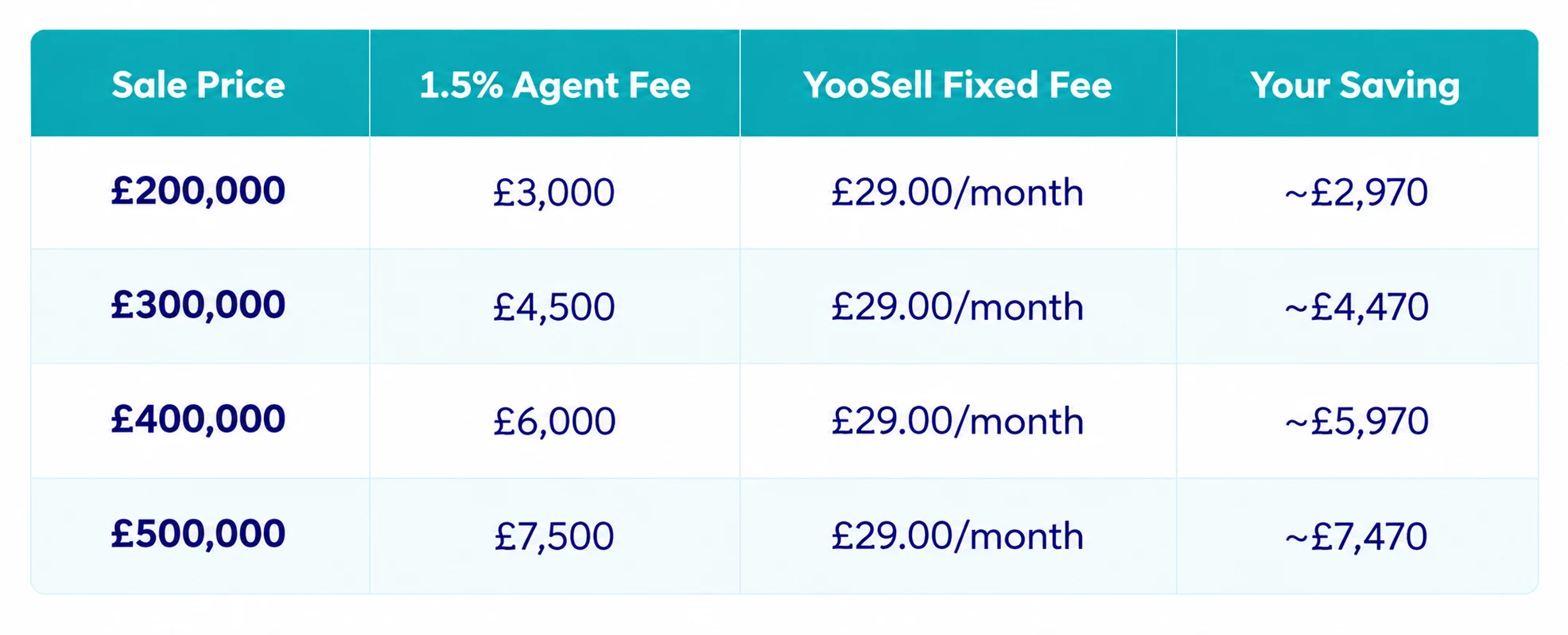
Traditional high street estate agents typically charge between 1% and 3% commission on the final sale price. On an average UK property sale of £343,822 (Savills, 2025), a 1.5% commission works out at around £5,157. On a £400,000 property, you're looking at £6,000. On a £500,000 home at 2%, that's £10,000 leaving your hands at completion.
Use YooSell's Cost Saving Calculator to see exactly what you'd save compared to a traditional agent on your specific property value.
YooSell charges a fixed monthly fee from £29.00, with no percentage taken at completion. You keep 100% of your sale price. That's not a marginal saving; on most properties, it's several thousand pounds.
Sold House Prices by Region: What the 2025 Data Shows
Understanding national averages is useful for context, but regional data is what actually informs decisions.
According to the ONS UK House Price Index for December 2025, average house prices by UK nation were:
England: approximately £302,000
Scotland: approximately £196,000
Wales: approximately £216,000
Northern Ireland: approximately £185,000 (Land and Property Services NI)
Within England, the East Midlands (which includes Leicestershire) showed steady annual growth in 2025, with the region consistently performing above the national average for transaction volumes. The North East and North West regions posted the strongest price growth at around 2.7% and 2.6% respectively year-on-year, while London and the South East saw slight declines.
For anyone selling in Leicestershire or the wider Midlands, check the YooSell Area Guides for neighbourhood-level insight alongside the national picture.
Conclusion
Sold house prices in the UK are publicly available, free to access, and genuinely useful for anyone buying or selling. The core takeaway is this: always base your price expectations on what buyers have actually paid, not what sellers have asked.
HM Land Registry's Price Paid Data, accessible directly through GOV.UK or via platforms like Rightmove and Zoopla, gives you over 28 million transactions to work with, stretching back to 1995. Factor in the typical 1-3 month data lag, account for property condition and size, and use the last six months of comparable sales as your benchmark.
If you're selling, that research puts you in the strongest possible negotiating position. You'll know whether an offer is reasonable, whether your asking price is justified, and exactly what your home is worth in the current market.
And once you know what your home is worth, the next question is how to sell it without giving away thousands in agent commission. That's what YooSell is built for. You list your property, manage your viewings, and handle offers directly, with expert support available whenever you need it, all for a fixed monthly fee from £29.00.
Here's your clear next step: run a quick sold price search on your postcode using GOV.UK or Rightmove, note your three to five closest comparables, and then use YooSell's free Valuation Calculator to see how your property stacks up. From there, list your property on YooSell in minutes, no estate agent required.
Knowing the market is step one. Selling on your terms is step two.
Frequently Asked Questions
Start Selling Your Home Today!
Take control of your sale with YooSell. Get started today and explore how we can help you sell smarter, faster, and with less hassle.