|Reading time: 13 minutes
Estate Agent Fees Explained: What You Pay, What's Hidden, and How to Save in 2026

Sarah M.
Sarah focuses on pricing strategy, presentation, and getting listings ready for market. She helps sellers present homes clearly without overcomplicating the process.
Estate agent fees in the UK in 2026 average 1.42% of your sale price including VAT, based on a standard sole agency agreement. On the current average UK house price of approximately £292,000, that works out at around £4,146 paid to your agent at completion. On a £500,000 property at the same rate, you're handing over more than £7,100. On a £750,000 home at a common London rate of 1.8% including VAT, the figure approaches £13,500.
Those are the headline numbers. The story behind them is more complex, and more costly, than most sellers realise before they sign. Percentage fees, VAT surprises, sole selling rights clauses, withdrawal penalties, and tie-in periods are all part of the picture that agents rarely explain upfront. And there is a fourth option most comparison guides ignore entirely: selling through a self-service platform at a fixed monthly subscription with zero commission at completion, which on a £400,000 property saves you over £6,500 compared to the average high street fee.
This guide covers every element of estate agent fees in plain English: what average fees actually look like across different property values, how percentage-based fees are calculated, where VAT catches sellers out, what online and fixed-fee models really cost, what the hidden charges are, and exactly how much you can save by choosing a different route in 2026.
What Are Average Estate Agent Fees in the UK in 2026?
The average estate agent fee in the UK in 2026 is 1.42% of the final sale price including VAT, according to the HomeOwners Alliance's February 2026 data and confirmed by Pine's updated guide of the same month. This figure is based on a sole agency agreement, the most common arrangement where one agent has the exclusive right to sell your property for a defined period.
Fees do not sit at a fixed rate. They vary by agent, location, property value, and contract type. The full range in 2026 spans from approximately 0.9% to 3.6% including VAT, with the lower end reflecting competitive regional markets and negotiated rates, and the upper end representing multi-agency agreements in premium markets.
Here is what the average 1.42% fee actually means in pounds at different property values:
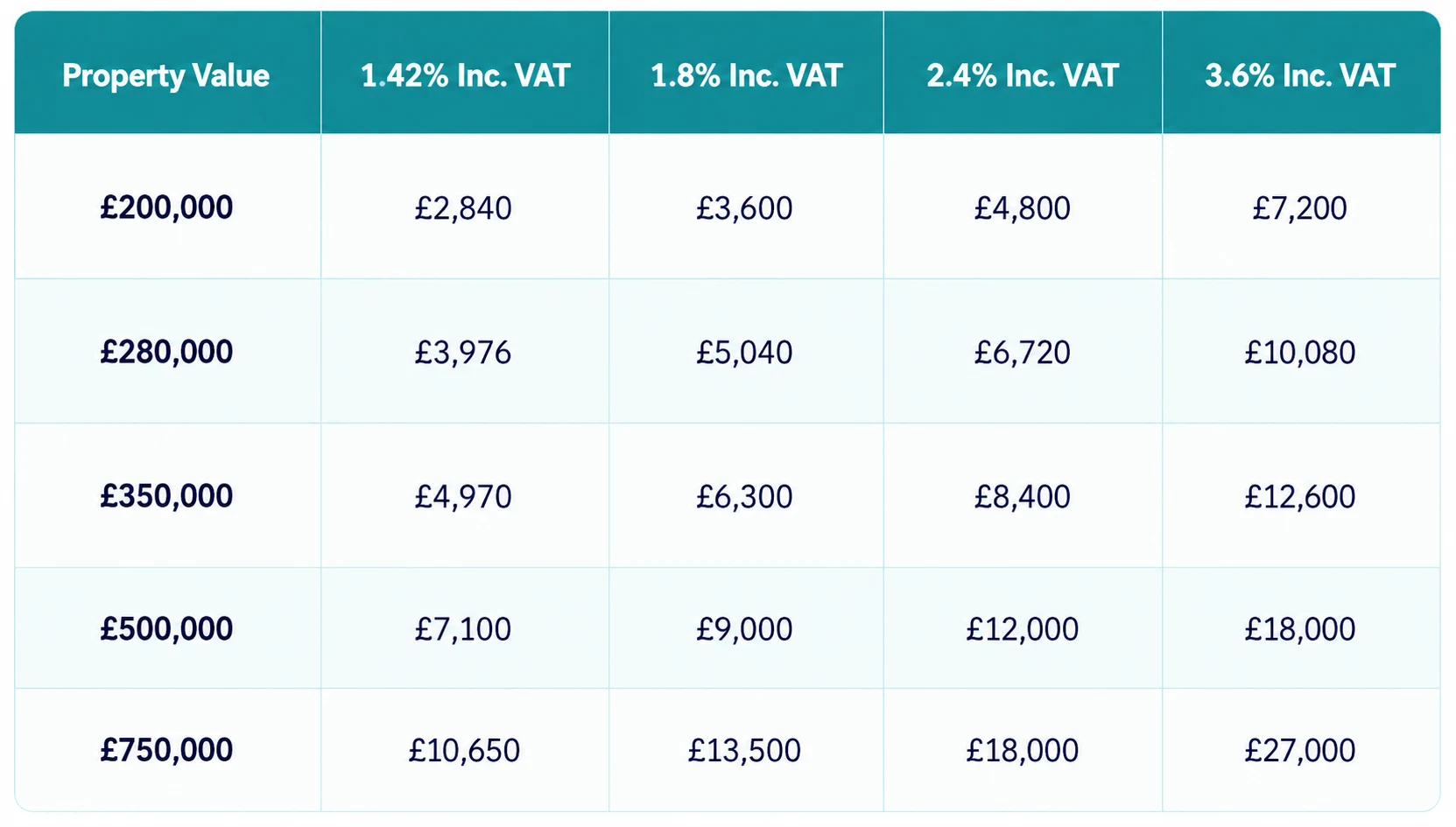
These figures leave your hands at completion day. They are deducted from your sale proceeds by your solicitor before the net balance reaches you. You do not pay upfront under a standard no-sale-no-fee agreement, but you pay in full regardless of how long the process took or how little hands-on work the agent did.
The legal requirement under the Estate Agents Act 1979 is that agents must confirm their fees and terms in writing before you are committed to them. That confirmation must include the fee amount, whether VAT is included or excluded, and the circumstances under which the fee becomes payable. If an agent does not provide this clearly before you sign, they may not be legally entitled to collect it.
How Do Percentage-Based Estate Agent Fees Work?
A percentage-based fee is calculated as a fixed percentage of the final agreed sale price at completion. The percentage is set when you sign the instruction agreement with the agent. If your property sells above your asking price, the fee increases proportionally. If it sells below, the fee reduces. The agent's earnings are directly tied to the completion price.
This sounds straightforward. There are several practical details worth understanding before you sign.
Sole Agency vs Multi-Agency
Sole agency means one agent has the exclusive right to market your property for the duration of the instruction agreement. Sole agency fees typically range from 1.0% to 1.8% plus VAT in 2026. It is the cheapest contract type and the most common.
Multi-agency means two or more agents market your property simultaneously, and the agent who introduces the buyer earns the full fee. Multi-agency fees typically range from 2.0% to 3.5% plus VAT in 2026, according to Pine's February 2026 fee guide. The higher rate compensates agents for the risk of doing marketing work and potentially not earning the commission if a competing agent closes the deal first.
Sole selling rights is a specific and important variation that many sellers sign without fully understanding the implication. Under a sole selling rights contract, the agent earns their fee even if you find your own buyer during the instruction period. If a friend, a neighbour, or someone you met approaches you directly and you complete a sale with them, the agent is still owed their commission. ValuQ's May 2026 comparison guide specifically flags this: "A sole-selling-rights contract obliges you to pay the agent even if you find your own buyer." Sole agency does not carry this clause. Always check which type you are signing.
How Is the Fee Collected?
The estate agent's commission is not typically collected by the agent directly. In standard UK practice, it is deducted from your sale proceeds by your solicitor on completion day, following written instruction from you. Your solicitor pays the agent, redeems your outstanding mortgage balance, pays their own fees and disbursements, and transfers the net balance to you.
This means the money comes out automatically. You do not write a cheque to your agent. But you should know exactly what they are collecting before completion day, because by that point there is little room to negotiate.
VAT and Estate Agent Fees: The Surprise That Catches Sellers Out
VAT is the single most common source of confusion in estate agent fee comparisons, and agents exploit this confusion regularly.
VAT on estate agent fees in the UK is charged at 20%. When an agent quotes you a percentage, they may quote it exclusive of VAT (meaning you add 20% on top) or inclusive of VAT (meaning VAT is already included in the figure they quote). The Property Ombudsman states that fees must be shown inclusive of VAT alongside a statement confirming that VAT is included. But according to the HomeOwners Alliance's 2026 consumer guide, agents "occasionally" quote fees excluding VAT, which means a quoted rate and the actual cost can be materially different.
Here is why this matters in practice. An agent quoting 1.5% on a £350,000 property appears to be charging £5,250. If that quote was exclusive of VAT, the actual fee is £6,300. That £1,050 difference is significant, and AgentSeeker's fee guide explicitly notes: "Some agents quote 1.5% and only mention the +VAT at instruction, turning a £5,250 fee into £6,300 on a £350k sale."
The rule is simple: always ask "is that percentage inclusive of VAT?" before you sign anything. Do not assume. Ask specifically, and get the answer in writing before instruction.
The national average fee of 1.42% quoted consistently across HomeOwners Alliance, Pine, and AgentSeeker is inclusive of VAT. When you see 1.2% quoted, that is typically the pre-VAT figure that becomes 1.42% after VAT is applied.
Online Estate Agent Fees: What the Fixed Fee Actually Covers
Online estate agents offer fixed-fee packages that are lower than high street commission on most properties. The tradeoff is a different service level and a different risk structure.
Online estate agent fees in 2026 typically range from £500 to £1,500 for a full package including a Rightmove listing, professional photography, a floor plan, and varying levels of buyer communication support. According to Property Investment Project's June 2026 review, the average UK high street fee runs to approximately £4,200, while many online agents offer packages from £500.
The most important structural difference from high street commission: online estate agent fees are typically owed whether or not your property sells. You pay on instruction or on a deferred basis within a set window (typically ten months), not exclusively on successful completion. If your sale falls through, or if you decide to withdraw, you have spent £999 or £1,499 with nothing to show for it.
The major online and hybrid agents in 2026 and their current fee structures:
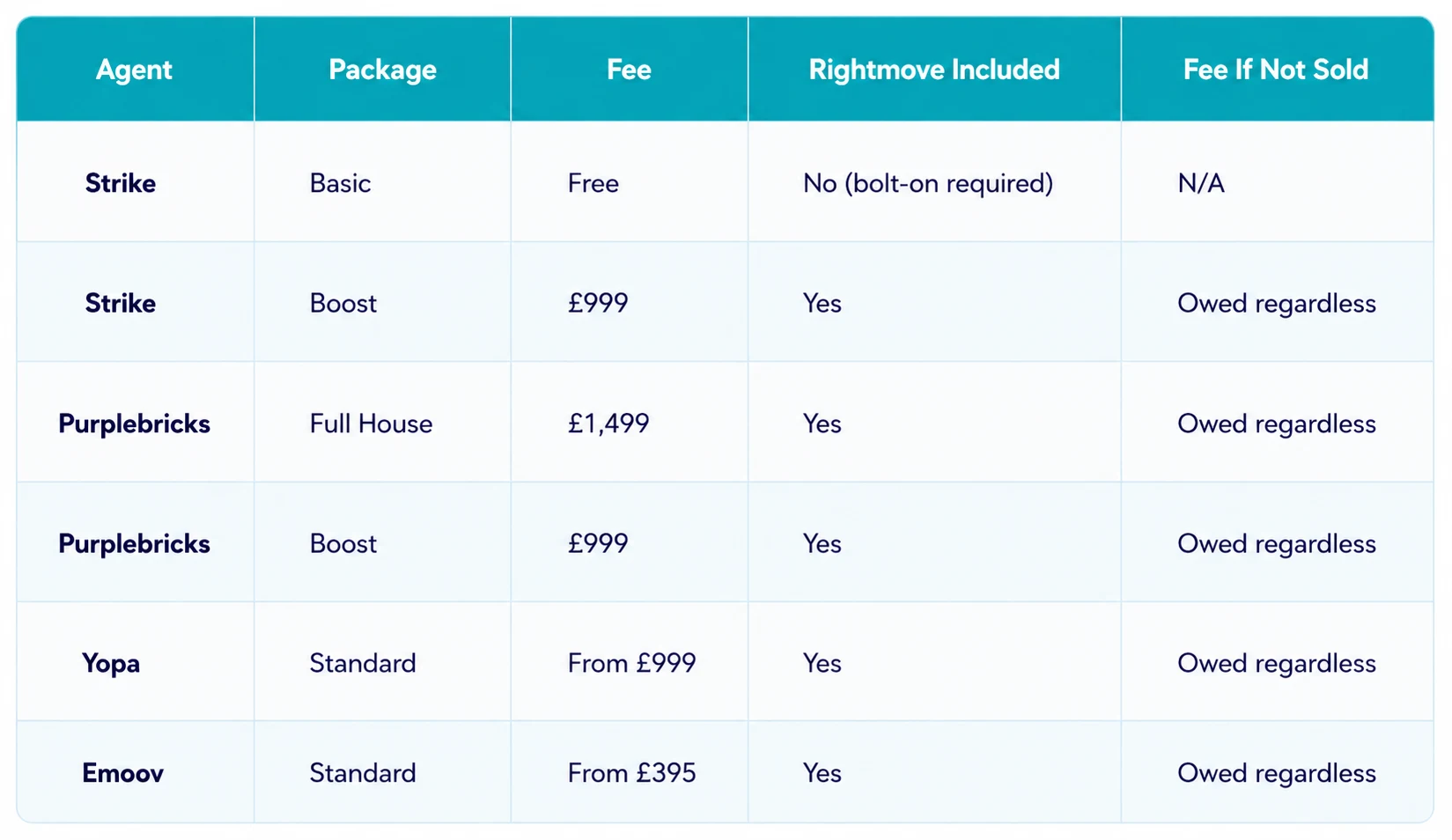
A few important nuances. Strike's free basic listing does not include Rightmove. Most of the features that make an online listing genuinely effective (premium portal placement, floor plans, accompanied viewings) are bolt-ons that push the total well above the advertised starting price. OffAgent's 2026 comparison noted that a "free" Strike sale and a Purplebricks sale can end up costing similar amounts once genuine extras are added.
The upfront fee model works in your favour if your property sells quickly. It works against you if it doesn't.
Fixed-Fee Models vs Percentage Commission: Which Costs Less?
The comparison between fixed-fee and percentage commission depends entirely on your property value. At lower values, fixed fees can cost more than commission. At higher values, commission always costs more than a fixed fee.
Here is the actual cost comparison across property values:
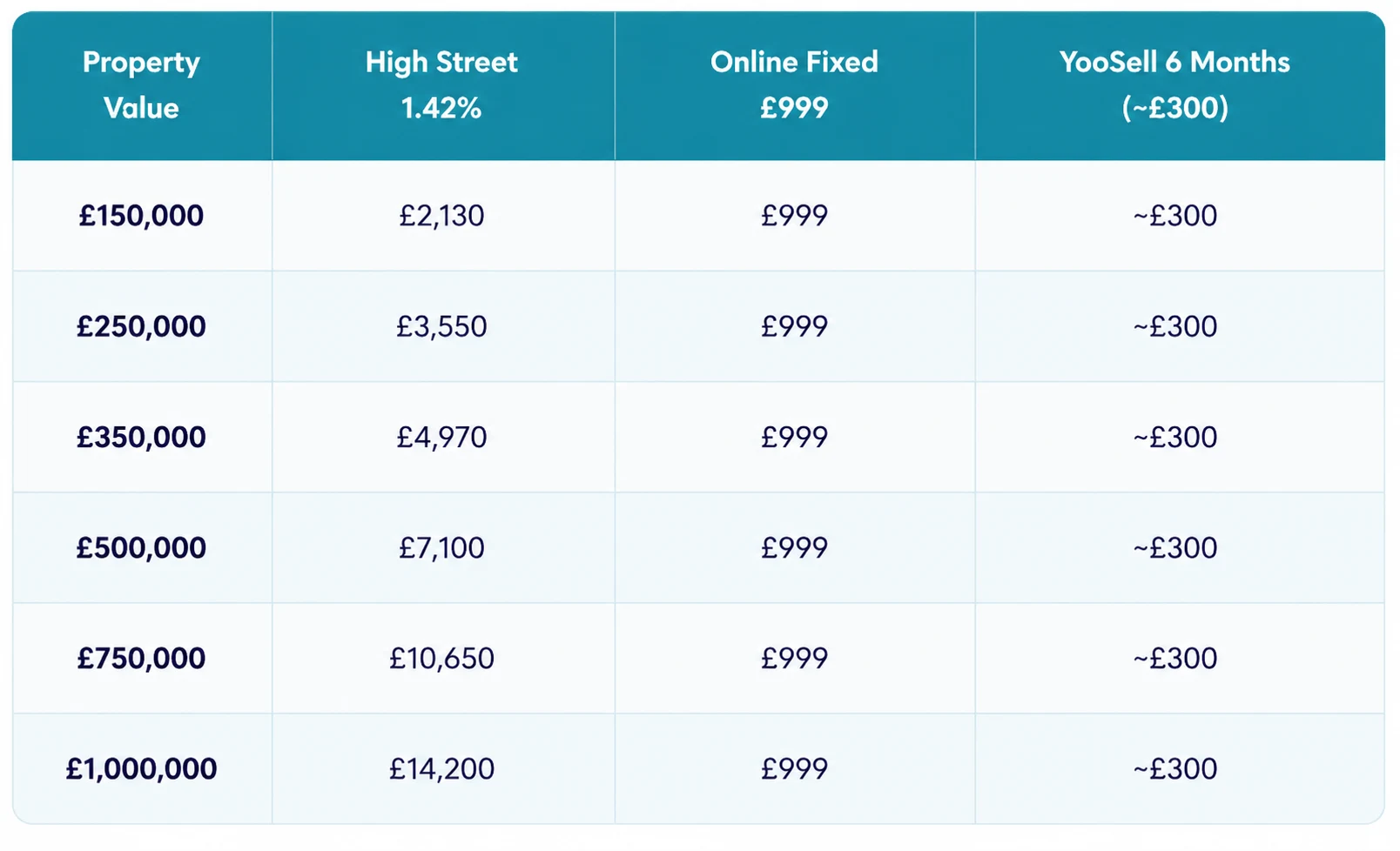
Two things stand out from this table. First, the financial advantage of a fixed online fee over percentage commission grows sharply with property value. On a £1,000,000 property, Purplebricks' fee of approximately £1,499 saves over £12,700 compared to a 1.42% commission. Second, the self-service subscription model (where you pay monthly only while on the market) costs significantly less than even the most competitive online fixed fee, at any property value.
The risk distinction is equally important: the online fixed fee is owed regardless of outcome, while a self-service monthly subscription stops when you choose to pause or when the sale completes.
Use YooSell's Cost Saving Calculator to calculate the exact saving on your specific property value.
What Are the Hidden Costs of Estate Agents?
Beyond the headline percentage, estate agent contracts contain charges that are frequently not mentioned in initial conversations. These are the ones to look for before you sign anything.
VAT added after quoting ex-VAT. Covered above, but worth repeating: an agent quoting 1.5% who adds "plus VAT" at instruction is charging 1.8%. On a £350,000 property, that is an extra £1,050 above what you thought you'd agreed to. The Property Ombudsman requires inclusive-of-VAT quoting. Not all agents comply.
Withdrawal fees. Some agents include a clause allowing them to charge a fee if you withdraw from the market during the tie-in period, or if you switch to another agent. These fees typically range from £200 to £500. Purplebricks' own guide acknowledges them: "Some estate agents may charge you a withdrawal fee if you change your mind about selling." Always ask explicitly before signing.
Marketing and photography charges. Some agents include professional photography in their fee. Others charge it as a separate line item (typically £100 to £300). A few charge for premium portal listings, "featured property" placements, or social media promotion as separate additions. Always ask for a complete itemised service breakdown before committing.
Sole selling rights penalties. As noted above, this clause means you owe commission even if you find your own buyer during the instruction period. It is a common source of post-sale disputes. If your contract says "sole selling rights" rather than "sole agency," the financial exposure is broader than you may realise.
Tie-in period penalties. Most agents require a minimum instruction period, typically eight to sixteen weeks. If you want to withdraw before the period ends, you may face a withdrawal fee or simply be locked in regardless of performance. AgentSeeker's 2026 guide recommends a maximum tie-in period of twelve weeks. Anything longer significantly limits your options if the agent underperforms.
"No sale, no fee" with small print. The no-sale-no-fee promise of high street agents is genuine in standard contracts. But withdrawal fees, marketing charges, and sole selling rights clauses can create fee obligations even without a completed sale. Read the complete contract, not just the headline terms.
According to the HomeOwners Alliance's 2026 seller guide, the specific things to look for when reviewing an agent contract are: whether VAT is explicitly included, whether withdrawal fees exist, whether you are paying for marketing materials separately, what the tie-in period is, and whether the contract is sole agency or sole selling rights.
How Much Can You Actually Save? Real Numbers for UK Sellers
Here is the concrete saving available to sellers in 2026 who move away from percentage-based commission to a self-service platform.
The comparison below uses YooSell's current pricing from £49.50 per month on a six-month market period (approximately £300 total), against the average 1.42% high street commission at different property values.
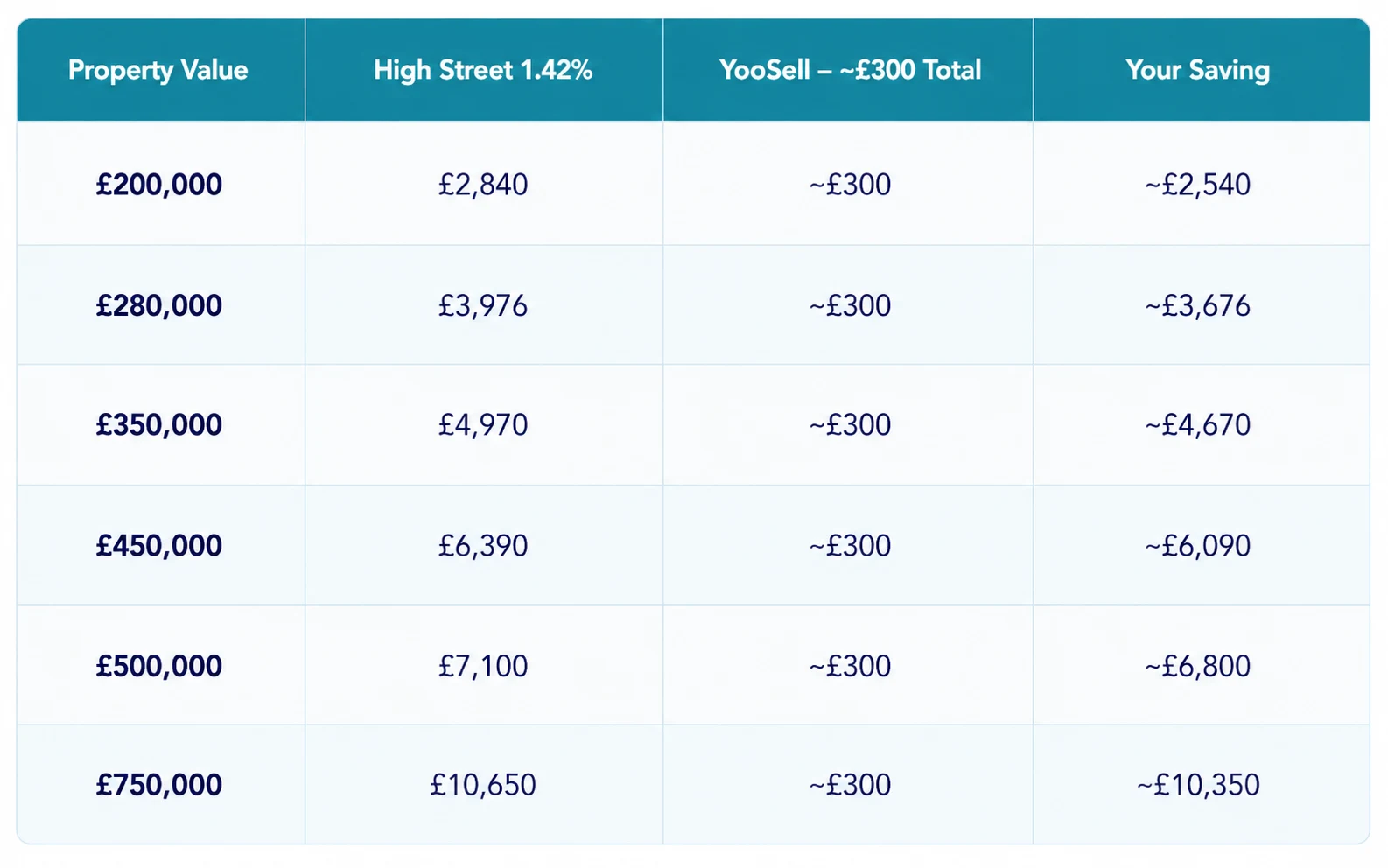
These are not theoretical numbers. They represent money that stays in your pocket at completion rather than being deducted from your sale proceeds by your solicitor before the balance reaches your account. On a £350,000 property, the saving of approximately £4,670 is enough for a new kitchen, several months of mortgage payments on the next property, or a significant lump sum towards a deposit top-up. On a £750,000 property, the saving exceeds £10,000.
How to Negotiate Estate Agent Fees
If you are using a traditional high street agent, the fee is almost always negotiable. Agents quote at the top of their range as a starting point, expecting sellers to push back.
The most effective negotiation approach, based on practical experience:
Get three written quotes on the same day. Competition is your leverage. Every agent who values your property wants your instruction. Written quotes from three different agents let you play them against each other honestly.
Quote the lowest competitor rate to your preferred agent. "Agent B has offered 1.1% including VAT. Your service appears stronger. Can you match or improve on that rate?" is a completely reasonable ask.
Negotiate on tie-in as well as percentage. Asking to reduce the tie-in period from sixteen weeks to eight weeks costs the agent nothing if they perform well. If they don't, you want the freedom to switch.
Negotiate on sole agency, not sole selling rights. If the contract initially says "sole selling rights," ask to change it to "sole agency." You want to retain the right to find your own buyer without owing commission.
Use seasonal leverage. Agents are more willing to negotiate in quieter months (typically December to February) when they are building stock. In spring, when the market is active and agents have more instructions, leverage reduces.
According to Open For Offer's February 2026 fee guide, negotiating from 1.5% to 1.2% on a £300,000 property saves £900 plus VAT. That is £1,080 in real terms just from asking. Most sellers never ask.
YooSell vs Traditional Estate Agent: A Direct Comparison
Here is the honest side-by-side comparison between selling through a traditional high street estate agent and selling through YooSell in 2026.
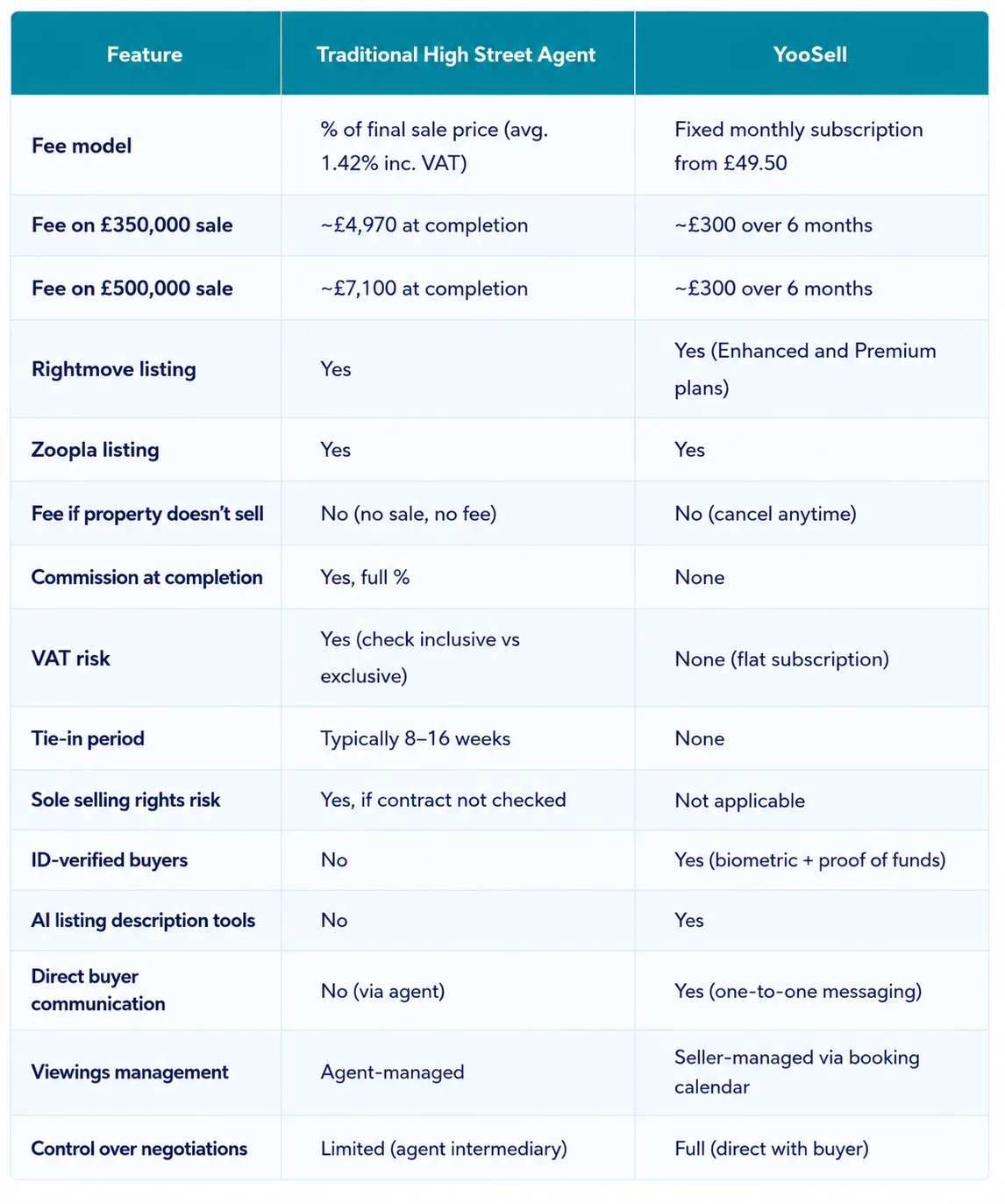
The core difference is this: with a traditional agent, you pay a percentage of your sale price for a service that is delivered on the agent's timeline, at the agent's pace, with the agent's financial incentive at the centre. With YooSell, you pay a small monthly subscription for tools, portal access, and verified buyer access while keeping full control of your sale and 100% of your sale price at completion.
See how YooSell works and use YooSell's free Valuation Calculator to establish what your property is worth before you list.
Conclusion
Estate agent fees in the UK in 2026 are simultaneously well-publicised and poorly understood. The 1.42% average gets quoted everywhere. What gets quoted less often is what that percentage becomes in real money across different property values, how VAT is routinely used to obscure the true cost until instruction, what sole selling rights clauses actually mean for your financial exposure, and how tie-in periods and withdrawal fees can turn a no-sale-no-fee promise into something considerably more complicated.
The key takeaway is equally straightforward: estate agent fees are the largest controllable cost in any UK property sale, and they are far more negotiable and avoidable than most sellers realise before they sign. On a £500,000 property, the difference between paying a 1.42% commission and selling through a self-service platform with a fixed monthly subscription is over £6,800 in your pocket at completion. That money is real, it is yours, and the route to keeping it is not complicated.
Here is your clear next step. Start with YooSell's free Valuation Calculator to understand what your property is worth right now. Then run your specific property value through the Cost Saving Calculator to see the exact figure you would save versus a traditional commission. When you are ready to list, register on YooSell from £49.50 per month, with a full Rightmove listing, ID-verified buyers, and zero commission at completion.
Browse YooSell's Property Guides for practical help on every stage of preparing and managing your sale.
Frequently Asked Questions
Start Selling Your Home Today!
Take control of your sale with YooSell. Get started today and explore how we can help you sell smarter, faster, and with less hassle.